

Microsoft is reportedly reconsidering parts of its 2030 clean energy strategy, including its ambitious goal to match 100% of its electricity use with carbon-free energy on an hourly basis, Bloomberg reports.
The review arrives as AI infrastructure grows quickly. This surge is pushing electricity demand well past earlier forecasts.
Data Centers Become the New Power Giants
The company’s flagship commitment, known as the “100/100/0” goal, was announced in 2021. It aims to cover 100% of electricity use, 100% of the time, with zero-carbon energy bought from the same regional grids where the power is consumed. This is much stricter than annual matching, which allows renewable energy credits to balance energy use over a year, not just by the hour.
Microsoft has met its annual goal of matching 100% of its electricity use with renewable energy. This was mainly achieved through long-term power purchase agreements (PPAs). However, hourly matching requires far deeper coordination between real-time electricity demand and carbon-free supply.
As AI workloads scale, this balance is becoming more difficult to maintain.
Global electricity demand from data centers is rising sharply, and AI is now the main driver of that growth. The International Energy Agency (IEA) predicts that global data center electricity use will hit about 945 terawatt-hours (TWh) by 2030. This is almost double the current levels. This would represent close to 3% of total global electricity demand.
Within that growth, AI is the fastest-expanding segment. The IEA predicts that electricity demand from AI-optimized data centers will rise over four times by 2030. This surge is fueled by extensive model training and inference tasks.

In the U.S., electricity use by data centers will rise by about 240 TWh by 2030. This is over a 130% increase from 2024 levels, based on industry analysis.
The IEA notes that data centers might make up over 20% of electricity demand growth in advanced economies by 2030. This means they could become a key source of power demand in today’s grids.
This structural shift is now directly impacting corporate clean energy strategies, especially for hyperscale technology firms.
The Hidden Gap Between Green Energy and AI Growth
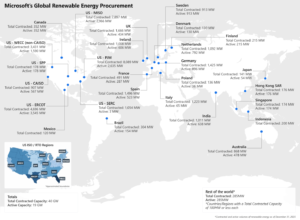
Microsoft has built one of the largest corporate clean energy procurement portfolios in the world. The company has locked in over 40 gigawatts (GW) of renewable energy capacity. This spans 26 countries and includes more than 400 power purchase agreements (PPAs).
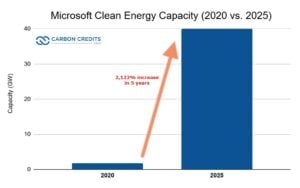
This includes partnerships with key developers. One example is a 10.5 GW agreement with Brookfield Renewable. This deal aims to speed up the renewable energy rollout while also giving multi-year demand signals for new projects.
Microsoft partners with over 20 energy firms. Each manages at least five renewable projects linked to its procurement pipeline. Several partners now have over 1 GW of contracted capacity each, linked to Microsoft demand. These investments help Microsoft reach its climate goals, including its promise to be carbon negative by 2030.
SEE MORE:
- Microsoft’s $6.2 Billion AI Bet in Norway for 100% Renewable Energy-Powered Computing
- Microsoft (MSFT) Signs Solar Deal with Zelestra to Power Data Centers in Spain, Supporting Community Projects
- Microsoft Leads on Climate: $800M CIF Drives Clean Tech and AI Energy Deals with ADNOC, Masdar, and XRG
However, the company’s electricity demand is rising quickly due to AI infrastructure expansion. Large AI model training needs big computing clusters. These clusters run all the time and use much more energy than regular cloud tasks.
This creates a growing gap between clean energy procurement and real-time electricity usage.
Big Tech Faces a Structural Clean Energy Bottleneck
Microsoft’s challenge is not isolated. It reflects a broader structural issue across the technology sector. Despite strong renewable energy procurement activity, overall corporate clean power contracting has slowed.
BloombergNEF reports that corporate buyers signed contracts for about 55.9 GW of clean power in 2025. This is a 10% drop from last year. It’s the first big slowdown in nearly ten years.
However, large technology companies remain dominant buyers. Amazon, Microsoft, Google, and Meta together accounted for about 49% of global corporate clean energy PPA volumes in 2025. This concentration highlights how heavily AI-driven firms now influence renewable energy markets. The chart below shows these tech giants’ planned data center growth in MW.

Another shift is also emerging. These companies are looking more into nuclear energy contracts. Recently, these contracts made up about 23% of Amazon and Meta’s clean energy purchases.
This shows a rising need for baseload clean power. It offers a steady electricity supply, no matter the weather, which is crucial for AI data centers.
Policy Changes and Energy Accounting Rules Add Pressure
Regulatory and accounting frameworks are also evolving, increasing pressure on corporate clean energy strategies. The Greenhouse Gas (GHG) Protocol is the main global standard for tracking corporate emissions. It is now updating its Scope 2 emissions method.
Proposed changes could require companies to move toward:
- Hourly matching of electricity consumption and clean energy supply,
- More localized energy procurement rules, and
- Stricter tracking of grid emissions data.
If implemented, these changes would make Microsoft’s hourly matching target more aligned with future reporting standards, but also significantly more difficult to achieve at scale. At the same time, policy uncertainty in major markets is affecting clean energy investment.
In the United States, corporate power purchase agreements (PPAs) hit a record 29.5 GW. However, the number of unique buyers dropped sharply to only 33 companies. This change shows tighter market conditions and uncertainty about tax credits and energy incentives.
From Annual Matching to Hourly Reality
The clean energy market is also shifting toward more reliable power structures. Developers are increasingly offering:
- Hybrid solar and wind systems,
- Co-located storage projects,
- Long-term nuclear PPAs, and
- Firm power contracts designed for 24/7 supply.
This trend is driven by the needs of AI data centers, which require constant electricity rather than intermittent supply. The IEA has warned that grid flexibility and firm clean power will become critical to managing rising electricity demand from digital infrastructure.
For hyperscale companies, this means a renewable energy strategy is no longer just about volume. It is now about timing, location, and reliability.
AI Is Redefining Corporate Climate Targets
Microsoft’s potential reassessment of its 2030 hourly clean energy goal highlights a wider shift in the global energy system. AI-driven electricity demand is growing faster than most long-term forecasts made just a few years ago.
At the same time, clean energy procurement is becoming more complex due to grid constraints, regulatory changes, and the need for continuous power supply.
Microsoft remains committed to its carbon-negative by 2030 goal. However, its situation illustrates a broader reality for the tech sector: clean energy targets are now colliding with the physical limits of electricity systems.
As AI continues to expand, the central challenge is no longer just sourcing renewable energy. It is matching clean electricity to real-time demand on a global scale. This tension is now shaping the next phase of corporate climate strategy across the world’s largest technology companies.