


Amazon has expanded its renewable energy portfolio in Australia to 990 MW across 20 projects. This marks a major jump from about 430 megawatts (MW) previously, driven by new agreements with multiple solar, wind, and battery projects. These include large-scale developments such as the Golden Plains wind farm and hybrid solar-battery installations built on former coal sites.
This expansion is not just about energy supply. It is closely tied to the growing demand from data centers that power cloud computing and artificial intelligence (AI). As Amazon Web Services (AWS) expands, energy demand continues to rise.
AI Data Centers Are Driving Amazon’s Energy Surge
The scale of energy required for digital infrastructure is increasing fast. Data centers already consume large amounts of electricity, and that demand is expected to grow sharply.
According to the International Energy Agency, global data center electricity use reached about 415 terawatt-hours (TWh) in 2024. This could rise to over 1,000 TWh by 2026, largely due to AI workloads.
Australia is also seeing this trend. Estimates suggest that data centers in the country now consume electricity comparable to all shopping centers combined. This is particularly according to Matt O’Rourke, AWS’s head of infrastructure and energy policy in Australia and New Zealand. He said:
“If you think about it from an economy-wide perspective, all of the datacentres in Australia collectively consume the same amount of electricity as all of the shopping centres, but the datacentres are … facilitating new renewable energy coming into the grid.”
This puts pressure on grids and increases the need for stable, clean power sources. As a result, companies like Amazon are investing directly in renewable energy rather than relying only on grid supply.
How Amazon Locks in Clean Power for Growth
Amazon’s clean energy strategy is built around long-term power purchase agreements (PPAs). These contracts allow Amazon to buy electricity from new wind and solar projects over 10 to 20 years.
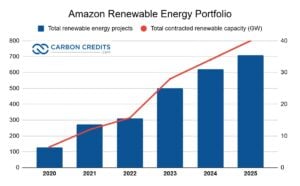
This approach gives Amazon more control over its energy future. It also supports its growing demand from AWS data centers, which require a large and stable power supply 24/7.
By 2025, Amazon is among the world’s largest corporate buyers of renewable energy. It has invested in more than 500 wind and solar projects around the globe. These projects will create enough clean electricity to power millions of homes each year, according to company reports.
PPAs also help in three key ways:
- They secure a long-term energy supply for fast-growing cloud infrastructure.
- They reduce exposure to short-term electricity price swings.
- They help finance new renewable projects by guaranteeing future revenue.
Battery storage is becoming a key part of this system. Amazon is supporting grid-scale storage projects that store excess solar and wind power during peak production and release it when demand is high. This helps smooth out renewable energy variability and improves grid reliability.
Amazon also highlights that many of its renewable projects are designed to add new clean capacity to the grid, not just buy existing power. However, independent analysts have pointed out that climate impact can change based on where a project is located and how the grid is set up. So, results aren’t always the same across different markets.
Climate Pledge in Action: Amazon’s Race to Net Zero
Amazon aims for net-zero carbon emissions by 2040. This goal is part of its Climate Pledge and is ten years earlier than the Paris Agreement timeline.

The company reports strong progress in renewable energy deployment. It says it has already reached 100% renewable energy matching for its global operations on a “procured energy basis” by 2023, ahead of its original 2030 target. This is based on contracted renewable energy capacity rather than hourly matching.
Amazon has put money into hundreds of wind and solar projects in North America, Europe, and Asia. This makes it one of the biggest companies boosting new renewable energy worldwide.
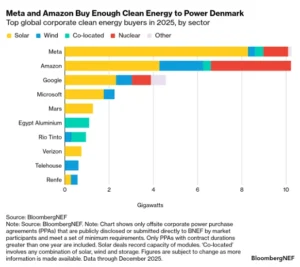
Beyond electricity, Amazon is expanding into broader decarbonization areas. This includes electric delivery vehicles, with a target of deploying 100,000 electric delivery vans by 2030 as part of its logistics transition. It is also investing in sustainable aviation fuel (SAF) partnerships and low-carbon fuels to reduce transport emissions.
The company is also scaling energy efficiency in its operations. This includes better warehouse design, smarter AI logistics routing, and improved cooling systems for AWS data centers.
However, emissions remain a structural challenge. Amazon reported 68.25 million metric tons of CO₂e emissions in 2024, up from 64.38 million metric tons in 2023.
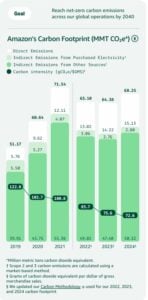
While the company has expanded its renewable energy use and lowered emissions intensity in some areas, total emissions rose as its logistics, e-commerce, and data center businesses continued to grow.
This highlights a key tension. Amazon is investing in clean energy, but demand from AI, cloud services, and global logistics can raise overall energy use. This makes decarbonization a moving target rather than a fixed endpoint.
Australia’s Renewable Energy Market Is Scaling Fast
Amazon’s expansion comes at a time of rapid growth in Australia’s clean energy sector. According to the Australian Energy Market Operator, renewables are expected to supply over 80% of Australia’s electricity by 2030 under current plans.
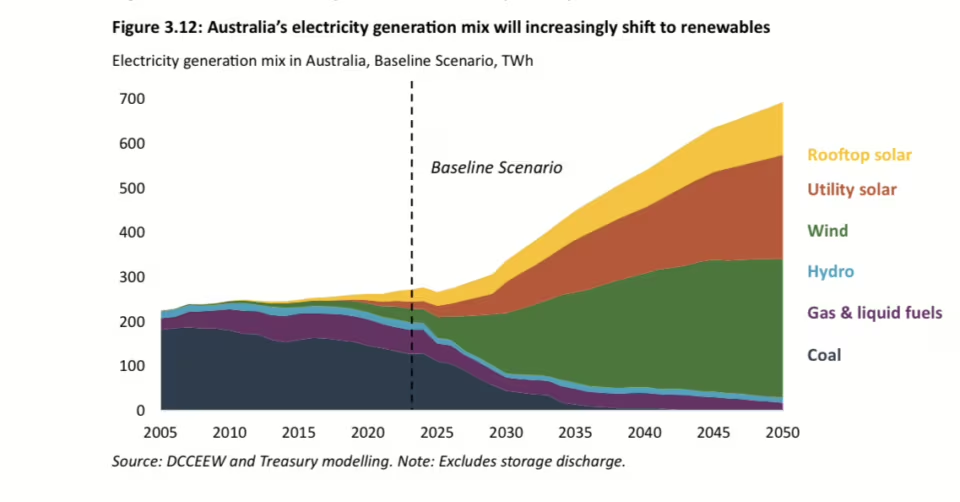
Solar and wind are leading this transition. Australia already has one of the highest rates of rooftop solar adoption globally, and large-scale projects continue to expand. Battery storage is also scaling quickly. This is critical for managing variability and supporting grid stability.
Corporate demand is playing a growing role in this clean power landscape. Companies are increasingly signing PPAs to secure clean energy. This helps finance new projects and accelerate the transition.
Amazon is part of a broader trend. Other tech firms, including Microsoft and Google, are also major buyers of renewable energy worldwide.
AI vs Climate Goals: The Growing Energy Dilemma
Despite progress, challenges remain. Data centers require not only electricity but also water for cooling and large physical infrastructure.
Some local governments in Australia have raised concerns about the impact of new data centers on power supply and community resources. This reflects a global issue. AI demand is growing faster than the clean energy supply in many regions.
Companies are responding with multiple strategies:
- Improving the energy efficiency of hardware,
- Using advanced cooling systems, and
- Building data centers in regions with strong renewable supply.
Still, total energy use continues to rise. This creates a gap between emissions targets and actual demand.
Tech Companies Become Energy Players, Not Just Users
Amazon’s move to reach nearly 1GW of renewable capacity in Australia signals a broader shift. Energy is becoming a core part of digital infrastructure strategy.
Companies are no longer just technology providers. They are also major energy buyers and investors. This shift is reshaping both industries.
Renewable energy projects now depend more on corporate demand. At the same time, tech companies depend on stable, low-carbon power to support growth. The result is a tighter link between the energy transition and the digital economy.
A Defining Moment for Big Tech’s Energy Strategy
Amazon’s expansion highlights a key turning point. The growth of AI and cloud computing is driving a new wave of energy demand. At the same time, companies are under pressure to meet climate targets. This creates both risk and opportunity.
The move to 1GW in Australia shows how companies are responding. They are investing directly in clean energy to secure supply and reduce emissions.
But the challenge is far from over. As demand continues to grow, the balance between expansion and sustainability will become even more important. For now, one thing is clear: the future of AI will depend as much on energy systems as on technology itself.