


Malaysia has renewed its 10-year energy efficiency strategy. Rising electricity demand, industrial growth, and more data centers are straining the country’s power system.
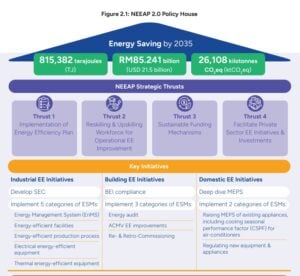
The National Energy Efficiency Action Plan 2026–2035 (NEEAP 2.0) aims for about US$21.5 billion (RM85.24 billion) in savings over the next decade. It also seeks to cut energy demand by 11.6% by 2035 compared to a business-as-usual (BAU) scenario.
This plan supports Malaysia’s goal of lowering greenhouse gas emissions while fostering a fast-growing economy. Energy efficiency is key. It can reduce consumption and emissions without hindering economic activity.
Malaysia Sets 11.6% Energy Demand Reduction Target
NEEAP 2.0 is expected to save 815,382 terajoules (TJ) of energy by 2035. These savings could avoid around 26.1 million metric tons of CO2-equivalent emissions compared to the BAU scenario.
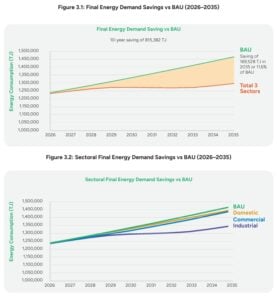
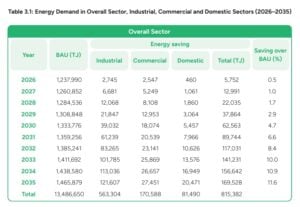
Without new measures, energy demand from industrial, commercial, and domestic sectors could hit 1.47 million TJ by 2035. The new plan aims to cut this demand by about 169,528 TJ.
Targets vary by sector:
- Industrial sector: 11.9% reduction by 2035
- Commercial sector: 13.2% reduction
- Domestic sector: 8.7% reduction
The industrial sector is expected to provide the largest savings, about 69% of total reductions. Commercial users will contribute around 21%, while households will account for about 10%.
This focus aligns with Malaysia’s industrial structure. Factories consume much more energy than homes. Improving industrial equipment and processes can lead to significant savings.
Malaysia’s Energy Demand Is Also a Climate Challenge
The efficiency push comes as Malaysia grapples with a significant emissions footprint.
In 2024, Malaysia’s CO₂ emissions, excluding land use and forestry, were about 8.3 tonnes per person, according to World Bank data. This is up from 5.7 tonnes per person in 2000, reflecting industrial growth.
This figure becomes critical as electricity demand rises. Malaysia attracts major investments in manufacturing, semiconductor production, and data centers, all requiring reliable power.
The land-use sector also affects emissions. Forests can reduce net greenhouse gas emissions when they absorb more carbon than they release.
Thus, cutting energy-related emissions is essential. Efficiency measures can help slow emissions growth while Malaysia expands its economy and increases renewable energy use.
First NEEAP Program Exceeded Its Target
NEEAP 2.0 builds on Malaysia’s first energy efficiency action plan from 2016 to 2025. The initial program saved around 60,886 gigawatt-hours (GWh) of electricity, exceeding its target of 52,233 GWh. This saved about RM16.1 billion.
- The first NEEAP also avoided an estimated 35.6 million tonnes of CO2-equivalent emissions.
The new program aims to improve results by creating a stronger regulatory framework and encouraging broader participation.
Data Centers Add to Malaysia’s Power Challenge
Malaysia’s growing data center industry highlights the need for energy efficiency.
The country is becoming one of Southeast Asia’s fastest-growing data center markets, attracting billions from global tech firms. Data centers require significant electricity for computing and cooling.
The rise of artificial intelligence may increase electricity demands as companies expand their computing capacity. This poses a challenge for Malaysia. It wants to attract energy-intensive industries while controlling electricity demand and emissions.
Thus, energy efficiency can bridge that gap. Improved cooling systems and energy management can lower energy needs while maintaining output.
New Rules Strengthen Energy Efficiency
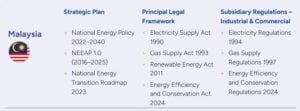
One major change is the Energy Efficiency and Conservation Act (EECA).
This law provides a stronger framework for managing energy use and emphasizes efficiency among major users. It shifts from voluntary measures to a more structured approach.
NEEAP 2.0 will work alongside this framework, extending efficiency measures to smaller companies, households, and other consumers. Financial incentives may encourage investments in energy-efficient technologies.
This approach creates a wider pool of participants contributing to Malaysia’s energy savings.
NEEAP 2.0 Supports Malaysia’s Net-Zero Goal
Malaysia aims to cut carbon intensity by 45% from 2005 levels by 2030 and reach net-zero emissions by 2050.
Achieving these goals requires more than just renewable energy. Malaysia must manage demand, boost industrial productivity, and cut unnecessary energy use. Thus, NEEAP 2.0 is vital for complementing renewable energy policies.
The plan also reflects a shift in how governments approach decarbonization. Malaysia targets reducing overall energy consumption, not just replacing fossil fuels.
Energy Efficiency Could Cut Costs and Emissions
The success of NEEAP 2.0 will depend on effective implementation.
Malaysia’s energy landscape has changed since the first NEEAP began in 2016. Electricity demand is rising, industrial investment is growing, and data centers are a larger part of the economy.
Overview and Comparison of Energy Policies in Malaysia
- The potential US$21.5 billion in utility savings is significant for businesses and consumers.
- The projected 815,382 TJ in cumulative energy savings could ease pressure on the power system and cut millions of tonnes of emissions.
For Malaysia, energy efficiency is more than a cost-saving measure. It is a crucial tool for managing rising power demand, boosting competitiveness, and cutting emissions.
If NEEAP 2.0 meets its 11.6% energy demand reduction target by 2035, it could strengthen Malaysia’s balance between economic growth and climate goals.