

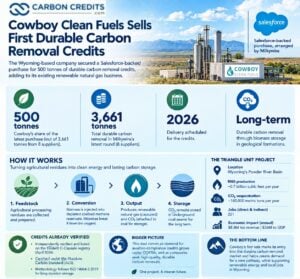
Cowboy Clean Fuels has sold its first durable carbon removal credits through a Salesforce-backed purchase arranged by Milkywire, with delivery scheduled for 2026. The Wyoming-based company said the transaction marks its entry into the durable carbon removal market. It adds carbon removal sales to its existing business producing renewable natural gas (RNG).
Cowboy is one of eight carbon removal suppliers included in Milkywire’s latest Salesforce-backed purchasing round. The group covers 3,661 tonnes of durable carbon removal across direct air capture, ocean alkalinity, biomass storage and related approaches.
Cowboy accounts for 500 tonnes of that total. The volume is small compared with the scale of global emissions. But the transaction is important for a different reason. Cowboy’s project is already operating, and the purchase helps create demand for a relatively new carbon removal pathway.
Ryan Waddington, Chief Executive Officer, Cowboy Clean Fuels, said:
“Durable carbon removal needs pathways that can be verified today and expanded tomorrow, and Wyoming’s subsurface gives us both. Buyers working with us get permanent removal alongside carbon-neutral renewable gas from the same operations, a combination very few suppliers can offer. This is an important step for Cowboy Clean Fuels and for the rural communities in Campbell County, Wyoming, that make the work possible.”
Cowboy Turns Farm Residues Into Carbon Removal
Cowboy’s process combines biomass carbon removal and storage (BiCRS) with renewable natural gas production. The company takes agricultural processing residues and injects them into depleted coalbed methane reservoirs in Wyoming’s Powder River Basin. Microorganisms inside the coal seams break down the biomass without oxygen.
That process produces methane and carbon dioxide.
Cowboy captures the methane as renewable natural gas, while the CO2 becomes attached to the coal and remains stored underground. The company calls this its BiCRS+RNG process.
The model differs from traditional bioenergy with carbon capture and storage (BECCS). In BECCS, biomass is burned for energy, and the CO2 produced is captured.
Cowboy instead relies on natural microbial activity underground. The company uses existing coalbed methane wells and infrastructure. This cuts down on the need for new infrastructure.
The Triangle Unit Is Already Operating
The carbon removal credits come from Cowboy’s Triangle Unit project, located in Wyoming’s Powder River Basin. The project is already operating. Cowboy says the facility started commercial operations after getting approval from Wyoming authorities. It has been injecting biomass to convert it into methane and CO2.
When fully operational, the Triangle Unit will produce about 0.7 billion cubic feet of renewable natural gas each year. It will also sequester around 180,000 metric tons of CO2 annually, as stated by the company. The project is also designed around existing energy infrastructure.
That approach could help lower capital requirements compared with building an entirely new carbon removal facility. Cowboy says it can also extend the useful life of existing wells and infrastructure while creating new income for land and resource owners.
The company estimates the project will support 221 jobs directly and indirectly. It will generate $8.8 million in annual tax revenue. Also, it will add over $36 million to Wyoming’s GDP each year when fully operational. These are company estimates rather than measured economic results.
Carbon Removal Credits Were Already Verified
The Salesforce-backed purchase is not the first time Cowboy has brought its carbon removal credits to the market. In April 2026, the company announced that its credits were independently verified and listed on the Evident C-Capsule registry. This means they are now available for purchase. The projects were certified under the Absolute Carbon Standard (ACS).
Cowboy has said its methodology follows ISO 14064-2:2019 and is designed for long-duration geological storage.
Climate Vault Solutions picked the Triangle Unit project for its carbon removal portfolio. This decision followed a review by its Technology Experts Chamber. Climate Vault said the project was the first BiCRS project to pass its review and that Cowboy became part of its independently vetted supplier portfolio.
These steps are important because carbon removal buyers increasingly want evidence that projects can measure and account for their net climate benefit.
Cowboy has also faced questions because its process uses coal formations and creates methane. The company says no coal is burned in its process and that the methane is captured for use as renewable natural gas. The CEO said the company is tackling issues like permanence, methane, and lifecycle emissions. They focus on measurement and third-party review.
Salesforce Is Creating Early Demand for CDR
The purchase is part of Salesforce’s commitment to contract $100 million of durable carbon dioxide removal by 2030. Salesforce made the commitment in 2022 as a founding member of the First Movers Coalition. The company says the goal is to help create demand for carbon removal technologies before they reach full commercial scale.
Milkywire is helping Salesforce deploy part of that commitment through smaller purchases from early-stage suppliers.
In January 2026, Milkywire made over 12,500 tonnes of Salesforce-backed purchases. These came from 19 suppliers and involved six carbon removal methods across 15 countries. That programme was valued at about $5 million and focused on technologies that were not yet attracting enough buyers.
The latest round adds another 3,661 tonnes from eight suppliers. Cowboy’s 500-tonne purchase is therefore one piece of a broader portfolio.
Milkywire says it has now facilitated more than $12 million of durable CDR purchases across 45-plus projects in more than 20 countries. The approach is important for newer technologies because early buyers can provide revenue before projects reach large commercial scale.
Durable CDR Is Growing, But Delivery Is Still Limited
The Cowboy transaction comes as the durable carbon removal market grows rapidly. CDR.fyi reported that durable carbon removal purchases in Q1 2026 reached about 2.3 million tonnes, the largest first quarter on record.
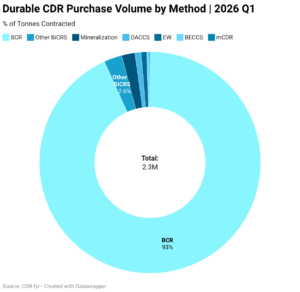
The total was 564% of Q1 2024’s volume. More than 113 buyers other than Microsoft contracted about 1.3 million tonnes during the quarter. But there is still a large difference between contracts and actual deliveries.
CDR.fyi said in June that durable CDR purchases outside Microsoft and Frontier had grown at a 151% compound annual rate from 2021 to 2025, while deliveries had grown at 131%. Biomass carbon removal and storage methods accounted for 96% of purchase volume and 91% of delivered volume in 2025.
This makes Cowboy’s sale notable. The company is not only signing a future purchase agreement. It is selling credits from an operating project with delivery in 2026. That moves the transaction closer to actual market performance rather than a long-term promise.
Could BiCRS Become CDR’s Next Growth Engine?
Biomass-based removal is receiving growing attention because it can combine carbon storage with energy production or waste management.
Cowboy’s model is one example. Other projects use biochar, BECCS, or underground biomass storage. The common idea is to take carbon absorbed by plants and keep it out of the atmosphere for a long period.
The challenge is proving the full climate benefit. Projects need to account for emissions from growing, collecting, and transporting biomass, as well as energy use and other parts of the supply chain. They must also show that the carbon remains stored for the required period.
Cowboy’s use of agricultural processing residues could help because the company is using an existing waste stream rather than growing dedicated energy crops. However, the sustainability and availability of feedstock will remain important as the company scales.
Cowboy is exploring more projects in the Powder River Basin. They are also contracting stronger carbon removal volumes and carbon-negative RNG supply.
The First Sale Tests a New Business Model
Cowboy’s first durable CDR sale is small in volume, but it links several parts of the emerging carbon market.
Salesforce’s approach also shows how large companies can help finance early CDR projects through smaller, targeted purchases. The bigger test is scale. Cowboy must demonstrate that it can grow while ensuring reliable carbon accounting, a sustainable biomass supply, and long-term storage.
The 500-tonne purchase does not prove that the technology can deliver hundreds of thousands of tonnes of removals. But it gives the company an important commercial milestone and provides a real-world test of its carbon removal pathway.
For the wider market, the development shows that durable carbon removal is slowly moving from early commitments toward actual deliveries. More buyers are entering the market. Projects that show measurable removals, clear accounting, and strong performance may secure bigger contracts.