

NVIDIA (NASDAQ: NVDA) is moving deeper into the center of the global AI infrastructure boom as spending commitments across the industry reach unprecedented levels. The chipmaker is benefiting from rising demand for AI computing, while also helping finance and build the infrastructure needed to support future growth.
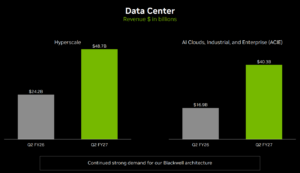
The trend is reflected in NVIDIA’s latest results. For the second quarter of fiscal 2027, revenue reached $96.2 billion, up 106% year over year. Data Center revenue rose 117% to $89 billion.
NVIDIA expects another record quarter, forecasting $108 billion in fiscal Q3 revenue. Behind those numbers is a much larger infrastructure cycle involving chips, data centers, networking, electricity, and financing.
The $2.7T AI Spending Wave Is Just Getting Started
The scale of AI investment has expanded sharply. Gartner forecasts worldwide AI spending at $2.7 trillion in 2026, up 49.5% from 2025. AI infrastructure is expected to account for about $1.48 trillion of that spending. Gartner forecasts total AI spending could reach approximately $3.64 trillion in 2027.
Data center investment is also creating a major new demand for electricity.
The International Energy Agency (IEA) estimates global data center electricity consumption will roughly double from 485 TWh in 2025 to 950 TWh in 2030. Electricity use from AI-focused data centers is expected to triple over the same period.
The IEA also expects data centers to account for about 3% of global electricity demand by 2030. In the U.S., they could account for almost half of electricity-demand growth through the end of the decade. This creates demand not only for GPUs but also for networking equipment, cooling systems, power infrastructure, and data center capacity.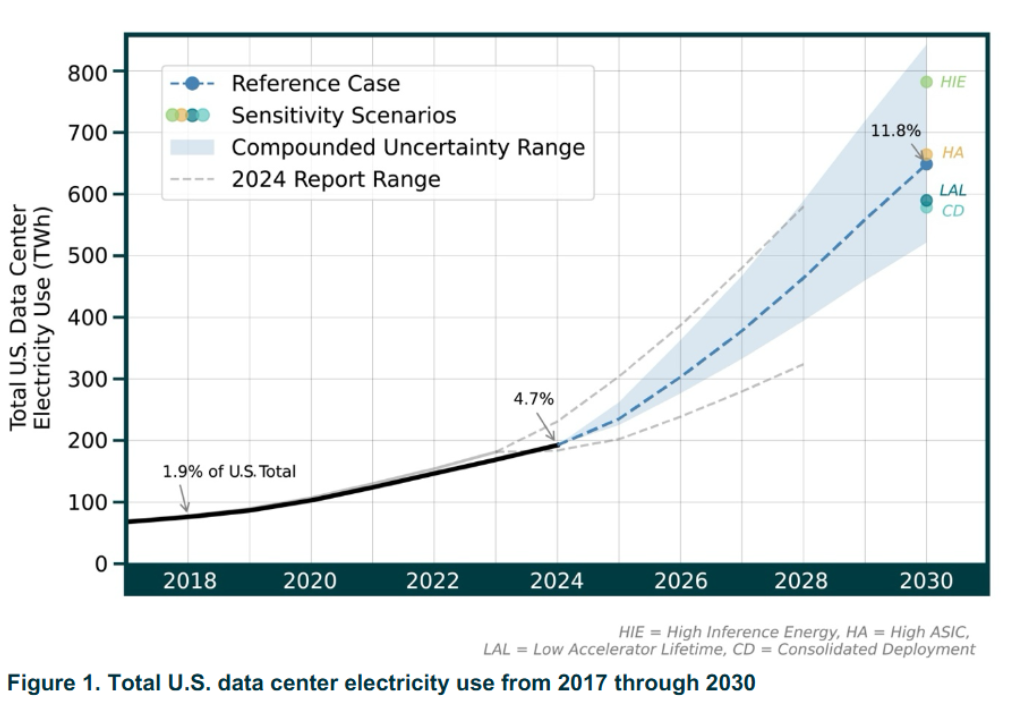
NVIDIA’s Results Show the Scale of Demand
NVIDIA’s latest financial results provide a direct measure of the AI infrastructure boom. For the quarter ended July 26, 2026, revenue reached $96.2 billion, compared with $46.7 billion a year earlier. Operating income climbed 124% to $63.7 billion, while net income increased 126% to $59.7 billion. GAAP gross margin was 75%.
The Data Center segment remains the main growth engine. Revenue increased 18% from the previous quarter and 117% from a year earlier to $89 billion. NVIDIA’s Edge Computing revenue reached $7.2 billion, up 27% year over year.
For fiscal Q3, NVIDIA expects revenue of $108 billion, plus or minus 2%. Its forecast assumes no Data Center compute revenue from China. Gross margin is expected at 74%, plus or minus 50 basis points.
The company has also sharply increased its supply and capacity commitments. NVIDIA’s fiscal Q2 filing shows these commitments rose from $119 billion to $279 billion as of July 26, 2026. The company said the increase was intended to meet future demand.
These commitments are not the same as revenue. They represent future obligations and capacity arrangements. NVIDIA also warns that customers could delay purchases because of shortages of land, electricity, data center shells, or capital.
NVIDIA Moves Into AI Infrastructure Financing
The world’s most valuable company is also expanding beyond chip sales. In August, NVIDIA announced partnerships with Apollo, BlackRock, Blackstone, Brookfield, Goldman Sachs and KKR to establish independent financing platforms for AI infrastructure.
The platforms aim to mobilize more than $500 billion of third-party capital over time. The objective is to help fund large AI data centers and computing systems. This reflects a broader shift in the industry.
The IEA says data center investments have become too large to be funded entirely from company balance sheets, making capital markets increasingly important.
However, the $500 billion figure is a target for capital mobilization, not money already committed. NVIDIA’s announcement says the arrangements remain subject to definitive agreements. NVIDIA’s Q2 filing also shows $99 billion of equity investments and $25 billion of equity investment commitments as of July 26, 2026.
OpenAI’s 10-GW Plan Adds Fuel to the AI Buildout
One of the clearest examples of AI infrastructure demand is NVIDIA’s partnership with OpenAI. In September 2025, the companies announced plans for at least 10 gigawatts of NVIDIA systems for OpenAI’s next-generation AI infrastructure.
NVIDIA said it intended to invest up to $100 billion in OpenAI progressively as each gigawatt is deployed. The first gigawatt was targeted for deployment in the second half of 2026 using NVIDIA’s Vera Rubin platform.
NVIDIA’s broader infrastructure model now covers computing, networking, software and financing. The company’s fiscal Q2 results also highlighted its DSX platform, which is designed to help infrastructure builders design, build and operate large-scale AI factories. This suggests that NVIDIA’s role in the AI economy is expanding beyond supplying individual processors.
- ALSO SEE: NVIDIA (NVDA Stock) Targets $500 Billion AI Buildout: The Race for Compute, Power and Clean Energy
The Next AI Bottleneck: Finding Enough Power
The next challenge is increasingly physical. AI data centers require enormous amounts of electricity, and connecting new facilities to power grids can take years. The IEA says bottlenecks involving grid connections, transformers, gas turbines, advanced chips and other infrastructure are already slowing some projects.
NVIDIA’s own regulatory filing makes a similar point. It says access to land, power, data center shells and capital is crucial to customer deployment.
This creates a potential constraint on how quickly AI computing capacity can grow. Having demand for GPUs does not automatically mean the infrastructure exists to operate them. It also creates a larger connection between the technology and energy markets.
The IEA expects renewables and natural gas to supply much of the additional electricity needed by data centers, with nuclear also becoming more important later this decade.
NVIDIA’s AI Growth Comes With a Bigger Emissions Bill
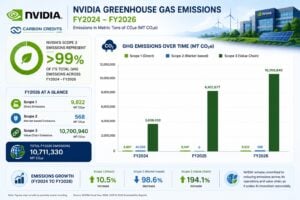
The infrastructure boom also raises environmental questions for NVIDIA and its supply chain. It has science-based emissions targets based on a FY2023 baseline, aiming to cut absolute Scope 1 and Scope 2 emissions by 50% by FY2030. It also targets a 75% reduction in Scope 3 emissions intensity from the use of sold GPUs per PFLOP by FY2030.
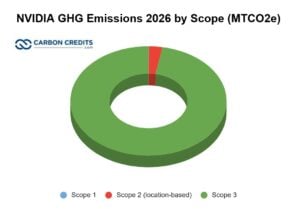
The company has made progress on operational electricity emissions. Its FY26 sustainability report shows 9,822 metric tons of Scope 1 emissions and 568 tons of market-based Scope 2 emissions. However, its wider supply chain footprint has increased sharply.
NVIDIA reported 10.7 million metric tons of Scope 3 emissions in FY26, compared with 6.9 million tons in FY25. Purchased goods and services accounted for 9.3 million tons. That increase highlights the environmental challenge created by rapid hardware expansion.
- The chipmaker is therefore pursuing two parallel goals: increasing computing efficiency while reducing emissions across its operations and value chain.
NVIDIA Stock Moves Higher as AI Spending Accelerates
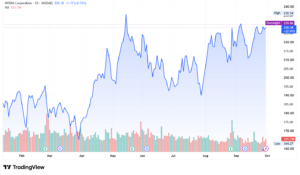
NVIDIA stock closed at $228.38 on September 30, 2026, gaining 0.5% for the session. The stock rose 1.7% on September 28 after NVIDIA announced a record $150 billion increase to its share-repurchase authorization. This lifts the total remaining authorization to about $235 billion.
Recent trading has therefore taken place alongside continued investor focus on AI infrastructure spending, NVIDIA’s earnings growth and its expanding capital-return program.
NVIDIA’s AI Infrastructure Cycle Keeps Expanding
NVIDIA enters the next phase of the AI buildout with several major infrastructure commitments already in place. OpenAI’s planned 10-GW deployment adds another large source of future demand.
At the same time, the industry faces physical and financial constraints. Electricity demand from data centers is projected to nearly double by 2030, while grid connections, power equipment, land, construction capacity and financing could limit the speed of new deployments.
For NVIDIA, the opportunity is therefore no longer limited to selling GPUs. The company is increasingly involved in the broader AI infrastructure stack, including computing, networking, software, capacity and financing.
The scale of those commitments shows how much capital is now moving behind AI. It also makes energy availability, infrastructure delivery, emissions, and the economic returns from AI spending increasingly important factors in the next phase of the market.