

Nvidia’s latest results show that the artificial intelligence boom is still accelerating, with revenue more than doubling from a year earlier. But the company’s rapid growth also highlights a growing climate challenge: Nvidia’s Scope 3 emissions reached 10.7 million metric tons of CO2e in fiscal 2026, driven largely by its expanding supply chain.
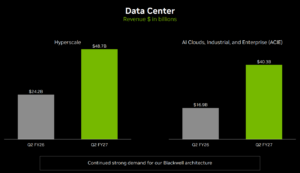
Nvidia reported its second-quarter fiscal 2027 results on August 26, 2026, with revenue of $96.2 billion, up 106% year-on-year. Data Center revenue reached $89.0 billion, up 117%, as demand for AI computing continued to drive sales.
Jensen Huang, founder and CEO of Nvidia, remarked during the earnings call:
“AI has reached its inflection point. It’s doing useful work. Its tokens are productive and profitable. Now, compute is revenue. And demand is accelerating. This time last year, one lab alone was driving the buildout; today, we have a golden age of new AI labs and startups, multiple frontier labs scaling in parallel, a thriving open-model ecosystem and physical AI coming online — with strong momentum across the U.S. and around the world. The AI infrastructure buildout is at full steam. Vera Rubin, now in full production, was built to power exactly this moment.”
The results show the strength of Nvidia’s business. Yet, they also raise a bigger question for the clean energy market: can AI infrastructure grow this quickly while companies reduce the emissions tied to that growth?
Nvidia’s AI Engine Blasts Past $96 Billion
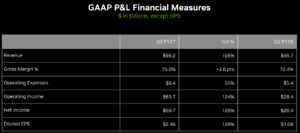
Nvidia’s Q2 revenue jumped to $96.221 billion, compared with $46.743 billion a year earlier. Net income rose 126% to $59.688 billion, while diluted earnings per share climbed 128% to $2.46.
The Data Center business remains the main growth engine. Revenue from the segment reached $89.0 billion, up 117% from a year earlier and 18% from the previous quarter. That means Data Center sales accounted for about 92% of Nvidia’s total quarterly revenue.
Nvidia also maintained a 75% gross margin in the quarter. The tech giant expects the momentum to continue. It forecasts $108 billion in revenue for the third quarter, plus or minus 2%. Nvidia does not include any Data Center computing revenue from China in that forecast.
The company also returned about $26 billion to shareholders through share buybacks and dividends during the quarter.
The AI Boom Is Also an Energy Boom
Nvidia’s earnings matter to the carbon market because its chips sit at the center of the expanding AI infrastructure system. AI data centers need large amounts of electricity to run and cool servers. Nvidia’s own latest sustainability report acknowledges that AI demand will increase energy use and says energy is the foundation of the AI infrastructure stack.
The company is trying to address part of this problem through more efficient computing.
The chipmaker says its Vera Rubin NVL72 platform can deliver up to 10 times the energy efficiency of its previous Blackwell architecture. Its Vera CPU can also run up to 50% faster with twice the energy efficiency of traditional CPU infrastructure.
Nvidia also says its Groq 3 LPX combined with Vera Rubin NVL72 can deliver up to 35 times more inference performance per watt than the Blackwell GB200 NVL72 for trillion-parameter models.
These improvements matter because higher performance per watt can reduce the electricity needed for a given amount of computing. But efficiency gains do not automatically reduce total emissions if companies deploy far more AI computing.
- RELEVANT: Nvidia’s $750 Billion AI Investment Web Faces Growing Scrutiny, Putting Stock Under Pressure
Scope 3 Emissions Hit 10.7 Million Tons
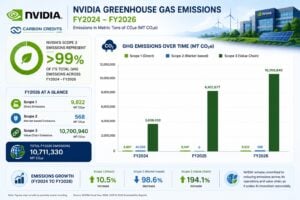
This is where Nvidia’s latest sustainability data becomes important. Its FY2026 Sustainability Report shows Scope 3 emissions of 10,700,940 metric tons of CO2e, up from 6,912,577 tons in FY2025 and 3,638,432 tons in FY2024.
That means Scope 3 emissions increased about 55% in one year and almost threefold in two years. Scope 3 covers indirect emissions across a company’s value chain. For Nvidia, the largest source comes from purchased goods and services.
Category 1 emissions reached 9,301,735 metric tons of CO2e in FY2026. That represented about 87% of Nvidia’s reported Scope 3 emissions.
The increase reflects the scale of Nvidia’s hardware business and the emissions linked to manufacturing the components and systems needed for its products.
This is important because Nvidia operates mainly as a fabless semiconductor company. Much of the physical manufacturing takes place through suppliers rather than inside Nvidia-owned factories.
Direct Emissions Are Much Smaller
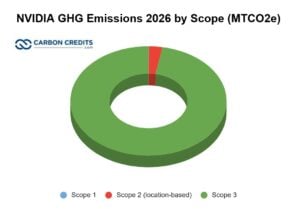
Nvidia’s direct operational emissions remain far below its Scope 3 footprint, as shown in the chart above.
In FY2026, the company reported 9,822 metric tons of Scope 1 emissions. Its market-based Scope 2 emissions were 568 tons. Together, Scope 1 and market-based Scope 2 emissions totaled 10,390 tons. Nvidia also reported 308,891 tons of location-based Scope 2 emissions.
The difference comes from the way the company accounts for purchased electricity. Nvidia says it matched 100% of its global electricity use with clean electricity in FY2026 through sources including on-site solar, long-term power purchase agreements, renewable electricity tariffs and energy attribute certificates.
That helped reduce its market-based Scope 2 figure. But it does not remove the much larger emissions connected to its supply chain. The data shows why Nvidia’s biggest climate challenge sits outside its own offices and facilities.
Nvidia Sets 2030 Climate Targets as Emissions Keep Climbing
The world’s most valuable company does have science-based emissions targets.
From a FY2023 base year, the company aims to cut absolute Scope 1 and Scope 2 market-based emissions by 50% by FY2030. It also aims to reduce Scope 3 emissions intensity from the use of sold GPU products by 75% per petaFLOP by FY2030. The Science Based Targets initiative has validated both targets.
The Scope 3 goal is an intensity target, not an absolute emissions target. This distinction matters.
Nvidia can reduce emissions per unit of computing performance while its total emissions continue to rise if it sells enough additional GPUs and systems. The FY2026 figures show why that issue is important.
Nvidia’s Scope 3 emissions rose from 6.91 million tons to 10.70 million tons in one year, even as the company continued to improve the efficiency of its products.
Nvidia Pushes Clean Power and Grid Flexibility
Nvidia says it has matched 100% of its global electricity use with clean electricity for two consecutive years. However, its biggest emissions source remains its supply chain, so the company is using more supplier-specific data to better track Scope 3 emissions and identify areas for cuts.
Nvidia is collaborating with Emerald AI, the Electric Power Research Institute (EPRI), and energy firms. They aim to create AI data centers that adjust power use according to grid conditions.
The company says this approach could help unlock up to 100 gigawatts of U.S. power capacity by using existing infrastructure more efficiently. Nvidia is also exploring onsite power generation and energy storage to help data centers connect faster and reduce grid pressure.
For the clean energy market, the strategy shows how AI companies are moving beyond clean electricity purchases toward more flexible power systems.
Nvidia (NVDA) Stock Jumps After Earnings, but Expectations Remain High
Nvidia stock initially dipped after its earnings release before jumping 4.2% in heavy after-hours trading, with more than 50 million shares changing hands, according to LSEG data. Investors responded to Nvidia’s stronger-than-expected results and its forecast for 70% revenue growth in fiscal 2028.
The company also expects $108 billion in third-quarter revenue, while Data Center revenue rose 117% to $89 billion in the latest quarter.
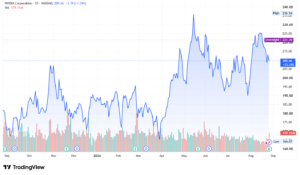
Despite the rebound, Nvidia stock remain up only more than 12% this year, compared with a more than 60% gain for the Philadelphia Semiconductor Index. Reuters noted that investor expectations have become so high that simply beating forecasts may no longer be enough to drive the stock higher.
AI’s Carbon Challenge Is Moving Upstream
Nvidia’s latest earnings make the AI boom look stronger than ever. But its latest sustainability report tells another part of the story.
The company is improving energy efficiency, matching its electricity use with clean power, and working on grid-friendly AI infrastructure. It also has science-based 2030 emissions targets. Still, the rapid rise in Scope 3 emissions shows the scale of the challenge.
Nvidia’s next sustainability test will not simply be whether each new GPU uses less energy. It will be whether the company can make its fast-growing AI supply chain cleaner as demand for computing continues to surge.