


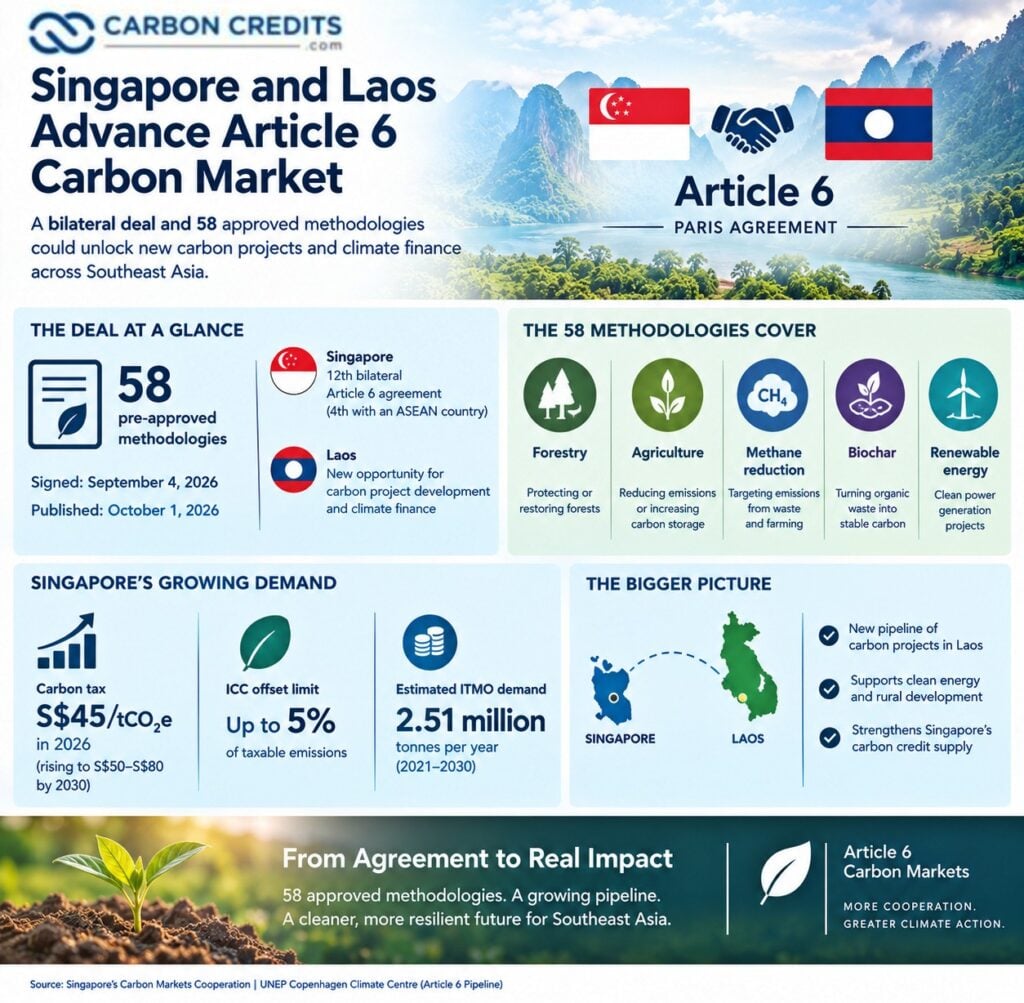
Singapore and Laos are taking another step toward building a cross-border carbon market. The two countries have agreed on 58 pre-approved carbon credit methodologies under their bilateral deal linked to Article 6 of the Paris Agreement.
The methodologies cover forestry, agriculture, methane reduction, biochar and renewable energy. They give project developers a clearer path to seek approval for carbon credits that could later be transferred internationally as Internationally Transferred Mitigation Outcomes (ITMOs).
Singapore and Laos signed their Implementation Agreement in September 2026. Singapore published the list of eligible methodologies on October 1.
The move could create a new pipeline of carbon projects in Laos while giving Singaporean companies another source of international carbon credits. It also adds Laos to Singapore’s growing network of Article 6 partners.
58 Methodologies Give Laos a New Carbon Project Pipeline
The new list covers a wide range of climate projects. Forestry projects can focus on protecting or restoring forests. Agricultural projects can reduce emissions or increase carbon storage. Methane projects can target emissions from waste and farming.
The list also includes biochar and renewable energy methodologies. However, the 58 methodologies do not mean that 58 projects have already been approved.
Projects must still go through Singapore and Laos’ authorization process before they can generate transferable ITMOs. Singapore says its methodology lists are designed to give developers more certainty because the methods have already been reviewed and published.
The next step will be the launch of the project application process. For developers, this could make Laos more attractive as a location for carbon projects targeting the international market.
Singapore and Laos Move From Agreement to Project Development
Singapore and Laos signed their Implementation Agreement on September 4, 2026. It was Singapore’s 12th bilateral Implementation Agreement for carbon market cooperation and its fourth with an ASEAN country.
The agreement allows eligible projects in Laos to generate carbon credits that can be transferred to Singapore, subject to approval by both countries. A key part of the system is the use of corresponding adjustments.
These adjustments help prevent the same emissions reduction from being counted twice — once by Laos and again by Singapore or another buyer. This is one of the main differences between Article 6 credits and many credits traded in the voluntary carbon market.
The agreement also sets financial and environmental safeguards. Laos will receive a 5% share of proceeds from authorized carbon credits to support climate adaptation. Another 2% of credits must be cancelled when the credits are first issued. These credits cannot be sold or used toward another climate target.
Singapore Has Growing Demand for Carbon Credits
The Laos agreement comes as Singapore’s carbon market expands. Singapore’s carbon tax rose to S$45 per tonne of CO₂e in 2026, up from S$25 in 2024 and 2025. The government plans to raise the tax to between S50 and S80/tCO₂e by 2030.
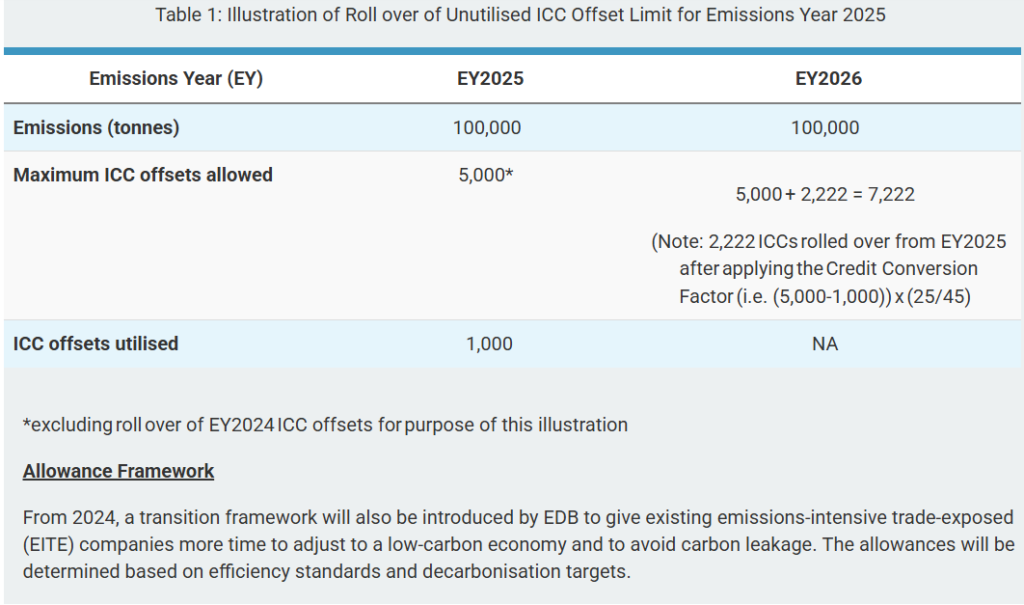
Companies covered by the carbon tax can use eligible international carbon credits (ICC) to offset up to 5% of their taxable emissions. That creates demand for high-quality international credits.
Singapore estimates that it could need about 2.51 million tonnes of ITMOs each year during its 2021–2030 climate-target period. But supply remains a challenge.
The government has said carbon projects can take several years to develop and generate credits. Singapore has therefore been working with several countries to build future supply. Laos now becomes part of that pipeline.
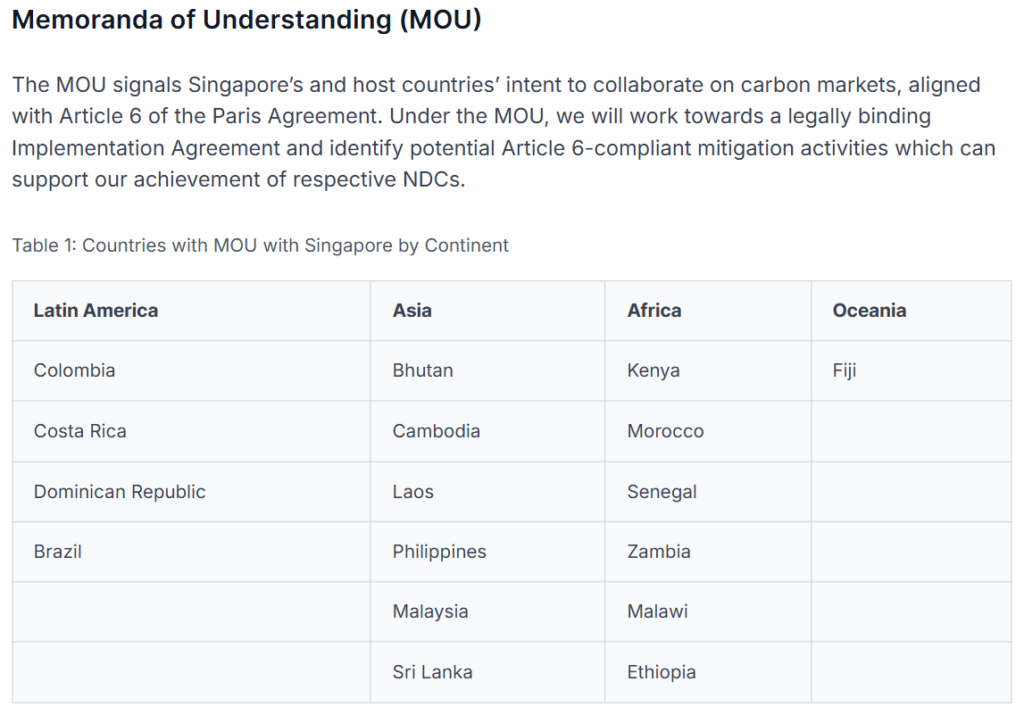
Singapore Is Already Paying for High-Quality Carbon Credits
Singapore has already committed significant money to international carbon projects. The government has contracted about 2.175 million tonnes of high-quality nature-based carbon credits from projects in Ghana, Peru and Paraguay.
The contracts are worth about S$76 million in total. That equals an average value of around S$35 per tonne, although carbon prices vary between projects.
Singapore has also continued to seek new Article 6 credits from partner countries. A 2025 government tender for nature-based credits attracted offers ranging from about $19 to $41 per tonne, according to S&P Global. The tender received offers from 17 suppliers.
These prices are not a standard market price for Article 6 credits. They show, however, that buyers are willing to pay more for credits that meet stronger quality and government-approval requirements. That could benefit projects in Laos if they can meet Singapore’s eligibility rules.
Laos Could Attract New Climate Finance
For Laos, the agreement creates a potential new source of international climate finance. The country has large areas of forest and significant agricultural activity. These sectors could support projects that reduce emissions, store carbon, or improve land management.
The 58 approved methodologies give developers several possible project types to explore. But carbon revenue is not guaranteed.
Projects must prove that their emissions reductions are real and meet the rules of both countries. They must also pass the required monitoring, reporting, and verification processes.
- The 5% share of proceeds gives Laos a direct financial benefit from successful projects. The 2% cancellation requirement also adds a climate-integrity safeguard.
For example, if a project generates 100 tonnes of eligible mitigation, two tonnes would be cancelled under the agreement. Only the remaining amount could potentially be transferred, subject to all other requirements.
Article 6 Market Is Growing, But Actual Trading Is Still Small
The global Article 6 market is expanding, but actual ITMO transfers remain at an early stage. As of September 4, 2026, the UNEP Copenhagen Climate Centre’s Article 6 Pipeline recorded 78 bilateral agreements in the East Asia and Pacific region, involving 16 countries.
- Singapore had the largest network, with 28 agreements, followed by South Korea with 14 and Japan with 32 globally.
However, only about 54,000 ITMOs had been transferred or received in the East Asia and Pacific region by that date. Globally, the number was much larger, but still concentrated in a small number of transactions.
This shows the gap between signing Article 6 agreements and actually generating tradable credits. Countries are building the rules, approving methodologies, and developing project pipelines before large-scale trading begins.
The market is also becoming more focused on high-quality credits. The World Bank says carbon credit issuances rose 8% in 2025, while credits eligible for international compliance markets continued to receive price premiums.
For Singapore and Laos, the 58 approved methodologies could help close part of that gap by giving developers a clearer route from project development to government authorization and eventual ITMO transfers.
Article 6 Market Could Expand Across Southeast Asia
The latest Singapore agreement shows how Article 6 is moving from international climate policy into actual carbon market development.
The Paris Agreement created the framework for countries to cooperate on emissions reductions. Bilateral agreements now provide the rules needed to turn that framework into transactions.
For Singapore, the goal is to secure a supply of high-quality international credits as its carbon tax rises.
For Laos, the opportunity is to attract investment into forestry, agriculture, methane reduction, renewable energy and other climate projects.
The two countries will still need to prove that projects can move from approved methodologies to real credits.
That is the next test. With 58 methodologies already eligible, Singapore’s carbon tax at S$45/tCO₂e, potential ITMO demand of 2.51 million tonnes a year, and billions of dollars of global interest in higher-quality carbon credits, the foundation is now in place.