


Canada is putting mining and critical minerals at the centre of a new push to attract global investment. Prime Minister Mark Carney hosted Canada’s first Investment Summit in Toronto on September 14–15, bringing together global investors and Canadian companies as Ottawa seeks to catalyze C$1 trillion in investment over the next five years.
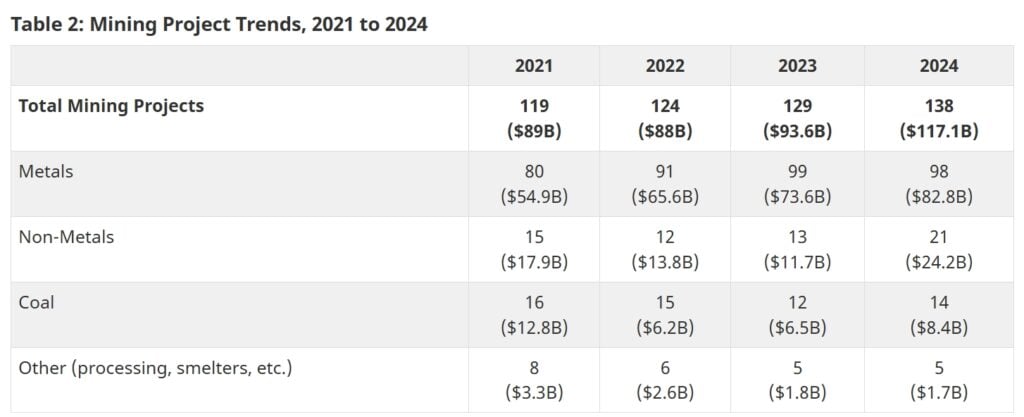
The government’s investment prospectus features 167 projects across eight sectors, with mining and metals accounting for 63 projects, the largest category in the portfolio. The projects span commodities including copper, lithium, graphite, gold and other minerals considered important to energy, technology and national security supply chains.
The focus on mining comes as governments and manufacturers look to diversify critical-mineral supply chains away from concentrated sources of production and processing.
For Canada, the opportunity is not simply to increase mine output. It is to attract the capital needed to build mines, processing facilities and infrastructure while keeping the environmental footprint of new production under control.
Mining Leads Canada’s Investment Pitch
The scale of the mining presence at the summit is significant.
As said before, of the 167 projects in the federal prospectus, 63 are in mining and metals. That makes the sector the largest component of Canada’s investment pitch to global institutional investors.
Canada already has a large and established mining economy.
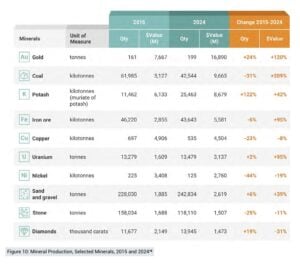
Natural Resources Canada says the country produced more than 60 minerals and metals worth C$64.3 billion in 2024. Metals accounted for more than half of that value, with gold alone contributing about 26%.
Canada is also a leading global producer of several critical minerals and ranked among the world’s major producers of uranium and palladium. The broader minerals sector directly employed approximately 438,000 people in 2024.
However, developing new deposits requires substantial upfront capital. Long permitting timelines, infrastructure requirements and the need for processing capacity can also make projects difficult to finance.
Ottawa is increasingly using government-backed capital to help bridge that gap.
C$140 Million backs Ontario’s Generation Mining Marathon Project
Canada Growth Fund announced a commitment of approximately C$140 million to Generation Mining (TSXV: GENM) to support the development of the Marathon Project in northwestern Ontario. The investment is intended to help advance the project toward construction and mobilize additional private capital.
The Marathon Project is a large copper-palladium development that also contains platinum, gold and silver.
Generation Mining announced separately that it has now assembled approximately US$1.3 billion in project financing for construction. The package includes the Canada Growth Fund investment, approximately US$50 million from the Canada Infrastructure Bank, senior and subordinated debt and metal-streaming arrangements.
The project is expected to enter early construction work in the fourth quarter of 2026, subject to the company’s financing arrangements and construction conditions.
Marathon is important beyond its individual production potential because it could strengthen Canada’s domestic critical-minerals chain.
The company has an agreement with Glencore to purchase the project’s polymetallic concentrate, providing a potential route into existing Canadian processing infrastructure.
Frontier Lithium’s PAK Lithium Project Adds Another Layer
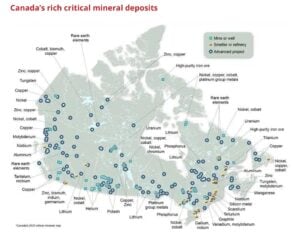
Lithium is another major theme in Canada’s investment push. Frontier Lithium’s PAK Lithium Project in northwestern Ontario has been included in the Canada Investment Summit prospectus and Ontario’s Deal Book. The company described PAK as the only lithium project included in Ontario’s investment portfolio.
Other projects are also seeking to connect Canadian mineral resources with international battery supply chains.
- E3 Lithium, for example, recently signed a non-binding memorandum of understanding with India’s Epsilon Advanced Materials to potentially supply up to 5,000 tonnes of lithium carbonate per year from its Clearwater project in Alberta over five years.
The agreement highlights another part of Canada’s strategy: using its mineral resources to build relationships with buyers outside the U.S.
Canada’s Mining Output is Already Substantial
Canada’s critical-minerals investment strategy is being built on an existing mining base.
The value of Canadian mineral production reached C$64.3 billion in 2024, although that was down from C$70.4 billion in 2023. Natural Resources Canada says metals production increased by 1%, while non-metals and coal declined, largely because of lower coal and potash prices.
The country therefore has an established workforce, mining expertise, capital markets and infrastructure that can support a new generation of projects.
The challenge is scaling that system quickly enough.
The Emissions Challenge is Harder to Ignore
Canada’s mining expansion also comes with a climate challenge.
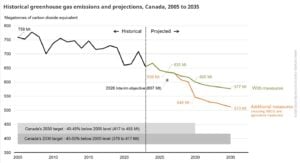
The country’s latest National Inventory Report, released in 2026 and covering emissions through 2024, puts Canada’s total greenhouse gas emissions at approximately 685 million tonnes of CO2e in 2024. It was about 10% below the 2005 level of 763 Mt CO2e.
Mining’s emissions require more careful interpretation.
Its stationary combustion emissions were about 5.5 Mt CO2e in 2024. This figure covers emissions from stationary fuel combustion and should not be treated as the industry’s entire carbon footprint.
Mining and quarrying also appear within broader energy-sector categories that include other activities.
For example, Canada’s facility-level reporting system groups mining, quarrying, and oil and gas extraction together. Those facilities reported approximately 126 Mt CO2e in 2024. However, that number should not be described as mining’s standalone emissions because the category includes the much larger oil and gas industry.
This distinction matters as Canada promotes new mining investment.
The country wants to increase production of the minerals needed for electrification and energy technologies while also reducing the emissions intensity of the economy.
Low-carbon power could become a mining advantage
Canada has one potential advantage in that race: electricity.
Several major mining provinces have access to large amounts of hydroelectric or nuclear power. That could help mines reduce their reliance on fossil fuels, particularly for electricity-intensive processing.
For investors and industrial buyers, the carbon footprint of mineral production could become increasingly important. Copper, lithium, nickel, graphite and other minerals may be essential to the energy transition, but producing them still requires energy, transportation and processing.
This creates an opportunity for Canada to compete not only on resource availability but also on the potential carbon intensity of supply.
A Race for Capital, Not Just Minerals
Overall, the Canada Investment Summit highlights a clear opportunity for the country’s critical-minerals sector. Canada has the resources and mining expertise. Now, it needs capital, infrastructure, and faster project development.
With 63 mining and metals projects in the summit prospectus, Ottawa is betting that its C$1 trillion investment ambition can turn mineral wealth into new domestic supply chains and lower-carbon growth.
The question now is whether Canada can bring these projects into production fast enough, while keeping their environmental footprint competitive.