


Canada stands at a crossroads. The country possesses vast reserves of critical minerals, abundant energy resources, and a strong reputation as a reliable supplier to global markets. Yet a new report prepared by Oxford Economics for PwC warns that the country could lose its competitive edge. Thus, faster infrastructure development and quicker project approvals are needed to attract investment, clean energy projects, and critical mineral supply chains.
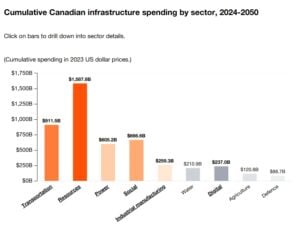
According to the forecasts, Canada will require roughly $4.7 trillion in infrastructure investment by 2050. The spending will support everything from roads, bridges, ports, and water systems to hospitals, defense facilities, power infrastructure, data centers, and mining projects.
The report argues that infrastructure is no longer simply about maintaining public assets. It has become a key driver of economic growth, energy security, trade competitiveness, and national sovereignty.
Infrastructure Spending Set to Rise, But Gaps Remain
Canada currently ranks among the world’s largest infrastructure investors, spending about $145 billion annually. By 2050, that figure is expected to climb to approximately $210 billion per year, representing a 45% increase.
While that growth appears significant, PwC notes that Canada still trails many leading economies when infrastructure spending is measured as a share of GDP.
Canada invests about 6.6% of its GDP in infrastructure today, compared with an average of 7.4% among top-performing countries. Closing that gap would require roughly $34 billion in additional annual investment by mid-century.
PwC emphasizes that future outcomes remain uncertain. Canada could surpass current forecasts if governments and industry act decisively. However, delays in decision-making and project development could leave the country behind as global competition intensifies.
The stakes are particularly high as nations race to secure critical mineral supplies, strengthen energy systems, and build the infrastructure needed for artificial intelligence, advanced manufacturing, and defense.
Critical Minerals Drive Canada’s Biggest Opportunity
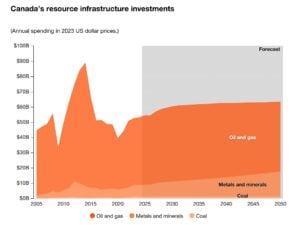
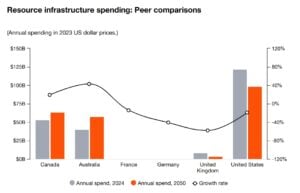
Resource infrastructure will remain the largest category of Canada’s infrastructure spending over the next 25 years.
Annual investment in facilities supporting mining, energy production, mineral processing, and transportation is projected to increase from approximately $53 billion today to $63 billion by 2050. Cumulatively, that represents nearly $1.6 trillion in spending.
Several factors are fueling this growth.
- Global demand for critical minerals continues to rise as countries expand electric vehicle production, battery manufacturing, renewable energy systems, and defense technologies.
- At the same time, geopolitical tensions are encouraging Western economies to diversify supply chains away from heavily concentrated suppliers.
Canada can significantly benefit from these trends.
The country currently produces more than 60 minerals and metals and remains a leading global supplier of nickel, potash, aluminum, and uranium. Canada has also identified 31 minerals as strategically important under its Critical Minerals List.
To qualify as a critical mineral, a resource must support Canada’s economic security, contribute to the low-carbon transition, or serve as a reliable supply source for allies and trading partners.
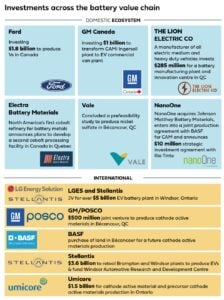
Government incentives are also helping attract investment. Tax credits and other support programs encourage companies to develop clean-technology manufacturing facilities and critical-mineral processing operations across the country.
Ring of Fire Highlights Infrastructure Challenge
Despite Canada’s vast resource potential, many opportunities remain difficult to develop because supporting infrastructure is missing.
PwC points to Ontario’s Ring of Fire as one of the clearest examples. The mineral-rich region contains significant deposits of nickel, chromite, copper, and other critical minerals. However, large-scale development requires much more than mines alone.
Roads, electricity transmission lines, digital connectivity, and community infrastructure must all be built simultaneously before production can begin at scale.
The report argues that future competitiveness increasingly depends on integrated infrastructure systems rather than isolated projects. Mining operations, processing facilities, transportation networks, and energy systems must advance together to unlock economic value.
Without coordinated development, Canada risks missing opportunities as investors seek jurisdictions capable of moving projects forward more quickly.
North America’s Critical Minerals Market Continues to Expand
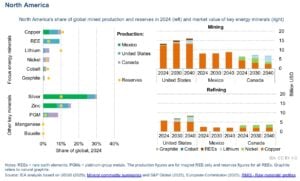
North America is expected to play an increasingly important role in global critical mineral supply chains over the coming decades.
IEA forecasts suggest the market value of North America’s energy mineral production could reach approximately $30 billion for mining activities and $14 billion for refining operations by 2040.
Growth will come from multiple sources, such as:
- Copper production is expected to expand significantly in the United States and Mexico, while Canada is positioned to benefit from rising lithium and nickel output.
- On the refining side, Canadian facilities are expected to strengthen their role in processing copper and nickel for domestic and international markets.
Defense Spending Emerges as a Major Growth Driver
The fastest-growing infrastructure category in Canada is defense.
PwC projects defense-related infrastructure investment will surge by nearly 389% between 2024 and 2050. The forecast aligns with Canada’s commitment to increase spending on defense and security by an additional 1.5% of GDP.
Many defense investments provide benefits beyond military applications. Airports, ports, communications networks, transportation corridors, and energy infrastructure can serve both national security and civilian economic needs.
As a result, defense spending could become a key catalyst for broader infrastructure modernization nationwide.
Canada Risks Falling Behind in Strategic Sectors
Although resource projects dominate Canada’s investment outlook, PwC warns that excessive concentration could create long-term vulnerabilities.
By 2050, resource infrastructure is expected to account for roughly 30% of Canada’s total infrastructure spending. Meanwhile, many competing countries are investing aggressively in sectors reshaping the global economy.
Nuclear power illustrates the challenge.
- Global nuclear infrastructure investment is projected to increase by approximately 45% through 2050.
- In Canada, however, growth is expected to reach only 11%, despite several major nuclear development projects already underway.
Canada also trails global growth projections in transportation infrastructure.
- Worldwide investment in ports is expected to rise 73%, compared with 64% in Canada.
- Airport infrastructure is projected to grow 93% globally versus 78% domestically.
The United States is forecast to outperform Canada in several strategic categories, including nuclear energy, airports, and other high-growth infrastructure segments.
PwC also highlights concerns about Canada’s ability to attract data center investments, where countries such as the United States, the United Kingdom, and Australia are moving rapidly to expand digital infrastructure.
Regulatory Delays Remain the Biggest Obstacle
While Canada offers strong mineral resources, political stability, and attractive investment incentives, the report identifies one persistent challenge: lengthy approval processes.
Complex permitting requirements, overlapping regulatory reviews, and extended timelines continue to increase costs and uncertainty for developers.
The federal government has acknowledged the issue, particularly for critical mineral projects that support climate goals and economic growth. Officials have emphasized the need to balance environmental protection, Indigenous engagement, and sustainable development with faster decision-making.
Canada has already introduced several funding programs to accelerate project development, including:
- A $2 billion Critical Minerals Sovereign Fund
- Substantial investments through the First and Last Mile Fund.
- Additional financing support is available through institutions such as the Canada Infrastructure Bank and the Canada Growth Fund.
However, PwC argues that financial support alone will not be enough.
To fully capitalize on its resource wealth and strategic advantages, Canada must modernize approval processes and accelerate infrastructure delivery. Otherwise, competing jurisdictions may capture the investment, jobs, and supply chain opportunities that Canada is well-positioned to secure.
The Race Is On
Canada possesses many of the ingredients needed to become a global leader in critical minerals, clean energy, and strategic infrastructure. Massive mineral reserves, supportive government programs, and growing global demand create a compelling opportunity.
Yet the window may not remain open forever.
The PwC report delivers a clear message: infrastructure investment and permitting reform will determine whether Canada strengthens its competitive position or falls behind countries moving faster to secure the industries of the future.