


Canada is entering a new phase in the global artificial intelligence (AI) race. The country is now moving beyond AI research and building the large-scale infrastructure needed to power advanced computing systems. Two major announcements this month show how fast this shift is happening.
HIVE Digital Technologies unveiled plans for a CAD $3.5 billion AI gigafactory near Toronto. The company says the facility could become one of the largest AI data centers in Canada.
At the same time, TELUS and the Canadian government announced a new AI data center cluster in British Columbia focused on “sovereign AI” computing.
These projects reflect a wider global trend. Countries now see AI infrastructure as a strategic national asset. Governments and companies want more control over computing power, data processing, and cloud systems as AI demand rises rapidly.
HIVE Plans One of Canada’s Largest AI Data Center Projects
HIVE Digital Technologies plans to build a 320-megawatt AI infrastructure campus in Ontario through its subsidiary BUZZ High Performance Computing.
Frank Holmes, Executive Chairman of HIVE and BUZZ:
“AI is the new industrial base and compute is the factory floor. Canada produced the Godfathers of deep learning but kept renting the factories. That era is over. Between Toronto and Waterloo, BUZZ is building the sovereign AI infrastructure that turns Canadian intelligence into Canadian dominance… Our vision is to build AI infrastructure that will serve humanity, with the potential to improve the quality of life for millions of Canadians.”
The company says the site will support more than 100,000 GPUs once fully built. HIVE bought about 25 acres of land across two sites for around CAD $58 million in Ontario’s Toronto–Waterloo technology corridor.
The tech company expects the project to start operating in the second half of 2027. It claims the project will create more than 800 construction jobs and hundreds of permanent operational jobs.
HIVE also says the facility will run on Ontario’s low-carbon electricity grid and use closed-loop cooling systems that avoid direct water consumption.
The announcement adds to HIVE’s wider AI expansion across Canada. Earlier this month, the company announced a $3.1 million fiber optic upgrade at its 70 MW Grand Falls data center in New Brunswick. HIVE is converting that site into a 50 MW AI factory for enterprise and government computing workloads.
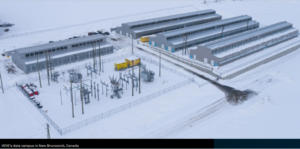
CEO Aydin Kilic says HIVE currently operates about 5,500 GPUs for AI computing. The company’s Canadian pipeline could eventually support around 130,000 GPUs. HIVE also reports more than 850 MW of global power capacity, including around 450 MW connected to operating data centers.
Investors reacted strongly to the news. HIVE shares climbed more than 24% after the announcement.

Canada Pushes Sovereign AI Infrastructure
Meanwhile, TELUS and the Canadian federal government also announced a major AI infrastructure expansion in British Columbia. The project includes:
- Expansion of the Kamloops AI facility,
- A new AI center in Vancouver’s Mount Pleasant district, and
- A downtown Vancouver AI facility planned for 2029.
TELUS says the project could become “one of the world’s most powerful and sustainable AI infrastructure clusters.”
- The federal government committed CAD $2 billion over five years beginning in 2024–25 to support sovereign AI data center projects across Canada.
Canadian officials say the goal is to keep advanced computing capacity inside the country. They also want Canadian-owned infrastructure operating under Canadian law.
TELUS says renewable sources will supply more than 98% of the electricity used by the facilities. The company also plans to recover waste heat from the Vancouver sites to help heat nearby buildings and homes.
The Kamloops expansion and Mount Pleasant facility will begin operations later this year.
- RELATED: Canada Approves First Uranium Mine in 20 Years as Tech Giants Eye Nuclear Fuel for AI Power
Canada Strengthens Its Position in the Global AI Economy
Canada already holds an important position in global AI research. Researchers in Toronto, Montreal, Vancouver, and Waterloo helped shape modern machine learning systems over the last decade.
Now the country wants to expand into AI infrastructure and commercial deployment. The Canadian AI market continues to grow quickly.
Canada’s AI sector could contribute more than CAD $230 billion to the economy by 2030, according to government and industry estimates. Generative AI could bring CAD $187 billion in economic value by 2030.
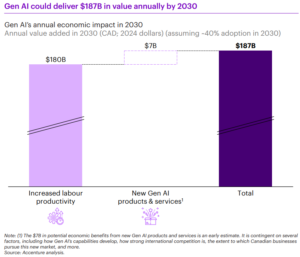
Moreover, the country ranks among the world’s leading AI research hubs by academic output and startup activity. More than 140,000 people already work in Canada’s digital and AI economy.
The country also attracted billions of dollars in AI and cloud infrastructure investment over the past three years. At the same time, global AI infrastructure spending is rising sharply.
Bank of America recently raised its forecast for the global AI data center systems market to about US$1.7 trillion by 2030. The bank also projects that annual AI infrastructure investment could reach US$1.4 trillion by the end of the decade.
Dell’Oro Group separately estimates global data center capital spending could approach US$1 trillion in 2026 alone and rise to US$1.7 trillion by 2030.
Much of this investment now focuses on generative AI systems, cloud computing, GPU infrastructure, national AI capacity, and sovereign computing systems. Canada’s latest projects directly fit into this global expansion cycle.
AI Data Centers Create New Energy, Emissions, and Grid Challenges
The rapid growth of AI infrastructure is also increasing pressure on power systems.
The International Energy Agency (IEA) says global electricity demand from data centers could more than double by 2030. AI systems require large amounts of continuous power, especially for training advanced models.
HIVE’s Ontario facility alone would require 320 MW of electricity, roughly equal to the power demand of a large industrial complex.
AI data centers are also increasing carbon emissions as electricity demand rises. The IEA estimates that data centers currently produce about 180 million tonnes of CO₂ emissions each year from electricity use.
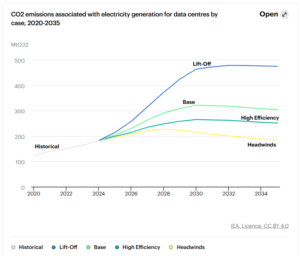
That figure could rise to around 300 million tonnes by 2035 as AI adoption expands. Much of the increase comes from growing power demand met by natural gas and coal generation.
Recent studies also show U.S. data centers already generate more than 105 million tonnes of CO₂e annually, equal to about 2.2% of total U.S. emissions. Meanwhile, the IMF estimates AI-driven power demand could add about 1.7 gigatonnes of global greenhouse gas emissions between 2025 and 2030 under current policies.
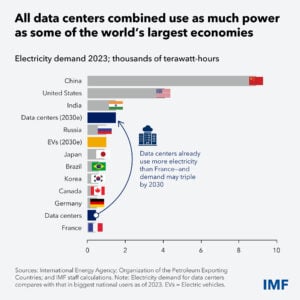
These trends are pushing tech companies to invest more in renewable energy and lower-carbon infrastructure. They also prompted major emitters to focus more on energy supply and emissions management.
Both HIVE and TELUS highlighted sustainability measures in their announcements. HIVE plans to use Ontario’s lower-carbon electricity grid and closed-loop cooling systems that reduce water use.
TELUS says renewable energy sources will provide more than 98% of the electricity used by its facilities. The company also plans to recycle waste heat from the Vancouver sites.
These measures matter because environmental concerns around AI are growing quickly. Analysts now warn that AI-driven data centers could significantly increase electricity demand and carbon emissions if grids fail to add enough clean power capacity.
Canada’s AI Buildout Moves Into Industrial Scale
Canada’s AI strategy is now shifting from research leadership toward industrial-scale infrastructure.
The HIVE and TELUS projects show how AI development now depends not only on software and algorithms, but also on physical infrastructure, power systems, and long-term energy supply.
As global competition in AI intensifies, Canada is positioning itself as both a research hub and a major location for next-generation AI infrastructure. The challenge now will be scaling these systems fast enough while managing power demand, sustainability pressures, and long-term economic risks.