

America’s uranium industry is reviving after more than a decade of decline. Rising nuclear power demand, government support, and energy security concerns are boosting investment in the domestic fuel supply. Once thought to be fading due to low prices and heavy imports, U.S. uranium mining is now gaining strength.
The recovery aims to lessen reliance on foreign uranium and nuclear fuel services. This comes as the country faces increased electricity demand from artificial intelligence (AI), data centers, electrification, and advanced manufacturing. The growth of nuclear power and small modular reactors (SMRs) also enhances uranium’s long-term prospects.
However, domestic uranium production has recently risen, supported by billions in federal funding to rebuild mining, conversion, enrichment, and fuel manufacturing.
US Uranium Output Climbs to Its Highest Level in Years
After years of modest production, U.S. mines are ramping up.
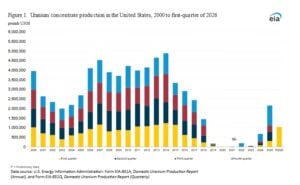
According to the EIA, domestic uranium concentrate production surged in 2025. In-situ recovery (ISR) operations restarted, and previously idle mines resumed production. This output roughly tripled from the previous year.
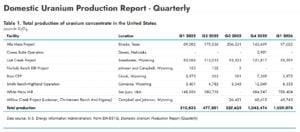
The momentum continued into 2026. In the first quarter, U.S. producers generated over 1 million pounds of uranium concentrate (U3O8) from six facilities.
They are mainly in Wyoming, Texas, and Utah. Wyoming led production, followed by Texas, where the Alta Mesa project resumed. Utah’s White Mesa Mill remained the only operational conventional uranium mill, processing ore from various states.
Despite this recovery, domestic production still covers only a small fraction of the uranium needed for America’s 94 operating nuclear reactors. The U.S. consumes over 50 million pounds of uranium annually, so imports are still vital.
Utilities have long relied on supplies from Canada, Kazakhstan, Australia, and Russia. Geopolitical tensions and supply chain security concerns have prompted Washington to rebuild domestic production.
DOE Federal Funding Sparks a Nuclear Fuel Renaissance
Government support drives the uranium industry’s recovery.
Over the past two years, the U.S. Department of Energy (DOE) has started initiatives to rebuild every stage of the nuclear fuel cycle—from mining to enrichment and advanced reactor fuel production.
A major investment occurred in early 2026 when the DOE awarded up to $2.7 billion in contracts to expand domestic uranium enrichment capacity. This funding aims to reduce reliance on Russian enrichment services while ensuring adequate fuel supplies for existing reactors and next-generation technologies.
The government is also investing heavily in High-Assay Low-Enriched Uranium (HALEU) production, which is needed by many advanced reactor designs.
In another significant step, the DOE awarded General Matter a contract worth up to $900 million to establish HALEU production at the Paducah facility in Kentucky. This project aims to boost America’s nuclear fuel independence while supporting advanced reactor deployment over the next decade.
Federal support also extends to mining and mineral processing. Energy Fuels, a major uranium producer, secured a conditional $725 million federal loan to expand domestic rare earth processing. This financing supports the company’s broader uranium operations and strengthens America’s strategic mineral supply chain.
These investments mark a policy shift. The U.S. is moving away from reliance on imported uranium and enrichment services to build a fully integrated domestic nuclear fuel industry.
Higher Uranium Prices Encourage Mine Restarts
The improving policy environment aligns with rising uranium prices.
After years of low investment post-Fukushima, uranium markets tightened as global demand grew and mine supply lagged.
Utilities are choosing long-term supply contracts more often than the spot market. This change leads to higher contract prices. It also gives mining companies the confidence to restart halted operations and invest in new projects.
Although uranium prices saw volatility in 2025, analysts expect the market to remain strong long-term due to limited new mine development and growing nuclear capacity worldwide.
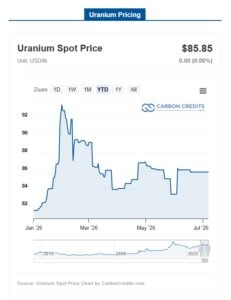
Several investment firms forecast supply deficits later this decade as reactor demand outpaces global mine production.
Leading Companies Drive Domestic Production
A few established producers are leading the U.S. uranium revival.
- Energy Fuels operates the White Mesa Mill in Utah, the only licensed conventional uranium mill. The facility processes uranium ore, produces vanadium, and is expanding into rare earth element processing.
- Uranium Energy Corp. (UEC) has quickly increased production through its Wyoming ISR operations and South Texas facilities, restarting several idle projects.
- Meanwhile, enCore Energy has resumed commercial production at its Alta Mesa ISR project in Texas, boosting domestic output.
- Global producer Cameco also maintains U.S. assets while supplying utilities worldwide through its Canadian operations.
Together, these companies are rebuilding an industry that nearly vanished after years of weak uranium prices.
AI and Nuclear Power Create New Demand
More than just government policy fuels the uranium recovery.
Electricity demand is rising as AI applications, cloud computing, and hyperscale data centers require reliable power. Unlike solar and wind, nuclear plants provide continuous carbon-free electricity, making them attractive to utilities and tech companies.
AI currently accounts for about 20% of total data center energy use, but this could rise to 40% by 2030 as AI applications expand. Goldman Sachs predicts that data center power use will climb by over 160% by the same period.
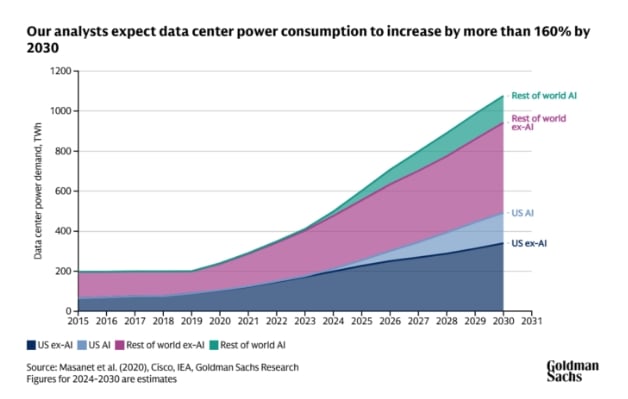
Several major tech firms have made deals to support nuclear energy, ensuring reliable electricity for future data centers. Countries worldwide are extending the lives of current reactors and planning new nuclear projects. Small modular reactors are attracting significant investment for their flexibility and lower costs.
These trends are expected to boost uranium demand in the coming decades.
A Long Road Still Lies Ahead
Despite the rapid recovery, significant challenges remain.
Domestic uranium production still meets only a small share of U.S. reactor needs, meaning imports will stay essential for years. Developing new mines requires substantial capital, environmental permits, and long timelines.
However, analysts believe the fundamentals are shifting. Stronger government support, rising uranium prices, expanding nuclear generation, and growing electricity demand are creating conditions not seen since the mid-2000s uranium boom.
As the U.S. aims to boost energy security and clean energy goals, uranium is gaining importance. Production is rising, federal funding is increasing, and new reactors are on the way. America’s uranium industry seems poised for steady growth in the next decade.