

The European Union is moving toward a major change in how it gives free carbon permits to industry. The European Parliament’s environment committee has backed a plan that could provide around 99 million additional free emissions allowances to certain industrial installations from 2026 to 2030.
The proposal aims to help European businesses manage carbon costs and compete with companies in countries with weaker climate rules. But it also raises a key question: how can the EU protect its industries while keeping pressure on them to cut emissions?
The committee’s position differs from the plan backed by EU member states, which would provide around 121 million allowances. Neither proposal should be treated as final law. The two sides must still agree on the rules.
EU Committee Backs 99 Million Free Allowances
The European Parliament’s Committee on the Environment, Climate and Food Safety (ENVI) backed changes to the EU Emissions Trading System (EU ETS). The vote was 64 in favor, 11 against, and two abstentions.
The plan covers industrial installations whose free allowances are calculated using heat and fuel benchmarks. These benchmarks apply when a specific product benchmark is not available.
Under the committee’s approach, around 88 million allowances available for free allocation would be used. It would add another 11 million allowances linked to existing conditions that some installations failed to meet. Together, these would bring the total to about 99 million allowances for the period through 2030.
Each EU ETS allowance permits its holder to emit one metric tonne of carbon dioxide equivalent (CO₂e). Companies that receive more free allowances may need to buy fewer permits to cover their emissions, depending on their actual emissions and allocation.
The proposal does not give every industrial company the same benefit. It concerns installations covered by the relevant heat and fuel benchmarks and remains subject to the final rules.
Why the EU Wants to Ease Carbon Costs for Industry
The EU ETS puts a price on greenhouse gas emissions from power generation, industry, aviation and other covered activities. Companies must surrender enough allowances to match their reported emissions. They can buy allowances at auction or trade them with other market participants.
The system is designed to make pollution more costly and encourage businesses to reduce emissions. However, some industries receive free allowances to limit the risk of carbon leakage. This happens when companies move production to countries with weaker climate rules, potentially shifting emissions rather than reducing them.
Free allocation is based on common benchmarks that reflect the emissions performance of the 10% most efficient installations in each sector. The EU has been tightening its carbon market rules as it pursues deeper emissions cuts.
The new proposal responds to concerns that updated heat and fuel benchmarks could raise costs for some industrial businesses. These rules are especially relevant to sectors that use large amounts of heat or fuel and do not have a specific product benchmark.
The European Commission’s original July proposal estimated that around 80 million allowances could be used for additional free allocation. Later estimates put the available amount at around 88 million. The committee’s position adds a further 11 million allowances to that pool.
EU Member States Want an Even Larger Allocation
The European Parliament committee and EU member states have taken different approaches to the available allowances. In September, the Council of the European Union backed a plan to combine around 88 million available allowances with a pool of roughly 33 million allowances linked to existing allocation conditions.
That would bring the total to about 121 million allowances for industry over 2026–2030. Reuters estimated that the Council approach could save affected companies around €8.25 billion in carbon costs.
The Parliament committee proposes a different split. It would direct about 11 million of the 33 million pool to industry, with one-third going to the Modernisation Fund and another third to the Innovation Fund. These funds support energy-system upgrades and low-carbon technologies.
The disagreement is not only about the number of permits. It is also about how much support should go directly to industrial companies and how much should help finance the wider energy transition.
The Commission has separately estimated that the roughly 88 million available allowances could avoid around €6 billion in costs for the affected sectors. That estimate relates to the available pool, not the full 121 million allowance option.
The European Parliament’s legislative tracker still lists the file as awaiting Parliament’s position at first reading. The committee vote therefore marks progress, but it does not make the proposed allocation rules law.
EU Emissions Are Falling as Climate Rules Tighten
The debate comes as the EU ETS continues to drive emissions reductions. The European Commission reported that verified emissions covered by the system fell by 1.3% in 2025 compared with 2024. Since the system began in 2005, emissions in covered sectors have fallen by about half.
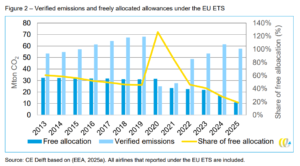
The EU ETS remains on track to meet its target of cutting covered emissions by 62% by 2030 compared with 2005 levels. Separately, the EU aims to reduce its net greenhouse gas emissions by at least 55% by 2030 compared with 1990 and reach climate neutrality by 2050.
These targets create a challenge for policymakers. European industries face pressure to lower emissions while managing energy and production costs. Free permits can offer short-term relief, but too much free allocation may weaken the financial incentive to invest in cleaner processes.
The EU has also been changing its wider carbon market rules. The Carbon Border Adjustment Mechanism (CBAM) is designed to address the risk that some carbon-intensive goods could gain a cost advantage by being produced under less stringent climate rules. The EU’s broader ETS framework also phases down free allocation in certain sectors as the new system develops.
- READ MORE: EU Unveils Biggest Carbon Market Overhaul Yet to Keep Industry Competitive and Net Zero on Track
How More Free Allowances Could Affect Industrial Investment
If adopted, the extra allowances could lower carbon costs for eligible industrial installations during 2026–2030. The impact on each business would depend on its emissions, allocation level, and the market price of allowances.
The proposal also points to a wider policy choice. Governments want European businesses to stay competitive. They also want companies to invest in energy efficiency, electrification, and lower-carbon production.
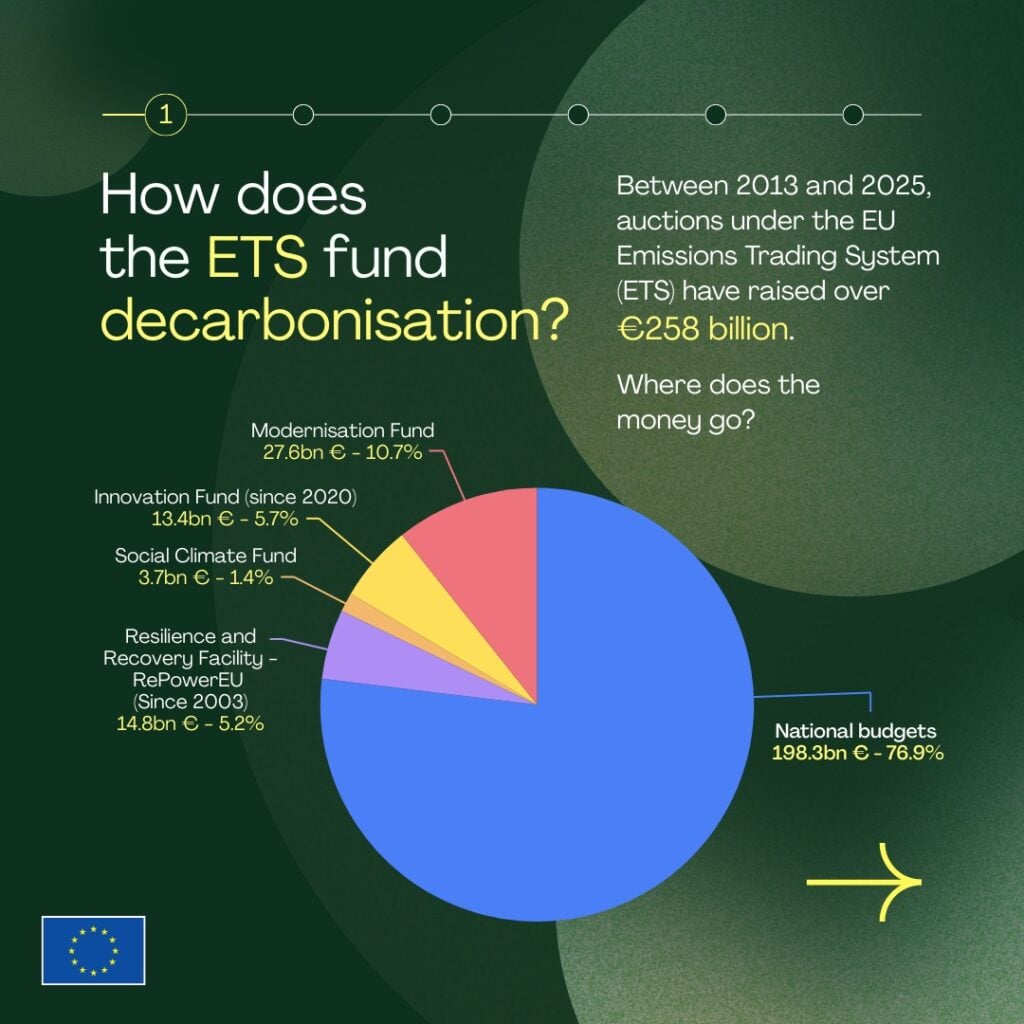
The Innovation Fund and Modernisation Fund are important parts of this effort. EU ETS revenues have helped finance renewable energy, energy efficiency and low-carbon technologies. The European Commission says the system has raised more than €175 billion since 2013.
For companies, free allowances can reduce near-term costs, but they do not remove the need to plan for tighter climate rules. Businesses that improve efficiency and reduce emissions may be better placed to manage future carbon costs as the emissions cap declines.
The Next Test for Europe’s Carbon Market
The next step is for the European Parliament and the Council to reach an agreement on the final rules. The result will show how many allowances can be freely allocated. It will also decide how to split the rest between industry and climate-related funds.
The decision matters beyond the immediate cost relief. The EU is trying to balance industrial competitiveness with a carbon market that continues to reward emissions cuts. Its official data show that covered emissions are falling, while its 2030 and 2050 targets require further progress.
The final design will determine how the EU shares the cost of that transition. More free permits could ease pressure on eligible industries, but the long-term test will be whether the system continues to support investment and deliver emissions reductions.