


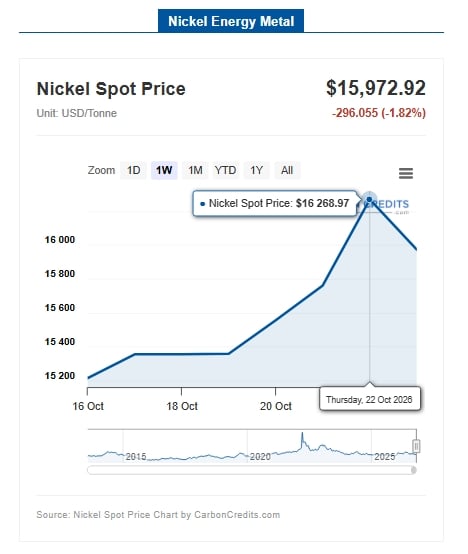
Nickel prices climbed above $16,000 per tonne on the London Metal Exchange (LME) as the prospect of production cuts by Chinese producers in Indonesia raised hopes of tighter supply. The rally marked a fourth consecutive day of gains after prices hit a nine-month low, giving the metal some relief from persistent oversupply concerns.
Nickel rose as much as 2.7% on October 21 before trading 2.1% higher at $16,005 per tonne. The rebound narrowed the metal’s decline for 2026 to less than 4%.
Bloomberg said that the price recovery reflects growing expectations that producers could reduce output to address weak prices and rising operating costs. However, the global nickel market still faces a supply surplus, and the strength of the rally will depend on whether proposed production cuts become actual reductions.
- CHECK: LIVE NICKEL PRICES
Nickel Price Analysis: Why Is the Metal Rising?
The latest rally follows growing speculation that major Chinese nickel producers could coordinate production cuts at their Indonesian operations. These facilities include high-pressure acid leaching (HPAL) plants that produce mixed hydroxide precipitate (MHP), an intermediate material used to manufacture battery chemicals.
Bloomberg further reported that executives from several major Chinese producers are considering potential output curbs. A previous attempt to agree on reductions in August failed to produce a deal.
Market participants are now focusing on the potential scale of the cuts. Gao Yin, an analyst at Shuohe Asset Management, told Bloomberg that the production reductions being discussed in the market were significant.
Production Cuts and Short-Covering Support Nickel Prices
Hopes for lower production have supported nickel prices by raising expectations of tighter supply. Indonesia is the world’s largest nickel producer, so changes in its output can affect global supply and prices.
Short-covering has also helped prices recover, according to Trading Economics. This happens when traders buy back nickel contracts to close bets on falling prices, adding to buying pressure.
However, the rebound does not guarantee a lasting recovery. Prices will depend on Indonesia’s production decisions, stainless steel demand, battery trends, and the growth of new supply.
LME Nickel Price Curve Signals Higher Future Prices
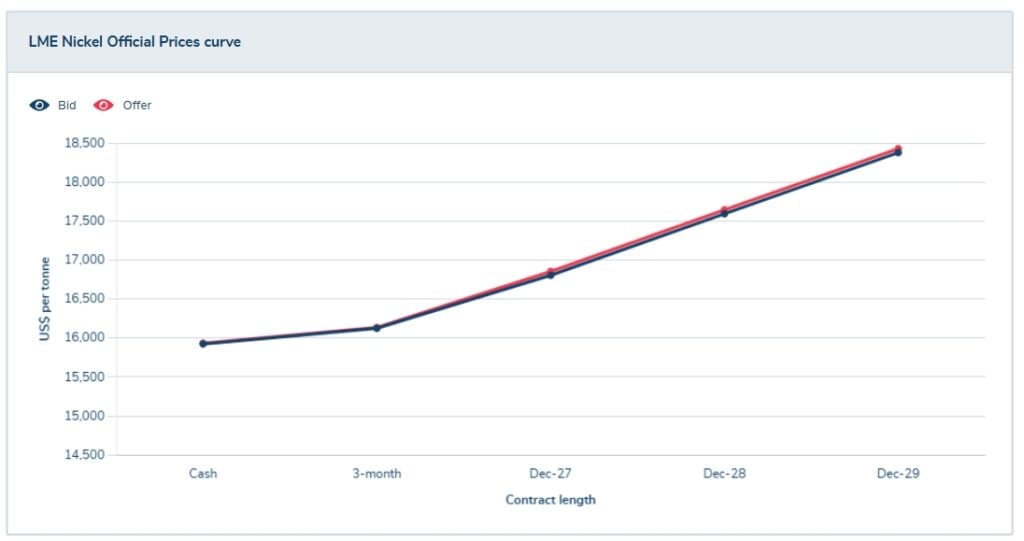
The LME nickel price curve shows that nickel prices are higher for contracts with longer delivery dates. Prices rise from around $15,900 per tonne for immediate delivery to approximately $18,400 per tonne for December 2029.
This upward trend suggests the market expects nickel prices to be higher in the future, although the curve reflects current market pricing rather than a guaranteed forecast.
Indonesia’s Production Cuts Could Tighten Supply
Indonesia’s nickel industry faces pressure from weaker selling prices, rising costs, and tighter mining quotas. These conditions have increased the incentive for producers to reconsider production levels.
Under its annual work plan and budget system, known as RKAB, the country approved a lower nickel ore production quota for 2026 than for 2025. The International Nickel Study Group (INSG) noted that Indonesia’s quota decisions consider supply and demand conditions. Applications for 2027 quotas are due by November 15, 2026.
Weather Disruptions and Weak Production Add to Supply Risks
Weather-related disruptions have added another supply risk. Bloomberg earlier reported that water shortages linked to El Niño forced nickel smelters at the Morowali Industrial Park to reduce nickel pig iron (NPI) production. The potential impact was estimated at 100,000 tonnes.
NPI is a lower-grade nickel product primarily used in stainless steel production. Reduced NPI output could tighten supply in that segment, while potential cuts at HPAL facilities could affect nickel intermediates used in battery manufacturing.
These developments could support prices if they lead to meaningful production losses. However, lower mining quotas and temporary operating disruptions do not automatically translate into a sustained global shortage, particularly when producers continue to expand processing capacity.
- IEA further added that low prices continued to hurt nickel production outside Indonesia, with mined output falling by over 10% and refined production declining by nearly 3%.
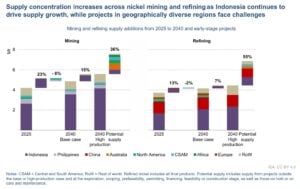
The Northern Miner reported that Chinese-backed projects in Indonesia have expanded capacity for both stainless steel and battery materials, adding to the challenge of balancing supply with demand.
INSG Forecasts Nickel Surplus in 2026 and 2027
Despite the recent price gains, the global nickel market is expected to remain in surplus, according to the INSG’s October outlook.
The intergovernmental group revised its 2026 forecast from a 32,000-tonne deficit in April to a 19,000-tonne surplus. The earlier projection would have marked the first annual supply shortfall since 2021.
The revision reflects stronger expected production growth than previously anticipated. Both supply and demand have increased in the group’s estimates, but production remains slightly ahead of consumption.
The INSG’s latest forecast is explained below in detail:
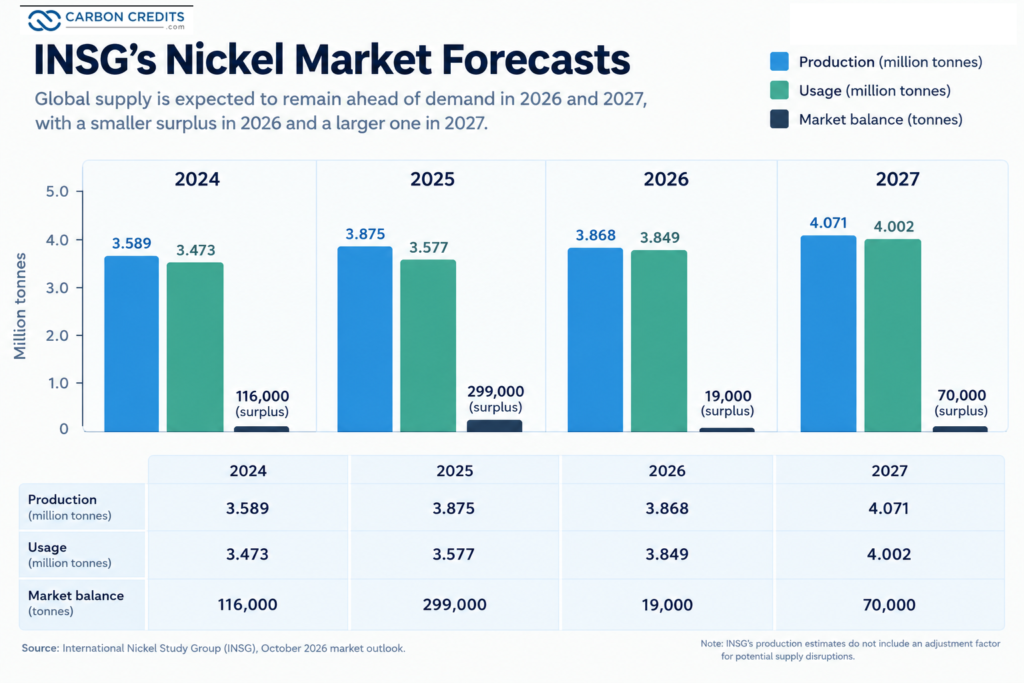
The forecasts suggest that the market surplus will narrow substantially in 2026 before expanding again in 2027. Although this year’s projected surplus is relatively small compared with 2025, it still indicates that expected production exceeds consumption.
The INSG also cautioned that its production estimates do not account for an adjustment factor for potential supply disruptions. Actual output could therefore differ from the forecast.
Stainless Steel and EV Battery Demand Remain Key Drivers
Nickel demand depends heavily on stainless steel manufacturing, with rechargeable batteries providing another important source of consumption.
According to the World Stainless Association, global stainless steel melt shop production increased 5% year over year in the first half of 2026. The INSG expects the sector to expand further in the second half of this year and throughout 2027.
Growth in stainless steel production could help absorb additional nickel supply. However, the outlook for electric vehicle (EV) batteries remains less certain.
IEA Forecast:
The IEA expects batteries to account for 30% of total nickel consumption by 2035, driving nearly two-thirds of demand growth. Demand is likely to come mainly from battery makers outside China, particularly in North America and Europe, where consumers favor long-range electric vehicles (EVs).
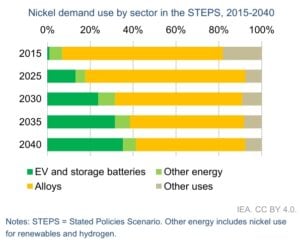
However, the growing adoption of lithium iron phosphate (LFP) batteries, which do not require nickel, could limit battery-grade nickel demand. Nickel-based batteries will remain important for some EV applications, but their adoption rate will influence how quickly new supply is absorbed.
Can Nickel Prices Sustain the Rebound?
Nickel’s rise above $16,000 per tonne shows how prices can react to expected production cuts. However, Indonesia’s producers have yet to agree on the proposed reductions, so actual supply cuts remain uncertain.
The INSG expects a small surplus of 19,000 tonnes in 2026, rising to 70,000 tonnes in 2027. This suggests oversupply risks will persist, especially if battery demand grows more slowly than expected.
For now, nickel prices will depend on actual production cuts, Indonesia’s mining quotas, and demand from stainless steel and battery makers. Without lower supply or stronger demand, the recent rally may be short-lived.
RECENT: Sumitomo Projects 34,000-Ton Nickel Surplus in 2027 Amid Indonesia Output Recovery