


General Motors (NYSE: GM) is investing $550 million in two large-scale solar projects in Michigan as the automaker expands its renewable energy strategy and works to manage rising electricity costs. The projects, developed by NorthStar Clean Energy, will add 300 megawatts (MW) of solar capacity and support GM’s manufacturing operations across the state.
The investment marks GM’s largest clean-energy project to date. It also highlights how major manufacturers are turning to renewable energy to secure more predictable electricity supplies as power demand increases across the United States.
The two facilities, Branch Solar in Branch County and Lake Iris Solar in St. Clair County, will generate an estimated 539,000 megawatt-hours (MWh) of electricity annually. GM will receive 92% of their combined output through a virtual power purchase agreement (VPPA).
According to GM, the projects will generate enough electricity to match the annual consumption of three Michigan manufacturing facilities: Factory ZERO, Flint Assembly, and Lansing Delta Township Assembly. Their combined output is also equivalent to the electricity needs of approximately 52,000 homes.
GM’s $550 Million Solar Investment Will Support Three Manufacturing Plants
NorthStar Clean Energy is developing both solar facilities, with GM serving as their primary customer through a VPPA.
The projects have different investment sizes:
- Branch Solar: Approximately $380 million.
- Lake Iris Solar: Approximately $170 million.
- Combined investment: Approximately $550 million.
Together, the facilities will deliver 300 MW of solar generation capacity, with 92% allocated to GM.
A VPPA allows GM to purchase renewable electricity from the projects through a long-term financial agreement without requiring the company to generate or consume all the electricity directly at its factories. The renewable energy credits (RECs) associated with the projects will help GM account for emissions linked to purchased electricity used in its manufacturing operations.
This arrangement can also help the automaker improve long-term energy cost visibility. By securing renewable energy through long-term agreements, GM can reduce its exposure to fluctuations in conventional electricity and fuel markets.
The move is particularly relevant as electricity demand grows across manufacturing, transportation, artificial intelligence (AI), and other energy-intensive industries.
GM Has Already Matched 100% of Its U.S. Electricity Use With Renewable Energy
The Michigan projects build on another major milestone in GM’s clean energy strategy.
In 2025, the company secured enough renewable energy to match 100% of its electricity consumption across all its U.S. facilities. GM said this achievement made it the first U.S. automaker to reach that milestone.
The company is also making progress in reducing emissions from its operations.
GM reported that it has cut its combined Scope 1 and Scope 2 emissions by 52% since 2018.
Scope 1 emissions come directly from sources owned or controlled by a company, such as manufacturing equipment and industrial processes. Scope 2 emissions come from purchased electricity, heating, and cooling.
By adding renewable energy to its electricity procurement strategy, GM aims to reduce the emissions associated with powering its factories while improving the stability of its energy costs.
U.S. Solar Market Expands as Electricity Demand Rises
GM’s investment comes as solar power gains a larger role in the U.S. electricity market.
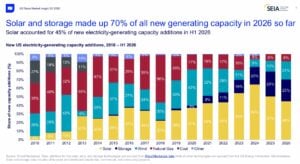
According to Wood Mackenzie and the Solar Energy Industries Association (SEIA), the United States added 11.4 gigawatts (GW) of new solar capacity in the second quarter of 2026. This represented a 45% increase compared with the same period in 2025 and a 43% rise from the first quarter.
Utility-scale solar accounted for most of the growth, adding 9.6 GW of capacity during the quarter, up 61% year over year.
The United States now has enough installed solar capacity to supply electricity equivalent to the needs of more than 50 million homes, representing over one-third of households nationwide.
Wood Mackenzie expects the U.S. solar market to nearly double over the next five years. Its forecast projects annual installations of approximately 44 GW through 2031, supported by a large pipeline of projects.
However, the industry still faces challenges. Permitting delays, grid connection constraints, changing trade policies, and the transition away from federal solar tax incentives could affect future project development.
The broader energy outlook also supports the need for additional renewable power. In its November 2026 Energy Transition Outlook, Wood Mackenzie examined how energy security, electrification, and growing electricity consumption could reshape global energy markets.
The report’s base-case scenario projects solar, wind, and battery capacity increasing by 60% by 2030 and reaching six times current levels by 2060. It also expects global electricity demand to double by 2060, with data center capacity alone projected to double between 2026 and 2030.
Although these are global projections rather than U.S.-specific solar forecasts, they highlight the growing importance of renewable generation and reliable electricity supplies.
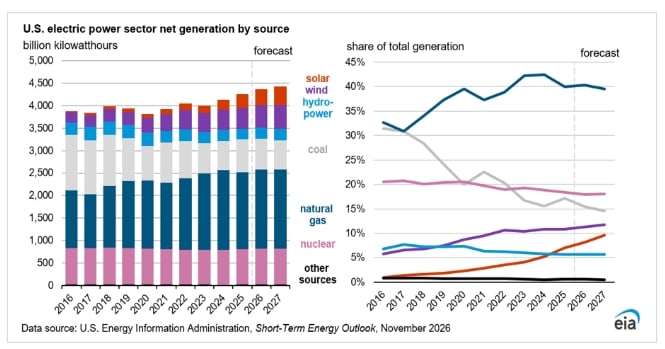
For the United States, the Energy Information Administration’s November 2026 outlook also expects utility-scale solar to provide nearly 10% of total electricity generation in 2027, compared with 7% in 2025.
These trends create a stronger business case for companies like GM to secure renewable electricity for their energy-intensive operations.
Solar Projects Bring Jobs and Environmental Benefits to Michigan
Beyond renewable electricity generation, the two projects are expected to support local employment and community development.
During their development, Branch Solar and Lake Iris together created more than 550 full-time local construction jobs.
The projects also bring direct economic benefits to surrounding communities.
Branch Solar helped Bethel Township secure a $1 million Renewables Ready Communities Award. The funding will support local priorities, including expanding the township hall and improving roads.
Meanwhile, Lake Iris Solar plans to incorporate pollinator habitats across the facility.
The project will use native plants to support local biodiversity and provide habitats for pollinators. These plantings could also reduce long-term maintenance requirements and help improve solar-panel efficiency.
GM is supporting the initiative and sees an opportunity to work with researchers to study the benefits of pollinator habitats and their contribution to local ecosystems.
The automaker also reported that its renewable energy projects have generated nearly $2 billion in economic impact across the United States. These projects support approximately 1,500 construction jobs each year in communities where GM operates.
GM Connects Renewable Energy With Long-Term Business Growth
GM’s latest investment shows how renewable energy is becoming part of corporate energy and cost management strategies.
As manufacturers expand production, electrify operations, and adopt new technologies, their electricity requirements are likely to increase. Securing renewable power through long-term agreements can help businesses manage energy expenses while reducing emissions from purchased electricity.
The Michigan solar projects will strengthen GM’s renewable energy portfolio while supporting local jobs, infrastructure, and biodiversity.
For the U.S. solar industry, investments from large corporate buyers also demonstrate the growing role of private-sector demand in supporting utility-scale renewable energy development.