

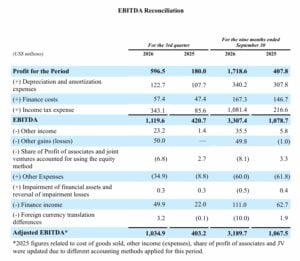
Sociedad Química y Minera de Chile (NYSE: SQM) reported a sharp increase in revenue and profit for the first nine months of 2026, supported by stronger lithium sales, higher realized prices, and growing demand across its major business segments.
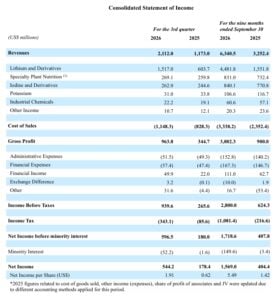
The Chilean mining and chemicals company generated US$6.34 billion in revenue for the nine months ended September 30, 2026, up 95% from US$3.25 billion in the same period last year. Net income climbed 288% to US$1.57 billion, compared with US$404.4 million a year earlier.
Lithium remained the company’s biggest growth driver. Demand from electric vehicles (EVs) and battery energy storage systems (BESS) continues to support the market, even as lithium prices have fallen from their second-quarter 2026 highs.
The latest results highlight the importance of lithium in the global energy transition. As countries expand renewable energy capacity and EV adoption, demand for battery materials is expected to increase. Lithium plays a central role in this shift because it is a key component in rechargeable batteries used in electric vehicles and energy storage systems.
SQM’s Lithium Business Drives Revenue Growth
- For the nine-month period, lithium and derivatives generated US$4.48 billion in revenue, an increase of 188.8% from US$1.55 billion a year earlier. The segment contributed approximately 79% of SQM’s consolidated gross profit, making it the company’s most important business.
The company also increased lithium sales volumes by 28% to 232,300 metric tons during the first nine months of 2026, compared with 181,000 metric tons in the same period last year.
Third-quarter performance was also stronger. Lithium and derivatives revenue reached US$1.52 billion, up 151.3% year over year. Sales volumes increased 8% to 78,900 metric tons.
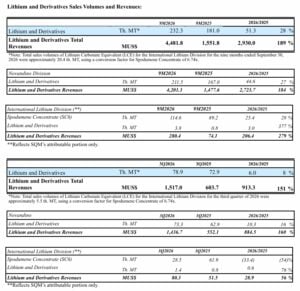
However, higher sales did not mean prices continued to rise. SQM reported that its average realized lithium sales price fell 10% in the third quarter compared with the previous quarter.
- The average price for lithium products from its Chilean operations reached approximately US$19.60 per kilogram, although this was still 123% higher than the third quarter of 2025.
SQM also expects lower average realized lithium prices in the fourth quarter because market prices declined significantly in recent weeks.
This shows the importance of balancing production growth with changing market conditions. Even when demand remains strong, falling lithium prices can affect revenue and profit margins.
EVs and Battery Storage Support Lithium Demand
Despite price fluctuations, SQM remains optimistic about the lithium market. The company expects global lithium demand to grow approximately 30% in 2026. It also believes annual demand could exceed 3 million metric tons by 2030.
Electric vehicles remain a major source of demand. However, the market is expanding beyond passenger cars.
Battery energy storage systems are becoming another important growth driver. These systems store electricity generated from renewable sources such as solar and wind. They can then release power when generation falls or electricity demand increases.
This makes lithium an important material for both transportation electrification and the expansion of renewable energy infrastructure.
- SQM also highlighted growing EV markets outside China. Electric vehicle sales in Europe remain strong, while Chinese vehicle exports are expanding into countries such as South Korea, Brazil, Australia and India.
Another factor is the increasing amount of lithium used in some electric vehicles. Heavy-duty truck electrification could also create additional demand as manufacturers move toward lower-emission transportation.
Together, these developments could support lithium consumption over the coming years, even as the market experiences short-term price volatility.
SQM Expands Lithium Production in Chile and Australia
SQM is also increasing production capacity to meet expected demand growth.
In Chile, its Novandino Division produced approximately 75,000 metric tons of lithium during the third quarter. The company expects production from the Salar de Atacama to reach around 290,000 metric tons for the full year 2026. It plans to increase output to slightly more than 300,000 metric tons in 2027 through operational improvements and better recovery rates.
Meanwhile, SQM is expanding its operations in Australia through the Mount Holland project. The concentrator currently produces approximately 175,000 to 185,000 metric tons of spodumene concentrate annually. Spodumene is a lithium-bearing mineral used to produce battery-grade lithium chemicals.
The company has started expanding the mine and concentrator. This project aims to increase SQM’s attributable production capacity to approximately 350,000 metric tons of spodumene concentrate annually by 2030–2031.
These investments could strengthen SQM’s position in the global lithium supply chain as battery manufacturers and automakers look for reliable sources of raw materials.
Other Business Segments Deliver Mixed Results
Although lithium led growth, SQM also reported progress in its other businesses.
Its iodine and derivatives segment generated US$840.1 million in revenue during the first nine months of 2026, up 9% year over year. Demand from X-ray contrast media continued to support sales. The company expects global iodine demand to grow by more than 3% in 2027.
Specialty Plant Nutrition revenue increased 13.5% to US$831 million. However, higher fertilizer prices affected purchasing activity. SQM lowered its full-year 2026 sales volume growth forecast for this segment to approximately 5%, down from its earlier estimate of 10%.
The company’s potassium business faced additional pressure. Sales volumes declined 29% in the third quarter as SQM gradually shifted operations at the Salar de Atacama toward lithium extraction.
This shift highlights how lithium is becoming increasingly important to the company’s long-term business strategy.
What SQM’s Results Mean for the Lithium Market
SQM’s latest results reflect two important trends in the battery materials industry. First, lithium demand continues to expand beyond electric vehicles as battery storage becomes more important for renewable energy systems. Second, producers are investing in additional capacity to prepare for future consumption.
However, price volatility remains a challenge. Lower lithium prices could affect profitability and investment decisions, particularly for higher-cost producers.
For SQM, expanding production in Chile and Australia while improving operational efficiency could help it capture future market opportunities. Its strong nine-month financial performance also provides a solid foundation for its expansion plans.
As the global energy transition progresses, lithium will remain an important material for EV batteries, renewable energy storage and other electrification technologies. SQM’s production strategy puts the company in a position to benefit from this growing market, although its future earnings will continue to depend on lithium prices, supply growth and global demand.