


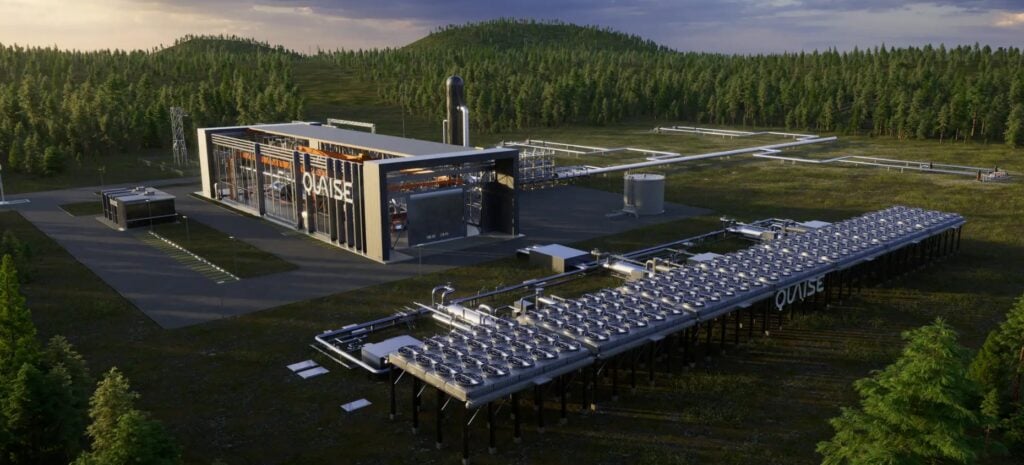
Google is expanding its clean energy portfolio with a new 50-megawatt (MW) geothermal power purchase agreement (PPA) with Quaise Energy. The deal will support the development of Project Obsidian, a next-generation geothermal power project in Central Oregon. It aims to deliver reliable, carbon-free electricity to Google’s data centers and nearby communities starting as early as 2030.
The agreement marks an important step toward commercial-scale superhot geothermal energy in the United States. Unlike conventional geothermal facilities, which depend on naturally occurring underground reservoirs of hot water, this technology aims to access much deeper and hotter underground resources.
As electricity demand rises with the growth of artificial intelligence (AI) and cloud computing, Google is looking for clean energy sources that can operate around the clock. Its partnership with Quaise adds another emerging technology to that strategy.
Google to Buy 50 MW of Geothermal Power From Quaise Energy
The first development phase will use conventional drilling equipment to reach superhot geothermal conditions and generate electricity at commercial scale. In the second phase, Quaise plans to introduce its millimeter-wave drilling technology.
Developed from research at the Massachusetts Institute of Technology (MIT), this technology uses high-powered millimeter waves to vaporize extremely hard underground rock. It aims to make deeper geothermal resources accessible without relying entirely on conventional mechanical drilling.
Quaise estimates that superhot geothermal systems could generate up to 10 times more clean electricity per well than traditional geothermal systems. Higher underground temperatures can produce more energy from individual wells, potentially improving project economics.
Project Obsidian could also bring economic benefits to Central Oregon. Quaise expects the development to create 200 to 400 construction jobs and more than 50 permanent skilled positions in engineering and operations.
The project will also support local grid upgrades and provide additional electricity to nearby communities. Google already operates three data center campuses in The Dalles, Oregon, with an 83% carbon-free energy share.
Google’s Clean Energy Investments Continue to Grow
The new geothermal agreement builds on Google’s expanding clean energy procurement strategy.
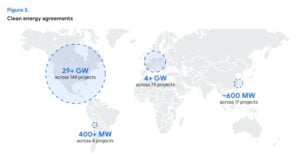
According to its 2026 Environmental Report, Google signed more than 240 agreements between 2010 and 2025 to purchase nearly 35 gigawatts (GW) of new clean energy. The company contracted more than 12 GW in 2025 alone, its largest annual procurement to date.
North America represents the largest portion of this portfolio, with more than 29 GW across 148 projects. Google also has over 4 GW of contracted clean energy in Europe, more than 400 MW in Latin America, and nearly 600 MW in Asia-Pacific.
Importantly, Google is moving beyond traditional solar and wind procurement. It is investing in technologies that can provide electricity when weather-dependent renewable sources generate less power.
Some of its major clean energy initiatives include:
- Nuclear power: Google supported the planned restart of Iowa’s Duane Arnold Energy Center, securing 600 MW of nuclear electricity.
- Hydropower: The company established a framework agreement to deliver up to 3,000 MW of hydropower across the PJM and MISO electricity markets.
- Enhanced geothermal: Google secured regulatory approval for 115 MW of enhanced geothermal power in Nevada.
- Solar energy: The company expanded its solar procurement in markets such as Japan and Malaysia.
Google also reported that its operational emissions declined by 2% in 2025 despite a 37% annual increase in electricity demand. Its efficiency improvements and clean energy procurement initiatives collectively avoided more than 58 million metric tons of carbon dioxide equivalent (tCO2e) across its operations and supply chain.
These investments support Google’s ambition to match its electricity consumption with carbon-free energy every hour of every day.
EIA 2026 Data Shows US Geothermal Energy Has Significant Growth Potential
Geothermal energy remains a relatively small part of the US electricity mix. However, newer drilling technologies could help the industry expand beyond its traditional western markets.
According to the US Energy Information Administration (EIA), geothermal power plants generated approximately 16 billion kilowatt-hours (kWh) of electricity in 2025. This accounted for about 0.4% of total US utility-scale electricity generation.
The latest EIA data, published in February 2026, shows that the country had approximately 2.7 GW of conventional geothermal summer generating capacity. Seven states produced geothermal electricity in 2025, with California accounting for 68.6% of national geothermal generation. Nevada followed with 24.7%.
The analysis also highlights the potential of enhanced geothermal systems (EGS). These systems use techniques such as horizontal drilling and hydraulic stimulation to create underground reservoirs where natural geothermal resources are limited.
The US Geological Survey estimates that the Great Basin region alone has approximately 135 GW of potential EGS electricity-generation capacity.
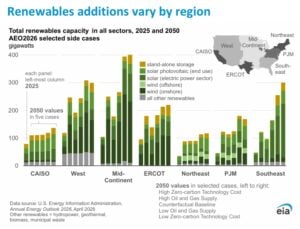
However, the EIA’s April 2026 Annual Energy Outlook presents a more conservative forecast. It projects geothermal generation capacity of approximately 7 GW to 9 GW by 2050, supplying around 1% of total US electricity generation. The agency notes that advances in enhanced geothermal technology could support additional growth beyond this outlook.
This difference highlights the opportunity as well as the uncertainty surrounding next-generation geothermal development.
Rising Data Center Demand Creates Opportunities for Geothermal Power
The US electricity market is facing growing demand from AI infrastructure, cloud computing, manufacturing, and electrification.
- The EIA’s 2026 Annual Energy Outlook projects that electricity consumed by data center servers alone could reach between 446 billion and 818 billion kWh by 2050, depending on the scenario.
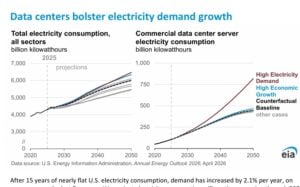
This creates an opportunity for geothermal developers. Solar and wind can supply large amounts of clean electricity, but their output changes with weather conditions. Geothermal plants can provide continuous power throughout the day and across seasons.
For technology companies, this reliability makes geothermal an attractive addition to renewable energy portfolios.
Google’s agreement with Quaise is particularly important because it gives an emerging geothermal developer a major corporate power buyer. It also provides a commercial pathway for technology that has yet to reach widespread deployment.
Can Quaise Make Superhot Geothermal Commercially Viable?
The 50 MW agreement represents a significant milestone, but commercial success will depend on execution. Drilling at extreme depths and temperatures presents technical challenges. High upfront costs, well performance, equipment reliability, and underground conditions will also influence project economics.
Project Obsidian’s initial development phase will help demonstrate whether superhot geothermal can deliver reliable electricity at commercial scale.
If successful, the technology could unlock geothermal resources in regions that lack conventional underground reservoirs. It could also create new opportunities for utilities, data center operators, and industrial power buyers.
For Google, the partnership is another step toward securing reliable, carbon-free electricity as its energy needs grow. For the US geothermal industry, it could help move next-generation geothermal power closer to mainstream commercial deployment.