


The United States is increasing support for its oil and natural gas industry. The U.S. Department of Energy (DOE) has announced up to $65.5 million in federal funding. This funding aims to improve production, reduce waste, and modernize energy infrastructure.
This investment comes as the U.S. remains the world’s largest producer of oil and liquefied natural gas (LNG).
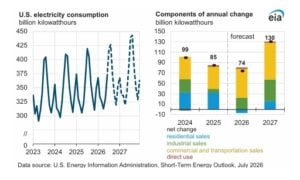
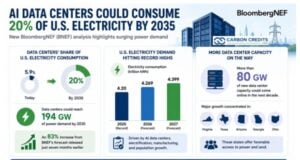
The U.S. Energy Information Administration (EIA) predicts record power usage by 2026, driven by AI data centers and manufacturing. Natural gas provides about 40% of U.S. electricity, while oil fuels most transportation. To meet growing energy needs, enhancing oil and gas infrastructure is essential for affordable and reliable energy.
DOE Targets Efficiency Across the Oil and Gas Value Chain
This announcement follows a $150 million DOE funding opportunity earlier this year.
That program focused on improving oil recovery from unconventional reservoirs and advancing hydraulic fracturing technologies. Together, these funding programs show ongoing federal support for enhancing domestic fossil fuel production.
DOE Under Secretary Kyle Haustveit noted that this investment reflects the Trump administration’s commitment to strengthening America’s energy sector.
And the new funding will focus on three main areas:
Turning Stranded Resources into Valuable Products
Many wells produce natural gas that can’t be transported because of limited pipeline capacity or impurities. Sometimes, producers flare or vent this gas instead of selling it.
The DOE wants to fund technologies that convert these stranded resources into higher-value products that are easier to market. Projects may include advanced catalysts and improved on-site gas processing technologies.
Building More Reliable Energy Infrastructure
The second focus area aims to enhance the durability of U.S. energy infrastructure.
Projects will develop advanced materials, coatings, and pipelines to reduce failures, prevent losses, and strengthen domestic manufacturing. These improvements can boost safety and lower maintenance costs across facilities.
Using Artificial Intelligence and Digital Technologies
The DOE also seeks to speed up digitalization in the oil and gas sectors.
The agency invites proposals that use artificial intelligence, digital twins, and continuous monitoring systems to optimize production and infrastructure. Field testing will help companies validate new technologies in real conditions before broader use.
U.S. Natural Gas Production Continues to Break Records
The DOE announcement comes as the U.S. remains the world’s largest natural gas producer.
- According to the EIA, dry natural gas production is expected to average 111 billion cubic feet per day (Bcf/d) in 2026, surpassing last year’s record.
- Domestic consumption is projected to stay high. LNG exports are expected to reach around 17.2 Bcf/d, up from 15.1 Bcf/d in 2025.
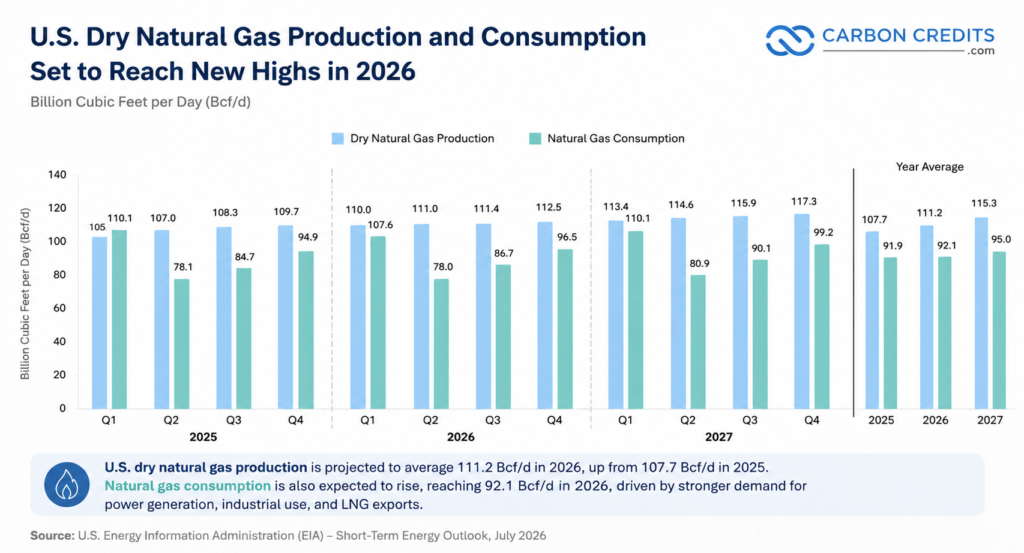
- Growing LNG export capacity supports global energy security. In April 2026, the U.S. exported 17.9 Bcf/d of LNG, contributing to total natural gas exports of 807.5 Bcf for the month. Export value is further set to hit 18.6 bcfd in 2027.
However, international markets remain volatile.
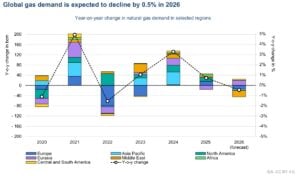
The International Energy Agency (IEA) recently noted that global gas demand might decline slightly in 2026 due to higher prices and supply disruptions. Geopolitical tensions also add uncertainty for LNG markets.
For U.S. producers, these conditions present both challenges and opportunities. Higher exports can boost revenues, but fluctuating global prices make efficiency vital.
Oil Markets Remain Under Pressure
The oil market is also experiencing significant volatility.
According to the IEA’s July Oil Market Report, global oil demand is recovering after a slowdown earlier this year. Demand is expected to strengthen in the second half of 2026 as transportation fuel use improves. Meanwhile, global oil supply has rebounded after earlier disruptions in the Middle East.
- The EIA expects crude oil inventories to gradually build, putting downward pressure on prices. Its latest forecast predicts Brent crude prices averaging around $65 per barrel in 2027.
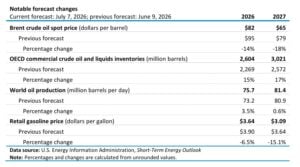
The U.S. remains the world’s largest crude oil producer, mainly due to shale production from the Permian Basin. Even with price fluctuations, producers are investing in technologies that improve recovery rates and lower costs.
Why the New Funding Matters?
Rather than just promoting more drilling, the DOE’s new funding focuses on maximizing energy from existing assets.
Recovering stranded natural gas, minimizing equipment failures, and improving efficiency can boost production while lowering costs. Many of these technologies also help reduce emissions by cutting flaring and leaks.
Digital technologies could play a bigger role. AI monitoring systems can detect failures early. Digital twins allow operators to simulate scenarios and optimize performance.
These improvements are increasingly important as electricity demand rises from AI data centers and industrial growth.
Looking Ahead
America’s oil and natural gas industry remains vital to the country’s energy system, even with rapid growth in renewables.
The DOE’s $65.5 million funding shows a plan to boost existing infrastructure. This investment will improve operations and technologies. The goal is to get more value from current resources. The department wants to enhance U.S. energy security and support economic growth.
As domestic production reaches new highs and LNG exports rise, innovations that boost efficiency and cut waste may be just as important as finding new oil and gas resources.