

Mars, the global company behind famous brands like M&M’s, Snickers, and Pedigree, has announced a major new initiative: a $250 million Sustainability Investment Fund. The fund supports innovations in agriculture, ingredients, and packaging. It focuses on areas that have the biggest impact on Mars’ environmental footprint and carbon emissions.
Mars is also working on its climate goals through the “Sustainable in a Generation” plan. The aim is to cut emissions in half by 2030 and reach net zero by 2050. Here’s how the fund fits into Mars’s sustainability journey—and why it matters for the food and consumer goods sector.
Why Mars Is Betting Big on Sustainability
Mars has tied up to 2,000 senior leaders’ compensation to emission reductions, showing strong internal accountability. But much of its carbon footprint—over 70%—comes from purchased goods and services like farming, animal feed, and materials.
Thus, the new fund will invest in the following areas to address those emission sources:
- Advanced Agriculture,
- Innovative Ingredients, and
- Next‑Gen Packaging
These focus areas target Mars’s main emissions hotspots. They aim to speed up solutions that go beyond traditional carbon offsets.
Here is how the fund will drive systemic change in the company’s quest for sustainability.
Modern Farming Practices
Mars will provide digital tools for farmers. These tools will help track fertilizer use, monitor soil health, and boost yields. They will also aid in reducing emissions. Remote sensing and satellites will help fight deforestation. They also improve traceability, which is important for sourcing ingredients.
Low‑Carbon Ingredients
The fund will finance innovation in plant-based proteins and raw materials. Shifting from animal-based inputs can significantly reduce emissions, water use, and supply‑chain risk.
Circular Packaging
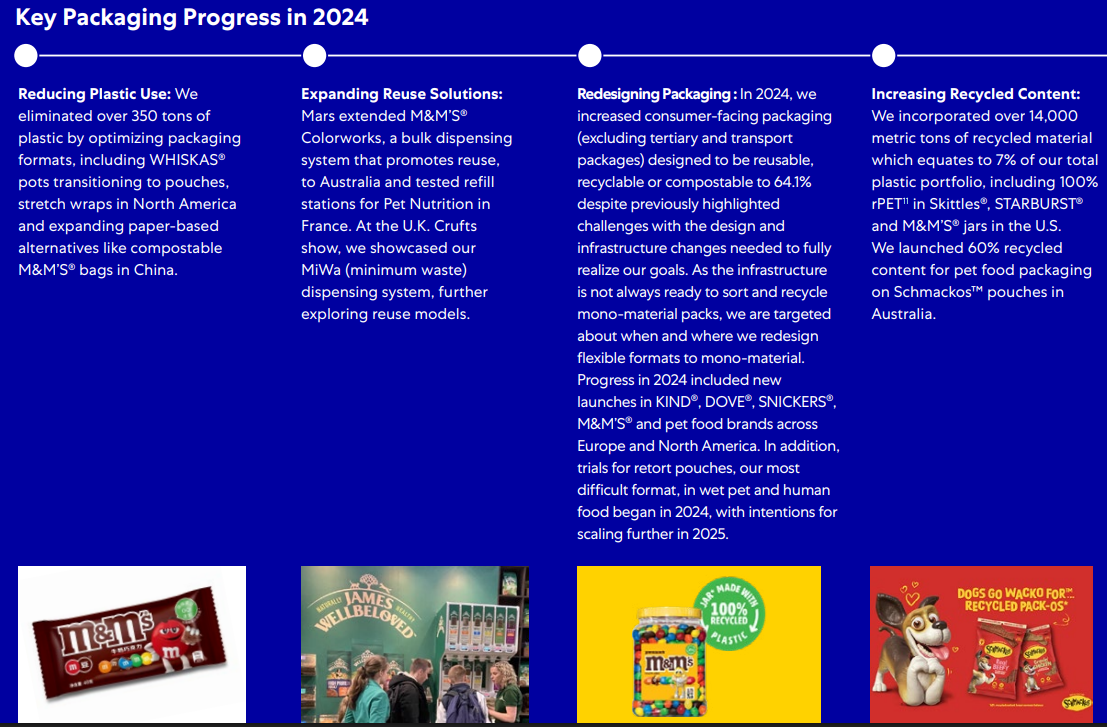
Packaging improvements include replacing flexible plastics with compostable or recyclable alternatives. Mars has already achieved meaningful shifts and now seeks to support emerging materials at scale.
All these help the company advance its path to net zero by 2050.

A Net-Zero Game Plan Backed by Real Numbers
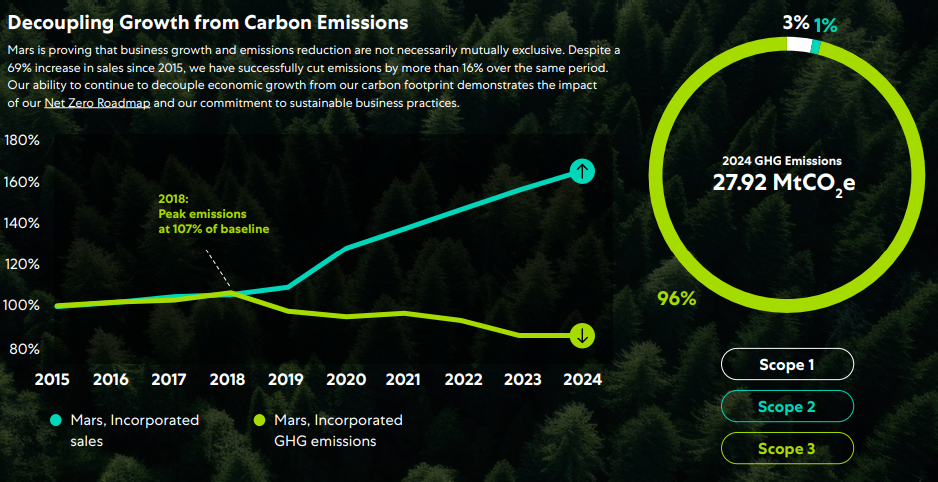
Mars has made strides in its emission reduction and net-zero goals. It cut greenhouse gas emissions by 16.4% since 2015. At the same time, revenue rose by 69%, hitting $55 billion in 2024. That includes a 1.9% drop in 2024 alone, as seen in the chart below.
By 2030, Mars aims to cut emissions by 50% throughout its entire value chain—Scopes 1, 2, and 3. The company will also integrate sustainability into executive performance.
The company also achieved several milestones in its net-zero journey, including:
- Transitioned 58% of its operations to renewable electricity, aiming for 100% by 2040.
- Made 64% of consumer packaging recyclable, reusable, or compostable.
- Launched climate-smart agriculture projects in 29 countries, across 60+ partnerships, including protecting 8,000 ha of forest in palm oil supply chains.
CEO Poul Weihrauch said during the launch of the sustainability investment fund,
“I’m pleased to see our continued ability to decouple our business growth from our carbon footprint while simultaneously investing in innovation and getting behind start-ups that will be creating new solutions and advance breakthroughs to help companies address resilience challenges. These are important areas to make meaningful progress in helping us to reduce exposure to future environmental risks, and eventually, turn it into profit and competitive advantage.”
This change marks a major step in blending scale with sustainability. Moreover, the company is buying high-quality carbon removal credits to offset emissions it cannot eliminate directly. These credits support carbon-neutral products like the Mars Bar. They help projects that remove CO₂ from the air, like reforestation and soil carbon efforts. The credits are verified by trusted standards, including the Gold Standard and Verra.
Mars views carbon removals as a key tool in its Net Zero by 2050 strategy. This is especially true for tough sectors like agriculture. The company invests in projects like the €150 million Livelihoods Carbon Fund 3. This fund supports nature-based carbon removal and helps develop communities.
Beyond Carbon: Mars’s Broader ESG Mission
Mars goes beyond carbon. Its reef restoration initiative has received over $10 million since 2020, deploying innovative “Reef Stars” in 12 countries to boost coral recovery.
The company also works on water stewardship and farmer livelihoods, aiming to help 30% of suppliers earn a living income by 2027. Some rice projects in Thailand increased yields by up to 43% while cutting water use by over 40%.
More notably, Mars ties 20% of executive pay to emissions progress. This makes sustainability a key part of its corporate culture.
Market Momentum Meets Mission-Driven Investment
Mars’s Sustainability Fund comes at a time when global demand for sustainable solutions is rapidly growing. The sustainable packaging market, a key focus area for Mars, is experiencing significant expansion. The market is expected to rise from $292.7 billion in 2024 to USD 423.6 billion by 2029, growing at a compound annual rate of 7.7%.
Additionally, over 54% of U.S. consumers now choose eco-friendly packaging. Also, 90% prefer brands that use it. Mars’s move towards sustainable materials matches what consumers want and where the market is heading.
The fund also taps into expanding carbon credit markets, particularly in agriculture, forestry, and land use (AFOLU). The market could rise from $5.8 billion in 2024 to $7.5 billion in 2025. This shows a nearly 29% annual growth rate. By 2029, it could hit $20.8 billion.

Carbon farming—which aligns with Mars’s agricultural footprint—could generate as much as $13.7 billion in credits annually by 2050. These trends suggest that innovative ag-focused investments may yield strong returns while advancing climate impact.
On the broader carbon removal front, the market is set to rise from about $733 million in 2024 to nearly $2.85 billion by 2034. This shows a projected growth rate of 14.5% each year. As Mars supports sustainable farming and packaging technologies, these markets offer both environmental value and long-term economic opportunity.
Why This Matters to Industry and Investors
Mars is a major player in food and pet care, including snack favorites and pet nutrition. Its investments set sector-wide signals on value-chain decarbonization, sustainable sourcing, and packaging evolution.
The fund’s 250 million-dollar commitment matches the scale already seen in clean agriculture and materials innovation. It provides early funding for innovative solutions. This way, it links financial success to environmental performance.
Investors should note Mars’s strong execution: a 16% emissions cut amid significant growth shows ambitious goals are feasible.
Mars’s Sustainability Investment Fund marks a strategic leap beyond internal emissions cuts. It tackles systemic issues—agriculture, packaging, ingredients—using innovative solutions.
As consumer goods and agriculture industries face climate pressures, Mars offers a model of responsible leadership. It funds future technologies and places sustainability at its core. This shows that profitable growth and caring for the planet can go hand-in-hand.