

Frontier, a group that includes big tech names like Google and Meta, just made a huge deal with Arbor. Arbor is a next-gen startup focused on bioenergy with carbon capture (BECCS). This pact signals a turning point in how carbon removal projects can support both climate goals and clean power needs.
Here’s what makes it significant, and why investors and industry watchers are paying attention.
Frontier’s $41M Vote of Confidence in Arbor’s Carbon Tech
Frontier, an advanced market commitment supported by companies like Google, Meta, Shopify, Stripe, and McKinsey, has made a key carbon removal deal with Arbor, a BECCS startup. Under the deal, Frontier will purchase 116,000 tons of durable CO₂ removal credits from Arbor’s future facility between 2028 and 2030.
The deal is worth $41 million. It is Arbor’s biggest offtake contract yet. Also, it’s one of the most important carbon credit deals using BECCS technology to date.
Arbor’s first commercial-scale plant will generate carbon removal credits. It will be near Lake Charles, Louisiana. This site was selected because it has access to sustainable biomass and skilled labor. It also has CO₂ transportation and storage systems in place.
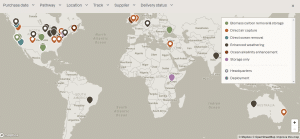
Construction of the plant is expected to begin in the next two years, with full operations planned for 2028. The deal features long-term commitments from various buyers in the Frontier coalition. This includes tech giants and climate-friendly brands like H&M, along with enterprise software leader Autodesk. The group has the following projects.
Offtake agreements give Arbor the financial support it needs. This helps them go from pilot operations to full-scale deployment. It also bridges the “valley of death” that often slows clean tech startups during scaling.
This commitment shows that buyers are more confident in new carbon removal technologies. It also highlights a shift in the industry. Now, companies want to invest in permanent carbon removal alongside nature-based offsets. It also sets a standard for future Frontier purchases.
Hannah Bebbington, head of deployment at Frontier, remarked:
“As we are thinking about carbon removal demand and where our electricity generation is going to come from, and how we are going to ensure that we are powering this [AI] boom as cleanly and efficiently as possible, Arbor really fits the bill.”
Turning Plant Waste into Climate Wins: Arbor’s Biomass Breakthrough
At the heart of this deal is Arbor’s innovative approach to bioenergy with carbon capture and storage. Unlike traditional BECCS plants that rely on large, centralized facilities, Arbor uses a compact, modular system. This technology turns low-grade organic waste, like forest residues and agricultural byproducts, into gas. It burns this gas with oxy-combustion, which uses pure oxygen.
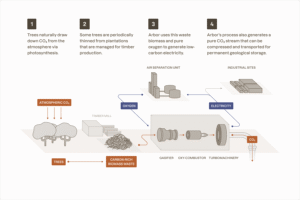
Such a carbon capture method helps achieve nearly complete combustion. The result is a high-purity stream of supercritical CO₂, more than 99% of which is captured and stored underground.
Arbor’s method stands out because it has dual functionality. First, it captures CO₂ and then, it uses that CO₂ to power an 18 MW turbine. This turbine produces a lot of clean electricity and also verifies carbon removals.
For each ton of CO₂ removed, the system can generate up to 1,000 kilowatt-hours (kWh) of electricity. That’s enough to power an average U.S. household for about a month.
Remarkably, Arbor’s plants are carbon-negative and energy-positive. They can provide 24/7 baseload power for energy-heavy sectors like data centers and AI infrastructure.
Moreover, Arbor’s modular units use technology inspired by rocket engines. This makes them scalable and cost-effective. They can be deployed in many different locations.
Each unit is self-contained and portable. With these, Arbor can avoid many permitting and infrastructure issues that come with centralized BECCS facilities. The system also doesn’t release particulate matter, NOx, or other pollutants. This tackles a big issue with biomass burning.
This architecture creates a new path in clean energy. It combines carbon removal, power generation, and industrial decarbonization all in one platform. Arbor’s model provides a strong solution for sectors aiming for net-zero goals and growing energy needs.
Broader Carbon Removal and Power Trends
BECCS is emerging as a top carbon removal method due to its scalability and dual benefits—carbon removal plus power generation. The International Energy Agency estimates that carbon capture from biogenic sources could hit 60 million tons per year by 2030. However, currently operational and planned BECCS capacity are not on track toward net zero. The world needs about 185 million tons to meet net-zero goals.

In 2024, the carbon removal market grew 59% to $3.34 billion, with BECCS accounting for most of the volume. Early adopter deals—like those between Microsoft and Stockholm Exergi—have already proven this model works.
Frontier’s purchase adds to a recent deal. In March, they teamed up with Eion for 78,707 tons of CO₂ removal using enhanced rock weathering. Arbor’s BECCS deal, larger and combined with clean electricity, shows how carbon credits can deliver powerful co-benefits.
Why This Deal Matters: How Frontier Is Scaling Carbon Removal
This Frontier-Arbor carbon credit deal is significant for the following reasons:
Dual Impact: Carbon Removal + Clean Power
The agreement showcases a new generation of climate solutions that pair carbon removal with dependable clean energy. Arbor’s system captures over 99% of CO₂ and generates electricity around the clock. This helps meet the rising energy demand from AI and data centers. This dependable energy source helps keep the grid stable and cuts emissions.
Scaling Up Carbon Markets
In 2024, BECCS accounted for nearly 90% of all carbon removal credits sold. Arbor’s high-quality approach sets a strong benchmark for permanence, verifiability, and climate benefit. By backing projects like this, Frontier is helping the voluntary carbon market shift away from less reliable offsets toward more impactful, long-term removal solutions.
Financing Commercial Deployment
Frontier’s $41 million advance purchase agreement gives Arbor the financial stability to build its first commercial-scale plant. These offtake deals function like power purchase agreements, helping startups bridge funding gaps and scale faster.
Meeting Tech Sector Needs
Big tech firms need clean, consistent energy to power AI-driven infrastructure. Arbor delivers both emissions removal and baseload electricity—meeting growing expectations for climate-aligned digital operations.
If Arbor delivers as promised, it may reduce the captured CO₂ price to below $100/ton, a critical threshold for scalable removal. Frontier’s $41 million deal with Arbor’s BECCS-based carbon credits sets a milestone in building a high-integrity market for dual-purpose projects, offering carbon removal and clean power.
The startup’s innovative oxy-combustion turbine and modular approach offer scalable potential. If successful, this model may transform carbon markets and the energy systems needed to support growing digital infrastructure.