


McDonald’s has admitted it will likely miss one of its major climate goals, showing how difficult supply chain decarbonization has become for global food companies. The food chain giant said it no longer expects to meet its target of cutting value chain emissions by 2030. Still, McDonald’s says it remains committed to reaching net-zero emissions across its operations and supply chain by 2050.
The update matters because McDonald’s is one of the world’s largest restaurant companies. It operates more than 43,000 restaurants in over 100 countries and serves around 70 million customers every day.
The food industry closely watches the company’s climate progress, where reducing emissions from agriculture and livestock is still difficult. McDonald’s states that inflation, new regulations, and tech limits have slowed progress to its 2030 goal. The size of its global supply chain also plays a role.
The company wrote:
“We still maintain a long-term ambition: net zero emissions by 2050. We know this depends on many external variables—the changes required to reduce Scope 3 emissions are largely systemic and interconnected across the value chain. Given these realities, we face significant challenges, and at this point, we do not expect to reach our 2030 Scope 3 goal on the original timeline.”
Supply Chain Emissions Remain McDonald’s Biggest Climate Challenge
McDonald’s says most of its emissions come from its supply chain rather than from restaurant operations. The company previously pledged to:
- Cut Scope 1 and 2 emissions by 50.4% by 2030
- Reduce Scope 3 energy and industrial emissions by 50.4% by 2030
- Cut Scope 3 forest, land, and agriculture (FLAG) emissions by 16% by 2030
- Reach net zero across the business by 2050
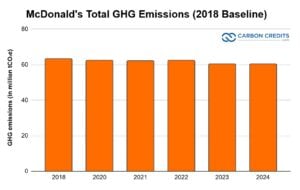
McDonald’s reported total greenhouse gas emissions of about 60.5 million metric tonnes of CO₂e in 2024. This is a decrease from around 63.3 million tonnes in 2018.
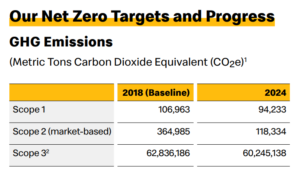
The company’s direct operational emissions improved. Scope 1 emissions dropped to 94,233 tonnes CO₂e in 2024, down from the 2018 level. Market-based Scope 2 emissions also declined sharply to 118,334 tonnes, compared with the baseline year.
However, Scope 3 emissions, mostly from agriculture, packaging, logistics, and franchises, made up around 60.2 million tonnes CO₂e of McDonald’s climate footprint in 2024. These supply chain emissions remain the company’s biggest challenge as it works toward its long-term net-zero target.
Food Systems Face Rising Pressure to Cut Emissions
McDonald’s reflects a broader challenge facing the global food sector. The United Nations Food and Agriculture Organization estimates that food systems produce about one-third of global greenhouse gas emissions.
Livestock production is a big contributor to greenhouse gases. Cattle release methane, which is much stronger than carbon dioxide in the short term.
At the same time, global meat demand continues rising. The OECD and FAO predict that global meat consumption will continue to rise over the next ten years. This growth will be especially strong in emerging economies.
This creates a difficult balance for food companies. Consumer demand for beef is strong. However, investors, regulators, and governments want companies to cut emissions.
Many food companies now face pressure to improve:
- Methane reduction,
- Forest protection,
- Packaging sustainability,
- Renewable energy use, and
- Agricultural supply chains.
However, changing large global supply systems takes years and often requires cooperation from farmers, suppliers, franchisees, and logistics operators. Amid all these, McDonald’s focuses on cutting emissions from its operations.
McDonald’s Expands Renewable Energy and Low-Carbon Operations
Even as its supply chain target slips, McDonald’s continues investing heavily in climate action across restaurants, sourcing, and logistics. The company is committed to reaching net zero by 2050. It also aligns its climate goals with the Science Based Targets initiative (SBTi).
The food chain giant states that restaurant operations are a key focus. This is because energy use, refrigeration, and cooking systems create significant emissions.
McDonald’s total GHG emissions have remained largely flat over 2020–2024 at roughly 60–62 million metric tons of CO₂e. It was able to cut emissions down by around 4.5% in 2024 compared with 2018 levels.
The company continues upgrading restaurants with energy-efficient kitchen equipment, LED lighting, smart energy systems, and lower-emission refrigerants. It keeps growing renewable electricity sources through virtual power purchase agreements and renewable energy certificates.
According to the report, McDonald’s now tracks emissions using millions of operational and supply-chain data points across sourcing, logistics, and restaurants. The company says these systems help identify emission hotspots and improve supplier accountability.
Transportation and logistics are also part of the company’s climate strategy. McDonald’s says suppliers are reducing fuel use through these means:
- route optimization,
- engineless refrigerated trailers,
- driver efficiency programs, and
- alternative fuels, including renewable natural gas, electricity, hydrogen, propane, and biofuels.
The company also continues pushing sustainability standards deeper into its supply chain. McDonald’s works with suppliers and farmers on several key areas. They focus on regenerative agriculture, forest protection, and reducing methane from beef and dairy. These practices help address emissions, which are significant for the company.
Packaging remains another major initiative. McDonald’s reports that more than 90% of guest packaging materials now come from renewable, recycled, or certified sources. The company also continues efforts to reduce packaging waste and increase the use of recycled materials globally.
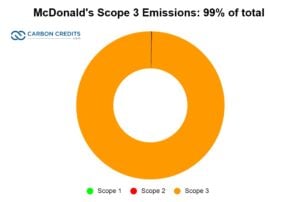
McDonald’s highlights that engaging suppliers is crucial. About 99% of its total emissions come from Scope 3 sources. These include agriculture, packaging, transportation, and franchise operations. The company added that long-term progress will depend heavily on how quickly lower-carbon technologies and farming systems scale globally.
Methane Reduction and Regenerative Agriculture Become Critical
Methane reduction now plays a central role in food-sector climate plans. The United Nations Environment Programme says methane has more than 80 times the warming power of CO₂ over 20 years.
Because beef remains one of McDonald’s largest emissions sources, the company increasingly focuses on lower-carbon farming practices. These include improved grazing systems, feed efficiency, manure management, and regenerative agriculture.
McDonald’s says it aims to scale regenerative agriculture practices across its supply chain to improve climate resilience and help reduce emissions.
Still, experts say large-scale adoption remains difficult because farmers often face high upfront costs and uncertain financial returns.
Investors Want More Than Net-Zero Promises
McDonald’s update comes as investors increasingly question whether companies can meet aggressive climate targets.
Over the last several years, many global companies have announced net-zero commitments tied to 2030 and 2050 timelines. However, supply chain emissions continue to challenge sectors such as food, aviation, shipping, and heavy industry.
Regulators are also increasing disclosure requirements.
Europe’s Corporate Sustainability Reporting Directive (CSRD) expands climate reporting rules for large companies. California also passed laws that will require many firms to disclose Scope 3 emissions later this decade.
Companies now compete not just on products and prices. They also focus on emissions performance and supply chain transparency.
McDonald’s Net-Zero Journey Is Entering Its Toughest Phase
McDonald’s decision to acknowledge likely delays in its 2030 supply chain target reflects a wider reality across corporate climate strategies.
Many companies can reduce operational emissions through renewable electricity and efficiency upgrades. But supply chain emissions are much harder because companies depend on global supplier networks and agricultural systems outside their direct control.
McDonald’s says it still plans to pursue net zero by 2050. The company’s long-term progress will likely depend on how quickly lower-carbon agriculture, renewable energy, methane reduction technologies, and sustainable logistics systems expand globally.
For the broader food industry, the message is clear: setting climate targets is only the first step. Transforming global food systems may prove far more difficult.