

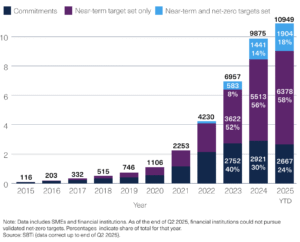
Companies around the world are accelerating their climate commitments at a record pace. The Science Based Targets initiative (SBTi) reports that corporates and other companies with both near-term and long-term net-zero targets jumped 227% in just 18 months.
Firms setting near-term only goals also grew by almost 97% in the same period. This fast growth shows a big change in how companies see climate responsibility. This is especially true for high-emission sectors like Industrials, Consumer Discretionary, and Materials.
The data shows that climate ambition is no longer a niche initiative. Companies are adding climate targets to their main business strategies. This change affects investors, supply chains, and whole industries.
Why Are Companies Choosing Science-Based Targets?
Science-based targets allow businesses to align with the Paris Agreement’s 1.5°C pathway, ensuring that emissions cuts follow the latest climate science. These targets give companies a credible plan to reduce emissions while addressing long-term risks.
The SBTi estimates that following science-based pathways could save $1.5 trillion in climate costs by 2030. The financial case is clear: strong climate plans save money. These goals help reduce risk, improve efficiency, and help companies adapt to a low-carbon economy.
Investor and customer expectations also play a critical role. Companies with validated targets are increasingly viewed as more reliable by the market.
In fact, businesses with SBTi-validated goals represented 39% of global market capitalization in 2023, and this share rose to 41% by 2024. These firms also outperformed the broader economy, growing market value by 16% compared to 11% for global GDP.
This net-zero or climate commitment alignment boosts corporate reputation. Brands with real emission-reduction goals stand out. Consumers and investors want proof of progress, so this gives companies an edge.
David Kennedy, SBTi’s Chief Executive Officer, stated:
“Building climate action into commercial strategy helps maintain competitiveness now and in the future and allows companies to capitalise on opportunities in the low-carbon economy.”
The report further reveals that more companies are now setting net-zero targets, showing a clear rise in ambition. In 2023, only 17% of corporates with validated science-based targets had committed to net-zero. By the end of 2024, that share had nearly doubled to 33%.
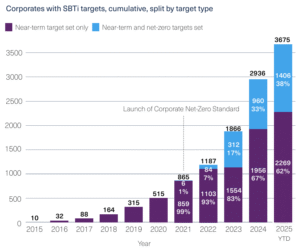
The trend continued into 2025. By mid-year, over 1,400 companies had announced net-zero targets, making up 38% of all corporates with science-based targets.
The 2027 Update: Raising the Bar
The SBTi will introduce updated standards in 2027 that will set tougher rules for how companies design and report their targets. The revisions aim to prevent greenwashing and ensure climate action stays in line with evolving science.
The changes will affect three main areas:
- Data quality: Companies must provide more robust proof of how they measure and report emissions.
- Scope of targets: Almost all targets already include Scope 3 emissions, which often account for over 70% of a company’s carbon footprint. The 2027 standards will ensure this remains mandatory and more consistent.
- Target reviews: Firms will be required to revisit and update their goals every five years, ensuring they remain scientifically valid.
The new framework will also require companies to publicly show whether their targets are active, updated, or withdrawn. This transparency will create stronger accountability and make it easier to compare progress across industries.
Asia’s Green Acceleration: China Takes the Lead
One of the most striking findings from the SBTi’s latest report is the surge of climate commitments in Asia. The region saw a 134% increase in the number of companies with validated targets, outpacing global averages.
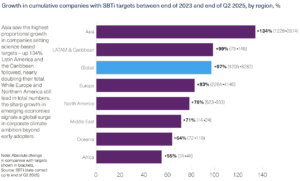
China is leading this momentum. In just 18 months, the number of Chinese companies with science-based targets grew from 137 to 450, marking a 228% increase. Much of this growth comes from industries central to the global supply chain, such as manufacturing, construction, and raw materials.
Other Asian economies are also moving quickly. Government pressure, export requirements, and investor expectations are driving firms to adopt science-based goals.
Big companies are urging their suppliers to do the same. This creates a ripple effect in local and global supply chains.
This trend suggests that Asia will play a central role in shaping the global low-carbon transition. As one of the world’s largest manufacturing hubs, actions taken here have a direct influence on global emissions.
Scope 3 in Focus: Tackling the Hardest Emissions
The growth in science-based targets is already making a measurable difference. Companies with validated targets must report and act on Scope 1, 2, and 3 emissions. These emissions include direct fuel use, as well as activities from suppliers and customers.
Since Scope 3 emissions are typically 11 times greater than direct emissions, this comprehensive approach drives meaningful reductions across value chains.
Currently, 96% of validated companies include Scope 3 in their plans. This ensures emissions are reduced not only at company headquarters but also across the entire production and distribution network.
As standards tighten, companies will have to further strengthen reporting, focus on harder-to-cut emissions, and increase transparency. These improvements will accelerate global decarbonization while also improving operational efficiency. Better emissions data helps businesses reduce waste, save energy, and boost long-term resilience.
Wall Street Meets Climate Action: Investor Shifts
The rise in corporate climate and net-zero ambition is also reshaping financial markets. Companies with clear, science-based climate targets are seen as less risky. This makes them more appealing to investors who care about Environmental, Social, and Governance (ESG) factors.
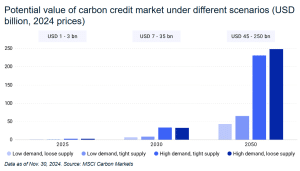
This trend is also fueling demand in the carbon markets. As companies work to cut emissions, many still face unavoidable Scope 3 emissions. To manage these, they increasingly turn to high-quality carbon credits.
The World Bank says the voluntary carbon market might reach $50 billion by 2030. This growth will partly come from companies following SBTi standards.
Regions moving quickly—such as China and other Asian countries—are likely to see economic benefits, including more jobs in green technology and clean energy industries.
On the other hand, slow-moving regions or sectors may lose competitiveness. Global buyers and investors prefer partners that align with climate goals.
Looking Ahead: The Path to Net Zero
The 227% rise in near-term and net-zero target adoption shows that companies are no longer delaying climate action. Key sectors such as industrials and materials, responsible for a large share of global emissions, are now leading the transition.
As the 2027 update approaches, expectations will rise even higher. Companies must keep data clear, track all value-chain emissions, and update their goals often. Those that succeed will not only contribute to global climate goals but also position themselves as leaders in the low-carbon economy.
The path forward is clear: corporations that act decisively today will shape business strategies, capital flows, and supply chains in the years ahead. In doing so, these corporates are not just helping reduce emissions — they are building the foundation for a sustainable, net-zero global economy.