


California enacts the nation’s first-of-its-kind climate disclosure law that requires companies doing business in the state to report on their carbon emissions and climate-related financial risks.
The new corporate climate legislation – SB 253 and SB 261 – covers companies with annual revenues surpassing $1 billion.
This comes as the U.S. Securities and Exchange Commission finalizes its rules that would mandate large companies to disclose their climate-related emissions. But the California laws require climate disclosures beyond what the SEC proposes.
California’s Climate Accountability Package
California Governor Gavin Newsom signed into law two different legislation collectively called the Climate Accountability Package:
Both private and public companies conducting business in the state are covered by the new climate disclosure laws. These include big oil firms like Chevron, tech giants like Apple, Amazon, Disney, Amazon, and 5,300 other corporations.
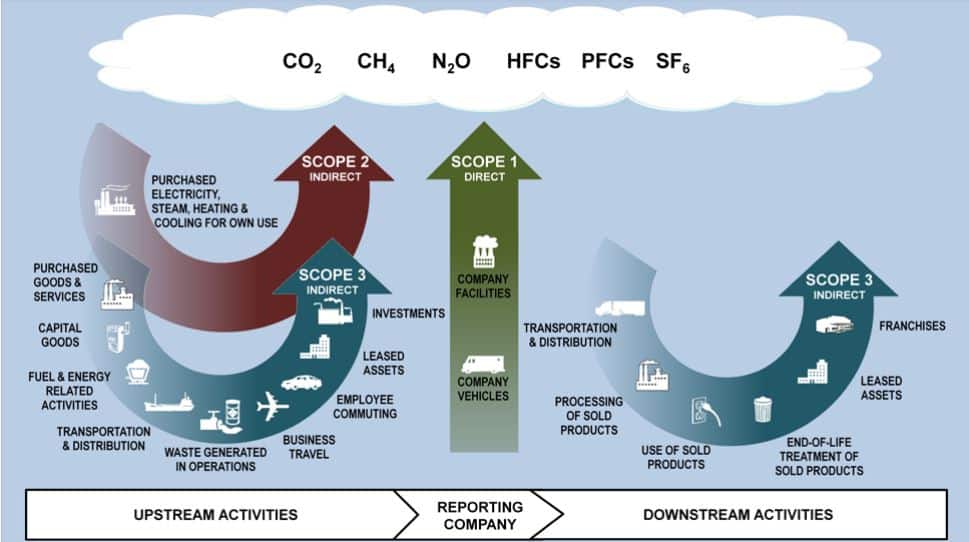
The new laws are broader than the SEC proposed rules, requiring all registrants, regardless of business size. SB 253 mandates companies to disclose Scope 1 and 2 emissions starting in 2026 and Scope 3 in 2027. They also must also disclose biennial climate-related financial risk and submit it to the California Air Resources Board (CARB) beginning in 2026 under the SB 261.
 Governor Newsom said this would encourage them to do business avoiding those risks. This is in accordance with the recommendations of the Task Force on Climate-Related Financial Disclosures (TCFD).
The CARB has to establish a new system for reporting carbon emissions by January 1, 2025. The Board is also managing and overseeing California’s cap-and-trade (carbon credit) program. It sets the declining limit on major sources of greenhouse gas emissions throughout the state, central to meeting its climate goals.
Both laws seek to prevent issues on greenwashing – companies falsely marketing their GHG emission reduction efforts to misled the public. For one of the bills’ proponents, avoiding greenwashing would help investors know better the vulnerabilities of various companies they want to support.
With the enactment of SB 253 and SB 261, California now joins others that introduced climate disclosures, particularly the EU. The EU even requires businesses to report on other things such as their climate transition plan and other sustainability matters.
Recently, the EU adopted the Corporate Sustainability Reporting Directive (CSRD) which addresses non-financial reporting requirements. It aims to ensure that companies report relevant information on their environmental impact as well as the risks related to environmental, social, and governance (ESG) issues.
The Caveats
Supporters said that both laws will make new data public beyond the state’s borders, which would be a game-changer. For an advocate, Hollin Kretzmann, speaking for the Center for Biological Diversity,
“The disclosure requirements would really pull back the curtain on the biggest climate destroyers in the oil industry and make it harder to greenwash.”
However, Governor Newsom said that the new laws came with caveats, noting concerns on reporting deadlines and associated costs.
The climate disclosure laws also faced significant opposition from fossil fuel interests, notably Chevron, Marathon Petroleum, and Western States Petroleum. The California Independent Petroleum Association and the American Chemistry Council also lobbied against the bills.
According to disclosure records, Chevron spent over $1 million in fighting the bill while it cost Western States Petroleum over $2 million.
The opposing interests requested to scrap Scope 3 requirements or weaken the measures. But the Governor hasn’t disclosed intent to do so, but noted to do “some cleanup on some little language”. For subject experts, tweaking the language used to protect big oil business interests can potentially weaken the legislation.
Opponents further claim that the California climate disclosure rules will cause inaccurate reporting and financial burden.
However, there are also strong supporters of the laws from other businesses, alongside environmental advocates. They notably include tech giants Microsoft, Google, Salesforce, and Adobe, as well as Ikea, Patagonia, and Amalgamated Bank.
A Piece of the Net Zero Puzzle
Failing to comply with the new laws will cost covered entities hefty penalties. Under SB 253, administrative fines may not exceed $500,000 in a reporting year. For SB 261 reporting requirements, imposed penalties should not go beyond $50,000.
Once fully enforced, it sets the national standard for climate disclosures and can potentially tackle a company’s entire value chain.
The legislation may face legal challenges when applied and administrative rulemaking process may be time-consuming and controversial. However, pressure strengthens to increase transparency in reporting carbon emissions both at the state and federal levels.
Climate-related disclosures are now a hot topic, not just in the U.S. but other parts of the world as efforts to curb planet-warming emissions intensifies. They are an important piece of the puzzle as the world pushes forward to net zero emissions. California’s Climate Accountability Package ushers in a new era of climate transparency for corporations.