

The disruption in the Strait of Hormuz—one of the world’s key oil and gas routes—raised fears of a fossil fuel shortage. However, instead of a return to coal or a spike in fossil fuel use, the global power system moved in the opposite direction. Clean energy quietly took the lead.
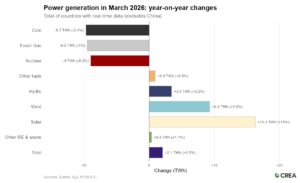
New analysis from the Centre for Research on Energy and Clean Air (CREA) shows that global fossil fuel power generation fell by about 1% in March, the first full month after the disruption began. What stands out is not just the drop, but what replaced it. Solar and wind grew fast enough to fully cover the gap left by fossil fuels.
Gas power fell by around 4%, while coal stayed mostly flat. At first, many expected coal to rise and fill the gap. But that did not happen. Instead, renewable energy took the lead.
No Sign of a Coal Comeback
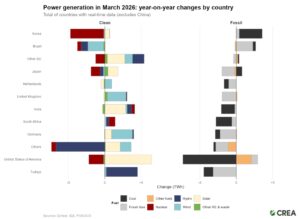
The shift was not limited to one region. Outside China, coal power fell by about 3.5%, while gas dropped by 4%. This trend was seen in major economies like the US, India, the EU, Turkey, and South Africa. At the same time, wind and solar grew fast enough to cover the drop in fossil fuels.
China showed a slightly different trend. Coal use rose by about 2% in coastal areas as high gas prices pushed some power plants to switch from gas to coal. Even so, China’s overall coal use stayed below last year’s levels. In fact, March 2025 still showed a 6% yearly decline. This suggests short-term fuel switching, not a long-term change.
Talk of a global “coal comeback” does not match the data. Even with high gas prices and supply stress, there has been no major restart of old coal plants or big new coal expansion. Most coal plants were already running near full capacity, so there was little room to increase output.
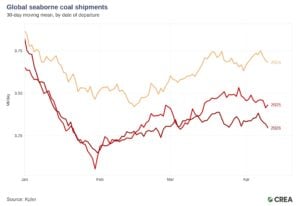
Global trade data supports this view. Seaborne coal shipments fell by about 3% in March, reaching their lowest level since 2021 during the Covid period. Demand dropped in key importers like China and India. Shipments also fell to South Korea, Turkey, and Vietnam. Only a few countries, such as Japan and some parts of Southeast Asia, saw small increases.
Renewables Reshape the Power System
Another key point is that electricity demand did not fall during the crisis. In fact, total power use in countries with real-time data rose in March after a weak start to the year. This shows that the crisis did not reduce demand; it only changed how electricity was produced.
The growth of clean energy is now large enough to matter at a global level. Solar and wind capacity added in 2025 alone is expected to produce about 1,100 terawatt-hours (TWh) of electricity each year. That is nearly twice the electricity that could be generated from all LNG that normally passes through the Strait of Hormuz.
Solar and Wind Take Spotlight
Breaking down further, Solar power rose by 14%, and wind increased by 8%. This growth came from record new installations in 2025. Hydropower also rose slightly, while nuclear power dipped. CREA’s data covers major markets like China, the US, the European Union, and India, which together account for most global coal and gas use. This makes the trend a strong signal of what is happening worldwide.
This matters because about 19% of global LNG trade flows through this route. That gas would produce around 590 TWh of electricity if used in power plants. But new solar and wind projects added in just one year now produce far more than that. This shows how fast clean energy is growing.
Ember Data Reveals Fossil Fuel Fragility, Rising Electrotech Alternative
At the same time, the broader narrative of fossil fuel security is also under pressure. A parallel analysis from Ember highlights a structural vulnerability: three-quarters of the world’s population lives in countries that import fossil fuels. Many major economies, including Spain, Italy, Germany, Japan, South Korea, and India, rely heavily on imported energy. This makes them highly exposed when trade routes like Hormuz are disrupted.
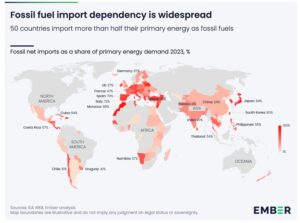
However, Ember also points to a rapidly emerging alternative—electrotech. Technologies such as electric vehicles, solar panels, wind power, batteries, and heat pumps are reducing reliance on imported fuels. Unlike fossil fuels, these systems rely on domestic resources like sunlight and wind, which are widely available across most regions.
Thus, this change is already visible. Electric vehicles alone are estimated to have reduced oil use equal to about 70% of Iran’s exports in 2025. At the same time, more solar power is replacing gas-based electricity, cutting the need for LNG imports. Clean energy is slowly becoming a buffer against global shocks.
Energy Security Is Entering a New Phase
The impact goes beyond short-term price changes. When fossil fuel prices rise during crises, import costs increase sharply. For every $10 rise in oil prices, global import bills go up by about $160 billion each year. This puts pressure on countries that rely on imports.
Because of this, clean energy is now seen not only as a climate solution but also as a way to improve energy security.
Looking ahead, many experts believe this crisis may speed up the energy transition. Solar and wind are now cheaper and faster to build than fossil fuel projects in many regions. Liquefied natural gas, once seen as a “bridge fuel,” is now facing stronger competition from renewables and storage systems.
At the same time, forecasts for oil demand are changing. The International Energy Agency has already reduced its growth outlook, and some analysts think global oil demand could peak earlier than expected, possibly before 2029. If that happens, the Strait of Hormuz disruption may be seen as a turning point rather than just a short-term shock.
Overall, the data shows a clear direction. Even during geopolitical stress, the world is becoming less dependent on fossil fuels. Solar and wind are no longer just extra sources of power. They are now strong enough to replace fossil fuels during crises.
In the end, the Strait of Hormuz disruption did not lead to a fossil fuel comeback. Instead, it showed how quickly clean energy is changing the global power system.