

Japan’s forestry sector is facing a deep crisis. Falling timber prices, an aging workforce, and shrinking rural populations are leaving large parts of the country’s forests abandoned or poorly managed. Now, carbon credits are emerging as a possible lifeline that could help restore forests, support local economies, and strengthen Japan’s climate goals.
According to reporting by The Japan Times, forestry groups in Miyagi Prefecture are trying to use carbon finance to transform struggling plantation forests into healthier and more climate-resilient ecosystems.
The effort highlights a larger shift happening across Japan as foresters, companies, and policymakers search for ways to make forest management profitable again while cutting carbon emissions.
Japan’s Forestry Industry Faces Long-Term Decline
Japan has vast forest resources, but many forests are no longer economically viable. Cheap imported timber has reduced domestic wood prices for years. At the same time, forest ownership is highly fragmented, making large-scale management difficult.
The workforce is also shrinking quickly. Many forestry workers are elderly, and younger generations are leaving rural communities for cities. As profits disappear, more landowners are giving up their forests entirely.
Akio Abe, associate director of the Ishinomaki District Forestry Association in Miyagi Prefecture, told The Japan Times that forest values have fallen so sharply that many owners no longer see a reason to keep managing their land.
Poor Forest Management Raises Climate Risks
Around 40% of Japan’s forests are planted forests, mostly dense cedar and cypress plantations established decades ago when timber demand was much stronger. These monoculture forests require regular thinning and maintenance. Without proper care, biodiversity declines and ecosystems weaken.
Many forests are now overcrowded because owners cannot afford thinning operations. That creates multiple environmental risks. Dense forests block sunlight from reaching the ground, preventing undergrowth and broadleaf species from developing naturally.
Koumei Maruyama, CEO and co-founder of Japanese startup iForest, explained that poorly managed plantation forests also develop weak root systems, increasing the risk of landslides.
How a Tsunami Helped Spark a Forest Carbon Project
The Ishinomaki forest carbon project began after the devastating 2011 tsunami that struck northeastern Japan. The disaster heavily damaged the city of Ishinomaki and nearby Onagawa, where forestry remains an important industry.
Years later, local populations still have not fully recovered.
In 2022, Hitachi Systems sent employees to Onagawa to explore regional revitalization ideas. The company partnered with French climate startup Everimpact, which specializes in carbon measurement and climate finance.
The project team selected 900 hectares of forest dominated by planted conifers. About 72% of the area consisted of cedar and cypress plantations.
Everimpact used two decades of satellite data to study changes in forest biomass and carbon storage. The analysis showed that many aging conifer plantations were declining.
As the trees aged, photosynthesis slowed while decomposition and respiration increased. Some forest areas were gradually becoming net carbon emitters during parts of the year instead of carbon sinks.
The findings confirmed what local foresters already feared. Without thinning and restoration work, the forests would continue losing ecological and climate value.
The Ishinomaki project hopes:
- Carbon finance can support this transition while generating new revenue for local forest owners.
- And it can potentially generate carbon credits worth up to ¥260 million.
Kitade said the goal is not simply to create profits, but to reinvest money into improving environmental value and sustaining forests for future generations.

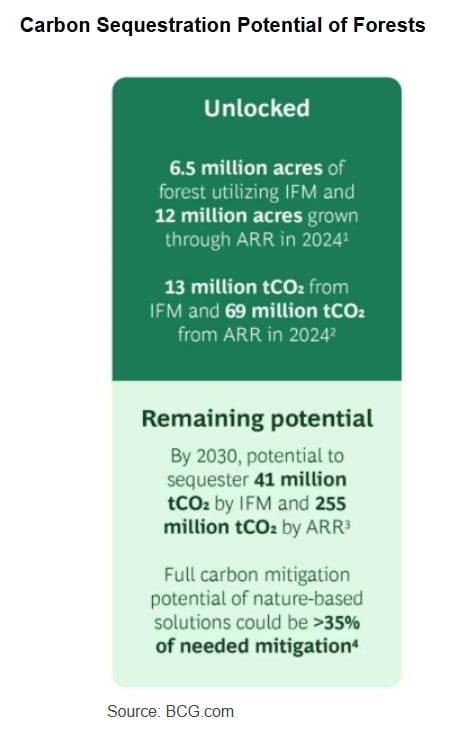
- The Ishinomaki project chose the Verified Carbon Standard’s Improved Forest Management methodology under Verra, one of the world’s largest voluntary carbon standards organizations.
- The methodology compares forest carbon performance against national forest data baselines.
Notably, the project team selected Verra’s program because it supports satellite-based carbon monitoring and has strong international market recognition.
Furthermore, high-quality carbon credits can also command higher prices, especially when projects provide biodiversity benefits alongside carbon reductions.
- According to iForest’s Maruyama, global data suggests carbon credits with biodiversity co-benefits can sell for 38% to 60% more than credits focused only on carbon.
However, forest carbon markets have also faced criticism. Multiple investigations in recent years questioned whether some forest carbon projects truly delivered the climate benefits they promised.
Experts continue to stress that carbon credits should support — not replace — direct fossil fuel emissions reductions. Still, many climate specialists believe forest carbon finance remains an important tool for protecting ecosystems and mobilizing investment.
Japan’s Government Wants Forests to Absorb More Carbon
Japan’s government sees forests as a major part of its long-term climate strategy.
- Government data shows Japan’s forests removed roughly 45 million tons of CO2 in 2023. Officials want that number to rise to 72 million tons annually by 2040 — an increase of about 60%.
- Japan is also targeting a 46% reduction in greenhouse gas emissions by 2030 compared with 2013 levels while pursuing net-zero emissions by 2050.
To help achieve these goals, the government operates the J-Credit system, launched in 2013. The program certifies emissions reductions from projects such as energy efficiency upgrades and forest management.
As of March, 356 forestry-related projects had been registered under the system.
According to reporting from S&P Global Commodity Insights,
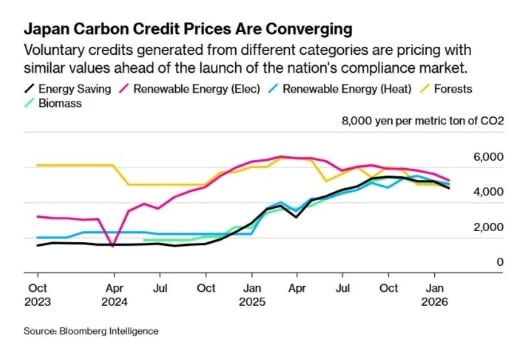
- Forestry J-Credits in Japan’s over-the-counter market were trading around ¥10,000 to ¥14,000 per ton of CO2 equivalent.
- That was significantly higher than solar renewable energy J-Credits, which traded near ¥4,000 per ton.
Market participants told S&P Global that forestry credits often command premiums because buyers value their environmental co-benefits, including biodiversity and local ecosystem restoration.
Carbon brokers also noted that many forestry projects are connected to local governments, which are often reluctant to sell credits quickly because forests are treated as important public assets.
Supply Constraints Could Push Carbon Prices Higher
Japan’s carbon market may face growing supply shortages in the coming years.
According to a 2025 market survey conducted by Exroad and the Tokyo Stock Exchange Carbon Credit Market Development Office, annual demand under Japan’s GX-ETS Phase 2 emissions trading system could conservatively reach 3 million tons per year.
- Current J-Credit supply, however, is estimated at only around 1 million tons annually.
- The report warned that this imbalance could push prices significantly higher. Forecasts suggest allowance prices may rise from roughly ¥4,000–6,000 per ton in 2027 to more than ¥6,000 per ton by 2030.
Without a major increase in domestic credit generation, carbon-intensive industries could face rising financial pressure as climate regulations tighten.
At the same time, stricter standards are making carbon credits more credible and scientifically rigorous.

For projects like Ishinomaki, this creates an opportunity to combine forest restoration, biodiversity protection, and climate action into one long-term economic model. The Ishinomaki team hopes its project can become a model for other regions across Japan.
Everimpact co-founder Alain Retierez said modern forestry must focus on building climate-resilient forests managed in a more selective and nature-focused way.
To sum up, the project aims to prove that carbon finance can help revive Japan’s struggling forestry sector while supporting the country’s path toward net zero.