


Alphabet Inc. (NASDAQ: GOOG, GOOGL) delivered another strong quarter, proving that its massive investments in artificial intelligence (AI) are paying off. The company posted double-digit revenue growth for the 12th straight quarter, powered by booming demand for Google Cloud, AI products, and its core Search business.
However, investors focused on another story. Alphabet plans to continue spending heavily on AI infrastructure, raising concerns about future costs. The stock slipped in after-hours trading despite the impressive financial results.
At the same time, Google’s latest Environmental Report reveals another challenge. While the company reduced emissions from its own operations, the rapid expansion of AI is driving up supply chain emissions and electricity demand, making its long-term climate targets more difficult to achieve.
AI Powers Alphabet’s Best Growth in Years
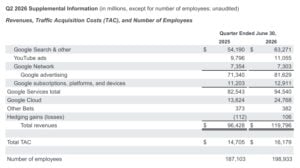
Alphabet reported second-quarter revenue of $119.8 billion, up 24% year over year (23% in constant currency). The strong performance came from nearly every part of the business, highlighting how AI is becoming central to Google’s products and services.
Google Services generated $94.5 billion in revenue, up 15% from a year earlier. Other financial results are:
- The company’s largest business, Google Search and Other, grew 17% to $63.3 billion as AI-powered search features encouraged more user engagement.
- YouTube advertising revenue climbed 13% to $11.1 billion, helped by strong global viewership during the 2026 FIFA World Cup. It attracted more than 1.7 billion unique viewers to World Cup-related content.
- Revenue from subscriptions, platforms, and devices also increased 15% to $12.9 billion, showing continued demand across Google’s consumer ecosystem.
The Biggest Standout: Google Cloud.
Cloud revenue jumped 82% to $24.8 billion, one of the fastest growth rates in the company’s history. The surge came from rising demand for Google Cloud Platform (GCP), enterprise AI infrastructure, and AI-powered business applications.
CEO Sundar Pichai said AI is now transforming every part of Alphabet’s business.
According to the company, nearly 90% of Fortune 100 companies now use Gemini Enterprise. Google’s Gemini models process around 22 billion API tokens every minute, while the Gemini app has reached 950 million monthly active users.
These figures show how rapidly businesses and consumers are adopting Google’s AI products.
Profit Jumps Despite Heavy Spending
Alphabet’s earnings also improved significantly.
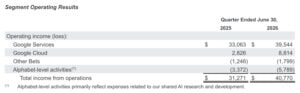
Operating income rose 30% to $40.8 billion, while operating margin expanded to 34%, up two percentage points from last year.
Net income reached $112.1 billion, nearly four times higher than the previous year. However, this figure included approximately $99 billion in unrealized gains from Alphabet’s equity investments, making it unusually high.
Diluted earnings per share climbed to $9.11, compared with $2.31 a year ago. Despite these impressive numbers, Alphabet continues to spend aggressively on expanding its AI infrastructure.
Capital expenditures totaled $44.9 billion during the quarter as the company invested heavily in new data centers, AI chips, networking equipment, and supporting infrastructure.
Those investments pushed free cash flow into negative territory at -$5.9 billion, as capital spending exceeded operating cash flow.
Source: Alphabet
- ALSO SEE: Alphabet (Google) Surpasses Apple in Value: But How About Their Climate Ambitions and Progress?
GOOGL Stock Faces Investor Scrutiny Over Rising AI Infrastructure Costs
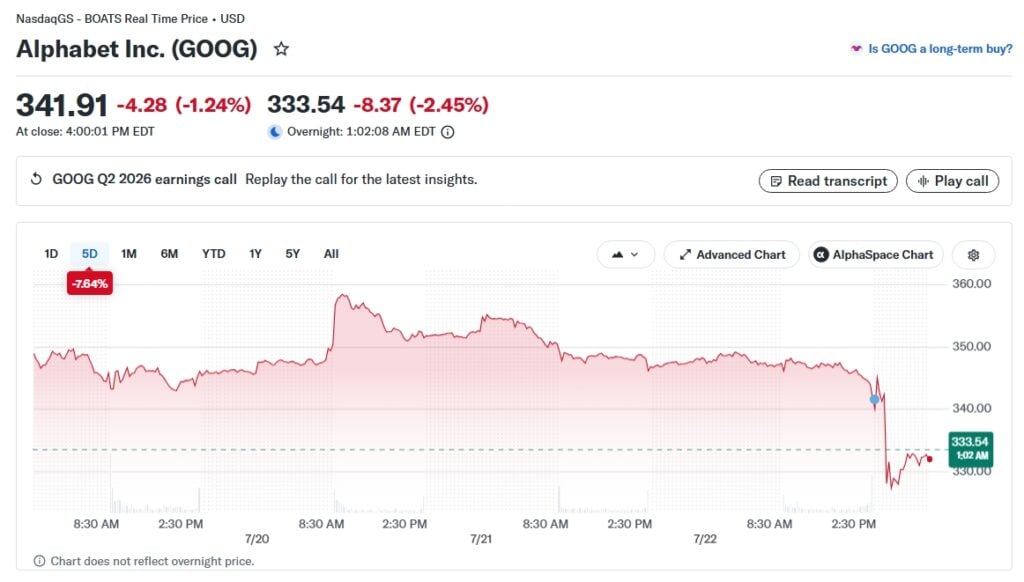
Before the earnings announcement, Alphabet shares traded near $347.80.
Although revenue and cloud growth exceeded expectations, the stock fell about 3% in after-hours trading. The decline reflected investor concerns over Alphabet’s rising AI investment plans rather than its operating performance.
Building AI infrastructure requires enormous capital. Companies must purchase advanced processors, construct new data centers, expand electricity capacity, and upgrade networking systems.
Many investors remain optimistic about Alphabet’s long-term AI opportunity. However, they are also watching whether these investments will continue generating strong returns while protecting profit margins.
Overall, market sentiment remains cautiously bullish. Investors see AI and cloud computing as powerful long-term growth drivers, but they also recognize that expanding AI infrastructure comes with high costs.
AI Expansion Creates a New Climate Challenge
Alphabet’s financial results were accompanied by its 2026 Environmental Report, which highlights another side of the AI boom.
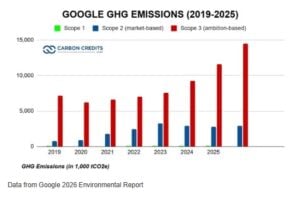
- The company successfully reduced emissions from its own operations in 2025. Combined Scope 1 and market-based Scope 2 emissions fell about 2% to 2.9 million metric tons of CO₂ equivalent.
This marks the second consecutive year of operational emission reductions, following a larger decline in 2024. The improvements reflect years of investment in renewable electricity, energy-efficient data centers, and cleaner operations.
However, Google’s broader carbon footprint continues moving in the opposite direction.
- Total ambition-based emissions reached approximately 14.5 million metric tons of CO₂ equivalent in 2025, an 18% increase from the previous year and 81% higher than the company’s 2019 baseline.
The biggest reason is the rapid expansion of AI infrastructure.
Google now requires more servers, semiconductors, networking equipment, construction materials, and data centers to support growing demand for products like Gemini and other AI services.
These activities fall under Scope 3 emissions, which now account for nearly 80% of Google’s total carbon footprint. As AI adoption accelerates, these emissions have become much harder to reduce.
The company acknowledged that its long-term climate ambitions are becoming more difficult because of several factors, including rapidly rising electricity demand, delays in connecting clean power to electricity grids, supply chain constraints, and limited availability of carbon-free energy in many regions.
Electricity Demand Keeps Rising
The Environmental Report also highlights how quickly AI is increasing electricity consumption.
Google reported a 37% increase in electricity load during 2025 as it expanded computing capacity for AI services.
The company says improvements in AI hardware and software efficiency helped limit even faster growth.
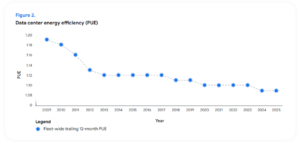
- Its data centers remain among the world’s most efficient, achieving an average Power Usage Effectiveness (PUE) of 1.09.
Still, efficiency improvements alone cannot offset the rapid expansion of AI computing. This reflects a broader trend across the technology industry.
- MORE DETAILS: Google’s Carbon Emissions Fall, But AI Makes Its Net-Zero “Moonshoot” Goal Harder Than Ever
Clean Energy Remains Google’s Main Strategy
To meet rising electricity demand while reducing emissions, Google continues expanding its clean energy portfolio.
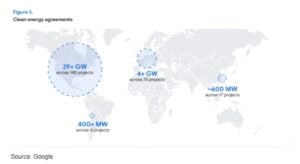
- During 2025, the company signed agreements for more than 12 gigawatts (GW) of new clean energy capacity.
- It also launched more than 25 energy projects, adding nearly 2 GW of new carbon-free electricity to the grids that supply its operations.
Google continues working toward its goal of matching 100% of its annual electricity consumption with renewable energy purchases.
Beyond solar and wind, the company is investing in advanced geothermal energy, nuclear power, and other carbon-free technologies that can provide reliable electricity around the clock for AI data centers.
Even with these investments, Google recognizes that some emissions will remain difficult to eliminate. Industries such as aviation, semiconductor manufacturing, and construction materials still generate emissions that are difficult to avoid.
To address those remaining emissions, the company is increasing investments in high-quality carbon removal projects alongside its broader clean energy strategy.
Can AI Growth and Sustainability Move Together?
Alphabet’s latest earnings show that AI is becoming one of the company’s strongest growth engines. Google Cloud is expanding rapidly, AI products are attracting businesses worldwide, and Search continues to benefit from new AI-powered features.
Yet the same technologies driving financial success are also increasing energy use, infrastructure spending, and supply chain emissions.
Google has demonstrated that it can lower emissions from its direct operations while continuing to grow. The next challenge will be reducing emissions across its much larger supply chain as AI infrastructure expands globally.
For Alphabet—and much of the technology sector—the future of AI will depend not only on faster chips and larger data centers but also on building a cleaner energy system capable of powering the next generation of digital innovation