


A new report from venture firm a16z highlights a shifting race in generative artificial intelligence (AI). Google’s Gemini, China’s DeepSeek, and even Grok, backed by Elon Musk, are gaining ground on OpenAI’s ChatGPT.
But as these AI rivals advance, there’s an urgent question: how green are their growing footprints? Let’s take a closer look at each of the top three AI’s environmental footprints below.
Competitors Rise: How Google and Grok Are Gaining Ground on ChatGPT
The a16z report maps the top 100 generative AI apps, showing that ChatGPT has strong competition emerging. Google’s Gemini is expanding quickly, and Grok—new but promising—is stepping onto the field, too.
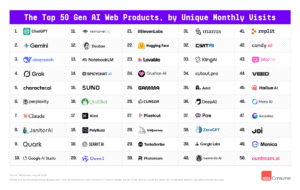
Gemini’s strength comes from Google’s massive infrastructure. Its backing allows faster improvements and better integration across services like search, Gmail, and cloud tools. Gemini’s smooth response and deep context give it a competitive edge.
Meanwhile, DeepSeek earns the third spot because it strikes a middle ground between efficiency and emissions. Much of its footprint comes from running on China’s coal-heavy power grid, which raises its carbon intensity compared to peers with greater access to renewable energy.
Meanwhile, ChatGPT stays strong thanks to its large user base and bold partnerships. OpenAI’s alignment with Microsoft means tight integration in Office, Azure, and more. ChatGPT also supports fine-tuning and plugins, making it more flexible for businesses and developers.

Despite their differences, the report shows all three top models are advancing quickly in user experience, expanding features, and market presence. It marks a growing field, not one dominated by ChatGPT alone anymore.
Watt for Watt: Who’s the Greenest Chatbot? Comparing AI Footprints
As AI usage grows, its environmental impact becomes critical. Let’s compare how these three models fare in energy use and emissions.
OpenAI ChatGPT
ChatGPT sits in the middle of the spectrum. Its exact footprint varies depending on which study you use, but most analyses suggest it consumes more energy and emits more carbon per query than Gemini.
Part of this comes from heavier model sizes and widespread usage. Improvements in hardware efficiency and energy sourcing are bringing numbers down, but its typical footprint is still higher than Google’s.
OpenAI’s Sam Altman claims a ChatGPT query uses as much power as running an oven for about one second. Independent estimates align with this level.
Although a single query uses moderate energy, the rapid growth in usage means overall consumption is significant. U.S. data centers—many of which power AI—could account for up to 8% of U.S. electricity use by 2030.
Greenly, a carbon accounting firm, estimates that using ChatGPT-4 to respond to one million emails monthly could generate 7,138 tonnes of CO₂, equating to about 4,300 round-trip flights Paris–New York per year.
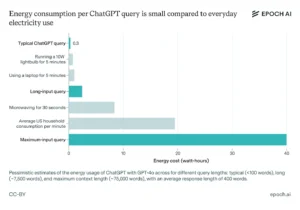
- Energy use per prompt: ~3 Wh (can be lower in some estimates, ~0.3 Wh)
- CO₂ emissions per prompt: ~2–3 g (includes amortized training emissions)
SEE MORE: ChatGPT Hits 700M Weekly Users, But at What Environmental Cost?
Google Gemini
Google has been working to make its AI models more efficient, and Gemini reflects this push. According to Google’s own reporting, text-based queries in Gemini consume very little energy compared to earlier AI systems.
The company highlights dramatic efficiency gains in both energy use and carbon intensity, making Gemini one of the leaner large models when handling short, text-only prompts.
- According to Google, a median Gemini AI text prompt uses just 0.24 watt-hours, emits 0.03 grams of CO₂, and consumes 0.26 milliliters of water—about five drops.
Over the past year, Google claims a 33× reduction in energy use per prompt and a 44× reduction in carbon footprint while improving quality.
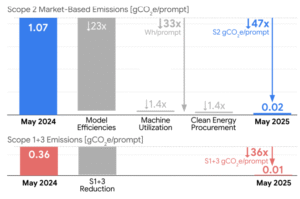
Experts warn Google’s method may understate environmental cost by excluding indirect water usage (e.g., power plant cooling) and relying on market-based carbon accounting.
- Energy use per prompt: ~0.24 Wh
- CO₂ emissions per prompt: ~0.03 g
- Water use per prompt: ~0.26 mL
READ MORE: Google Reveals the Environmental Cost of Gemini AI Query
DeepSeek R1
DeepSeek’s reasoning models work well with long, complex prompts. This makes them more energy-intensive than regular chat models.
DeepSeek hasn’t shared its exact CO₂ figures. However, benchmarking shows that its energy use per query is much higher than competitors. This is especially true for tasks that require multi-step reasoning or coding. This places DeepSeek at the high end of per-query emissions.
A recent academic study found that models like DeepSeek-R1 use more than 33 Wh per long prompt—over 70× the energy of smaller models like GPT-4.1 Nano. Large-scale inference, with 700 million queries daily, could use as much electricity as 35,000 U.S. homes. It would also need a forest the size of Chicago to offset its carbon emissions.
- Energy use per long reasoning prompt: >33 Wh
- CO₂ emissions per prompt: Likely an order of magnitude higher than ChatGPT (depends on grid mix): ~2–4 g
At first glance, Gemini seems the greenest per query (with footprints barely visible in the chart below), while ChatGPT has a moderate impact, and DeepSeek is the least efficient. But real-world AI use involves billions of queries daily. So, even small differences matter.
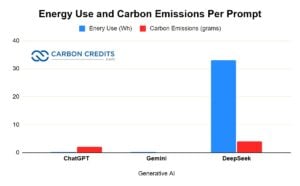
As AI scales, overall energy and CO₂ use skyrocket unless systems are optimized for efficiency.
Data Centers or Carbon Centers? The Stakes for Climate
The environmental stakes are real. Experts estimate global data center use could hit 945 terawatt-hours (TWh) by 2030, with AI responsible for 652 TWh—an 80× jump from today.
Generative AI alone may cause 18–246 million tons of CO₂ emissions per year by 2035, similar to entire industries like aviation or shipping.
Without green design, AI growth could claw back efforts to reduce climate impact. Companies need to think beyond speed and accuracy—AI must grow sustainably, too.
AI Growth Meets Climate Responsibility: What Comes Next
The AI competition is intensifying—with ChatGPT, Gemini, and Grok pushing each other forward. Users benefit from better tools, but rising usage means rising environmental costs. To move forward responsibly, analysts suggest these actions:
- Developers should optimize AI models for energy efficiency, just like Gemini’s leap.
- Companies should track and reveal full lifecycle impacts—not just inference costs.
- Cloud providers and AI firms need policies favoring renewable energy and efficient data center cooling.
- Public policy could reward low-carbon AI, possibly with incentives or carbon pricing.
The a16z report shows that generative AI has entered a new phase—competition among equals, not a single leader. ChatGPT, Gemini, and Grok are all driving innovation in AI. But with growing usage comes growing environmental responsibility.
As the field speeds up, AI’s impact on climate can’t be ignored. Models that combine high performance with low energy use will define the future. If innovators balance progress with sustainability, AI’s value could be even greater—and greener.