


Apple Inc. (NASDAQ: AAPL) reported record fourth-quarter revenue for fiscal 2026, supported by strong iPhone sales and growth in its Services business. The company also made further progress toward its 2030 carbon neutrality goal, with lower greenhouse gas emissions, more renewable energy across its supply chain, and greater use of recycled materials.
The company reported September-quarter revenue of $114.5 billion, up 12% from $102.5 billion a year earlier. Diluted earnings per share (EPS) increased 14% to $2.10, while net income reached $30.7 billion.
The results capped a strong fiscal year, with total revenue reaching $478.8 billion. Alongside its financial performance, the company continues to work on reducing emissions across its global operations and manufacturing network.
This progress is important because most of its carbon footprint comes from its supply chain and the production and use of its devices, rather than its offices and retail stores.
Apple Q4 Earnings: Revenue and Profits Rise
The September quarter showed strong growth across several business segments. Product sales reached $82.9 billion, compared with $73.7 billion in the same quarter last year. Services revenue increased to $31.6 billion from $28.8 billion, setting another quarterly record.
Here are the main financial highlights:
- Total revenue: $114.5 billion, up 12% year over year.
- Net income: $30.7 billion, compared with $27.5 billion a year earlier.
- Diluted EPS: $2.10, up 14% from $1.85.
- Gross margin: 47.9%, including an approximately one-percentage-point benefit from tariff refunds.
- Operating cash flow: Approximately $28 billion for the quarter.
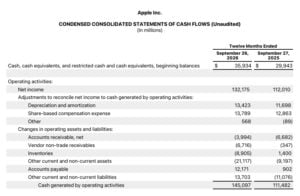
For the full fiscal year, revenue increased 15% to $478.8 billion, while net income rose to $132.2 billion from $112 billion in fiscal 2025.
iPhone remained the biggest revenue contributor, generating $57.6 billion, up 17% year over year. Mac sales increased 24% to $10.8 billion, while Services revenue grew 10%.
iPad revenue declined 10% to $6.2 billion, and Wearables, Home and Accessories sales fell 8% to $8.3 billion.
The results show that the company continues to benefit from strong demand for its devices and a growing Services business. Its installed base of active devices also reached a new record across major product categories and geographic markets.
AAPL Stock Faces Pressure Despite Record Earnings
Despite beating market expectations, Apple shares came under pressure following the earnings announcement.
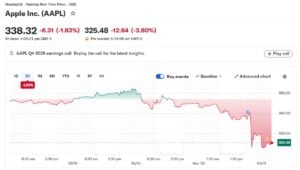
The stock closed at $338.32 on November 2, down 1.83% for the session. It fell further in premarket trading on November 3, reaching $321.53.
Investors are watching rising component costs and their potential impact on profit margins. The company expects gross margin to decline to 45%–46% in the December quarter, compared with 47.9% in Q4.
Higher memory chip costs and expenses linked to its artificial intelligence (AI) rollout could put additional pressure on profitability.
For the December quarter, management expects:
- Revenue growth of 7%–10% year over year.
- Services revenue growth of 8%–9%.
- Gross margin of 45%–46%.
This outlook suggests that strong product demand may not fully offset higher manufacturing and technology costs. Investors will also watch holiday-season sales and whether the company can maintain its revenue growth without sacrificing margins.
Emissions Down 60% Since 2015
Beyond its financial results, the 2026 Environmental Progress Report highlights progress toward Apple 2030, its goal to become carbon neutral across its entire value chain by 2030.
The company aims to reduce its gross greenhouse gas emissions by 75% from 2015 levels before addressing the remaining emissions through carbon removal solutions.
Its 2025 emissions data show meaningful progress:
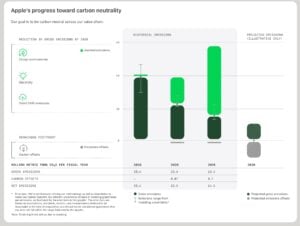
This represents a reduction of approximately 60% in gross emissions over the decade.
The company also reported that its business revenue grew substantially over the same period, showing that it has reduced its overall carbon footprint while expanding its operations.
Its environmental programs focus on several areas:
- Switching suppliers to renewable electricity.
- Using recycled and lower-carbon materials.
- Improving manufacturing energy efficiency.
- Reducing emissions from transportation and product use.
- Supporting carbon removal and nature-based projects.
The challenge is to maintain these reductions as production expands and demand for its devices and digital services grows.
Scope 1, 2 and 3
For 2025, the report’s corporate emissions breakdown showed approximately 55,200 metric tons of Scope 1 emissions, 1,100 metric tons of market-based Scope 2 emissions and 513,700 metric tons of corporate Scope 3 emissions.
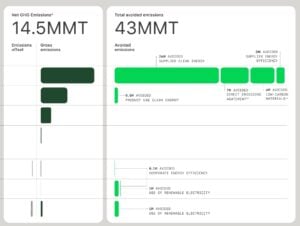
Product-related emissions are reported separately in the product life cycle breakdown. These reached approximately 14.71 million metric tons of CO2e.
Manufacturing was the largest contributor, accounting for 8.15 million metric tons. Product use added 4.12 million metric tons, while transportation contributed 2.37 million metric tons.
This difference highlights an important point: reducing emissions from offices and company facilities alone will not be enough. The company needs its manufacturing partners to make bigger changes.
Renewable Energy and Recycled Materials Gain Ground
Renewable electricity is one of the biggest parts of the company’s emissions reduction strategy.
Its corporate offices, retail stores, research facilities and data centers already use 100% renewable electricity. The next major step is helping suppliers make the same transition.
In 2025, suppliers in its clean energy program had more than 20 gigawatts (GW) of renewable energy capacity operational. These projects generated over 38 million megawatt-hours (MWh) of clean electricity.
The company is also working with manufacturers to improve energy efficiency and reduce emissions from industrial processes.
Other environmental milestones include:
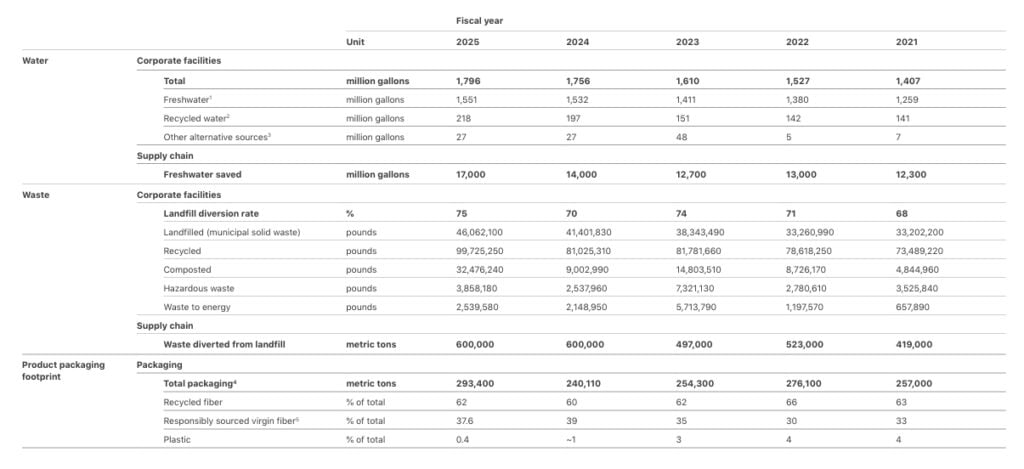
- 30% recycled content: A record share of materials across all products shipped in 2025 came from recycled sources.
- 100% recycled cobalt: All batteries designed by the company now use recycled cobalt.
- 100% recycled rare earth elements: All magnets use recycled rare earth materials.
- Plastic-free packaging: Products now ship in fibre-based packaging.
- Water conservation: The company and its suppliers saved 17 billion gallons of freshwater in 2025.
These efforts help reduce demand for newly mined materials, limit manufacturing waste, and lower the environmental impact of its products.
Resource Efficiency Data
Can Apple Keep Its Climate Goals on Track?
The latest results show that strong financial growth and emissions reductions can move forward together. However, the harder part of the climate transition lies across the global supply chain.
Manufacturing remains the largest source of product-related emissions, and moving suppliers toward clean electricity will require investment, reliable renewable power, and better industrial technologies.
The company has made measurable progress, but its 2030 target will depend on how quickly its manufacturing partners can reduce their dependence on fossil fuels.
For investors, the next question is whether it can maintain revenue growth, protect profit margins, and continue cutting emissions as its business expands.
The coming years will show whether its climate progress can keep pace with its ambitions for growth.