


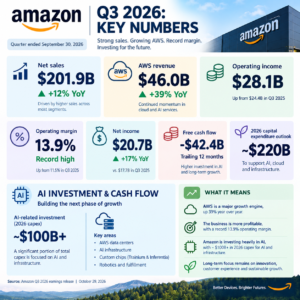
Amazon.com (NASDAQ: AMZN) reported strong third-quarter 2026 results, with revenue rising 12% year over year to $201.9 billion. However, heavy investments in artificial intelligence (AI) infrastructure and a weaker holiday-quarter outlook weighed on investor sentiment.
Amazon Web Services (AWS) drove most of the growth. Its revenue climbed 39% to $46 billion, marking its fastest growth in nearly five years. The cloud division also helped lift Amazon’s operating income to a record $28.1 billion.
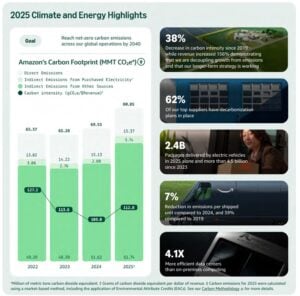
But the company’s AI expansion comes with growing financial and environmental costs. Amazon expects to spend approximately $220 billion on capital investments in 2026, much of it on AI infrastructure and data centers. Its latest sustainability report also showed that total greenhouse gas emissions increased to 80.9 million metric tons of carbon dioxide equivalent (CO₂e) in 2025.
As Amazon expands its cloud business, investors will watch whether it can balance higher profits, rising infrastructure costs, and its commitment to reach net-zero carbon emissions by 2040.
Amazon Revenue Reaches $201.9 Billion in Q3 2026
For the quarter ended September 30, 2026, Amazon reported net sales of $201.9 billion, up 12% from $180.2 billion in the same period last year. Excluding foreign exchange effects, revenue increased 13%.
The company’s three main business segments delivered mixed results.
- North America: Sales increased 6% year over year to $112.9 billion.
- International: Revenue grew 5% to $43.1 billion, or 8% excluding foreign exchange effects.
- Amazon Web Services (AWS): Sales jumped 39% to $46 billion, making it the fastest-growing segment.
Operating income increased to $28.1 billion from $17.4 billion a year earlier. This represented an operating margin of 13.9%, Amazon’s highest ever.
AWS remained the biggest contributor to profitability, generating $17.8 billion in operating income, compared with $11.4 billion in Q3 2025. North America contributed $8.7 billion, while International operations generated $1.6 billion.
Net income, however, declined to $20.7 billion, or $1.89 per diluted share, from $21.2 billion, or $1.95 per share, a year earlier. The decline mainly reflected a $9.5 billion pre-tax gain from Amazon’s Anthropic investment included in the previous year’s results.
Amazon also reported a 29% increase in trailing 12-month operating cash flow to $168.3 billion.
However, free cash flow turned negative, reaching an outflow of $42.4 billion for the 12 months ended September 30, 2026. The company attributed this to higher spending on property, equipment, and AI infrastructure.
READ MORE: Amazon (AMZN) Stock Jumps on Record $200B Q2 Revenue, Fueled by AI Growth and Water-Positive Goals
AMZN Stock Falls as AI Spending Concerns Grow
Amazon shares came under pressure following the earnings announcement on October 29. The stock closed at $243.79, down 4.3% during the regular trading session, and fell further in after-hours trading.
Investors focused on the company’s rising capital expenditure and weaker-than-expected earnings and revenue figures.

The company’s fourth-quarter outlook added to investor concerns. Amazon expects revenue between $240 billion and $247 billion, representing 12% to 16% annual growth. The midpoint of this range was slightly below analyst expectations.
Meanwhile, Amazon maintained its 2026 capital expenditure forecast of approximately $220 billion. CEO Andy Jassy indicated that spending could increase further in 2027.
Despite the market reaction, AWS remains a major growth opportunity. Jassy expects the cloud business to grow by more than 40% annually in both 2027 and 2028.
The challenge for investors is whether this aggressive AI investment will generate enough long-term revenue and cash flow to justify its cost.
Amazon’s Carbon Emissions Rise to 80.9 Million Tons
Amazon’s rapid expansion also brings environmental challenges.
According to its 2025 Sustainability Report, the company’s total greenhouse gas emissions increased by more than 16% to 80.9 million metric tons of CO₂e in 2025.
The increase highlights the environmental impact of expanding its global operations, particularly data centers, transportation and supply chains.
Scope 2 emissions, which come from purchased electricity, increased nearly 34% year over year. Scope 3 emissions, generated across the company’s wider value chain, rose nearly 20%.
This is important because Amazon’s AI ambitions require more computing power, servers and data center capacity. These facilities consume large amounts of electricity and require cooling systems, water and other resources.
Amazon has made progress in reducing the carbon intensity of its business. Since 2019, its carbon intensity has fallen 38%, even as revenue increased 156%.
However, lower emissions intensity does not necessarily mean lower total emissions. The latest figures show that absolute emissions remain a major challenge as the company continues to grow.
Clean Energy Goals and Net-Zero Commitment
Amazon co-founded The Climate Pledge in 2019 and committed to reaching net-zero carbon emissions across its operations by 2040.
Renewable energy is a major part of this strategy. Amazon matched 100% of the electricity consumed by its global operations with renewable energy for the third consecutive year in 2025.
Its carbon-free energy portfolio includes more than 712 projects across 30 countries, representing approximately 42 gigawatts of capacity.
The company is also exploring additional energy sources to support its growing electricity needs. These include nuclear power, advanced geothermal energy, and long-duration energy storage.
These investments are particularly important as AI data centers increase electricity demand.
- Amazon is also working to reduce emissions from its transportation network. In 2025, it operated more than 52,700 electric delivery vehicles globally and delivered 2.4 billion packages using electric vehicles.
- The company aims to deploy 100,000 electric delivery vehicles worldwide by 2030.
Another important target is water conservation. It is working toward becoming water-positive by 2030, meaning it aims to return more water to communities than it uses in its direct operations. The company reported that it was 75% of the way toward this goal in 2025.
Its data centers are also becoming more water-efficient, with the company reporting that they use seven times less water than the industry average.
The Bottom Line: AI Push Meets the Reality of Rising Carbon Emissions
Amazon’s Q3 2026 earnings highlight the growing importance of cloud computing and AI to its long-term business strategy.
AWS is delivering strong revenue growth, while investments in data centers and AI technologies could create new opportunities across industries. However, these investments also increase electricity demand, infrastructure costs, and environmental pressure.
The company’s $220 billion capital expenditure plan shows how much it is willing to invest to strengthen its position in the AI market. At the same time, its rising emissions demonstrate the difficulty of separating business growth from environmental impact.
Amazon has made progress through renewable energy procurement, electric delivery vehicles, efficient data centers, and water conservation. But its 2025 emissions increase shows that these measures have not yet reversed the growth in its overall carbon footprint.
For investors, the bigger question is whether Amazon can turn its AI investments into sustainable long-term growth while keeping its 2040 climate commitment within reach.