


Alphabet’s latest earnings show how quickly its artificial intelligence (AI) business is growing. However, the expansion also raises a major environmental challenge for Google: how to meet its climate goals while building more data centers, buying more computer equipment, and using more electricity.
Alphabet reported $127.6 billion in revenue for the third quarter of 2026, up 25% from a year earlier. Google Cloud revenue more than doubled to $30.7 billion, driven by demand for AI infrastructure and services.
Yet, investors reacted to weaker-than-expected results and rising spending. Alphabet’s free cash flow turned negative by $9.1 billion as the company invested heavily in its AI and cloud businesses. Its shares fell about 10% in after-hours trading following the October 28 earnings release.
The financial results highlight the scale of Alphabet’s investment plans. Google’s latest environmental report reveals a different story: its total climate footprint grew by 18% in 2025, hitting around 14.5 million metric tons of carbon dioxide equivalent (CO₂e).
The company is still investing in clean energy and ways to reduce emissions. Still, its growing AI infrastructure is making its 2030 climate goals harder to achieve.
Alphabet’s AI Growth Comes With Rising Costs
Google Cloud revenue more than doubled, and operating income rose 30% to $40.6 billion, but net income fell 25% to $26.2 billion, partly due to losses on investments. The company also reported negative free cash flow of $9.1 billion, as capital spending reached $51.4 billion, largely to support AI infrastructure.
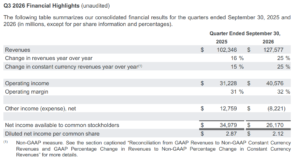
Alphabet shares fell about 10% in after-hours trading following the results, as investors weighed the costs and returns of its expansion. These results show how quickly Google is expanding its AI business—and how much infrastructure that growth requires.
The same investment in servers, data centers, and electricity also creates environmental pressures, helping explain why Google’s emissions remain a major challenge despite its clean energy efforts.

Google’s Emissions Rise as AI Infrastructure Expands
The tech giant aims to reach net-zero emissions across its operations and supply chain by 2030. The plan aims to cut Scope 1, Scope 2, and Scope 3 emissions by 50% from 2019 levels. Then, it will use carbon removal to balance any remaining emissions.
Scope 1 covers direct emissions from sources the company owns or controls. Scope 2 covers emissions linked to purchased electricity, heating, and cooling. Scope 3 includes other indirect emissions across its supply chain, such as making computer equipment and building data centers.
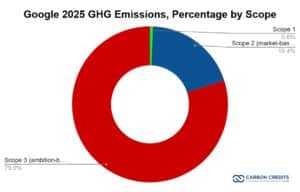
Google’s 2026 Environmental Report, which covers 2025, shows how difficult this target has become. Its total ambition-based emissions reached about 14.5 million metric tons of CO₂e in 2025, up 18% from 2024 and 81% above the 2019 baseline.
Scope 3 emissions accounted for about 11.6 million metric tons, or roughly 80% of the total. They rose 25% in 2025, mainly because Google needed more hardware and logistics to expand its technical infrastructure, along with more data center construction.
This matters because Google cannot cut its footprint by focusing only on electricity used in its own buildings. It must also address emissions from the companies that make its chips, servers, and other equipment.
Google says its emissions would have been much higher without its climate measures. It estimates that efficiency improvements and clean energy efforts avoided over 58 million metric tons of CO₂e in 2025. This is compared to a scenario without those measures. This is an estimate of avoided emissions, not a reduction in its reported total footprint.
Clean Energy Deals Grow, But the Challenge Remains
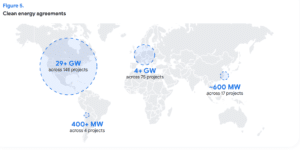
Google is expanding its clean energy purchases to support its growing electricity needs. In 2025, it signed agreements for more than 12 gigawatts (GW) of new clean energy. Google said this was the largest annual total in its history and exceeded its combined procurement in the previous two years.
These agreements can support new energy projects and help bring more clean electricity onto power grids. However, contracted capacity is not the same as electricity already generated. Actual output depends on when projects are completed and how they perform.
Google also aims to match its electricity use with carbon-free energy every hour of every day by 2030 in every grid where it operates. This goes beyond buying enough clean energy over a full year. It requires clean power to be available when its data centers and offices need electricity.
That goal is becoming harder as AI demand grows. Google says its AI infrastructure is expanding faster than electricity grids are becoming cleaner. Delays in grid connections, limits on energy supplies, and slow development of new technologies can all hold back progress.
The company’s challenge is therefore not just to sign more clean energy deals. It must help secure reliable, carbon-free electricity at the scale and times its growing operations require.
AI Spending Brings More Pressure on Energy and Emissions
Alphabet’s latest results show how strongly AI is driving its business. Google Cloud revenue rose 103% year over year to $30.7 billion in the third quarter. The company also reported rising demand for its AI infrastructure and computing systems.
However, data centers need electricity to run servers and keep equipment cool. Building them also requires steel, concrete, chips, and other materials that carry emissions before the facilities even begin operating. These impacts help explain why Google’s supply chain emissions rose even as its operational emissions fell.
Google reported that combined Scope 1 and market-based Scope 2 emissions fell 2% in 2025 compared with 2024. This was a positive result despite higher electricity demand. However, operational emissions remained about 240% above their 2019 level.
The figures show that improvements in electricity sourcing and efficiency can help, but they have not yet reversed the longer-term rise in emissions. For Alphabet, the environmental test is whether efficiency gains and clean energy can keep pace with the rapid expansion of AI.
- INTERESTING READ: Google, Constellation Strike 890 MW Nuclear Deal to Support PJM Grid
Water Use and Data Center Waste Add to the ESG Challenge
Energy and carbon emissions are not Google’s only environmental concerns. Data centers also need water, while their construction and operation create waste.
Google reported that its water projects replenished about 7.7 billion gallons in 2025, equal to roughly 78% of its total freshwater consumption that year. Its portfolio included 165 projects across 97 watersheds.
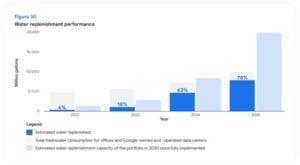
The company aims to replenish more water than it consumes by 2030, on average across its offices and data centers. Replenishment projects can help restore water supplies, but their local impact depends on where they are located and whether they benefit the same watersheds affected by Google’s water use.
Google also reported that it diverted 88% of operational waste from disposal across its company-owned and operated data centers in 2025. These efforts show progress in managing resources. Still, growing demand for data center capacity can make it harder to maintain progress as the company expands.
Can Google Meet Its 2030 Climate Targets?
Google’s environmental results show both progress and a growing gap between its ambitions and its total emissions.
The company has increased clean energy purchases, reduced its operational emissions year-over-year, and invested in efficiency and water projects. It also says its climate measures prevented a much larger emissions footprint than it would otherwise have had.
However, its total reported emissions are still rising. The largest increase is coming from its supply chain, where the production of equipment and construction of infrastructure are closely tied to its AI expansion.
Alphabet’s latest earnings show that the company has the financial resources and growing business demand to keep expanding AI. Its environmental report shows that this growth comes with a serious climate challenge.
The key question is whether Google can make its AI business grow while bringing its absolute emissions down toward its 2030 target. For now, the company’s clean energy investments are growing, but its overall climate footprint has yet to turn downward.