

BBVA is strengthening its sustainability strategy with a new environmental roadmap for 2026-2030. The bank says it already achieved the goals from its earlier eco-efficiency plan two years ahead of schedule. Now it wants to move even faster by cutting emissions further, improving energy efficiency, and expanding the use of renewable electricity across its operations.
- The latest figures show that BBVA has already made major progress. In 2025, renewable sources supplied 99% of the bank’s electricity use worldwide.
- Furthermore, since 2019, the bank has reduced Scope 1 and Scope 2 carbon emissions by 83%. These emissions come from the company’s own operations and purchased energy.
The press release also revealed that the bank lowered electricity use per employee by 22%, total energy consumption by 19%, water use by 36%, paper consumption by 44%, and net waste by 33%. At the same time, environmentally certified office space reached 62%, far above the original 45% target.
New Eco-Efficiency Plan Raises the Bar
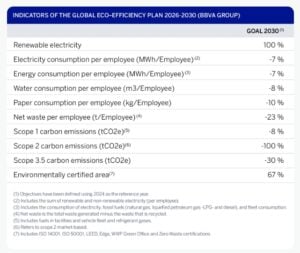
BBVA’s new 2026-2030 Global Eco-efficiency Plan focuses on reducing the environmental impact of the bank’s direct operations. The strategy builds on the strong results achieved under the 2021-2025 plan.
The bank now plans to source 100% of its electricity from renewable energy in the near future. It also wants to improve energy, paper, and water efficiency per employee while reducing indirect emissions linked to employee activities such as travel and transportation.
Another important target involves green buildings. BBVA aims to ensure that at least two-thirds of its facilities hold environmental certifications by the end of the decade.
The bank designed the new roadmap with input from local teams across all countries where it operates. This approach allows BBVA to maintain a global strategy while adapting solutions to local market conditions.
Alberto Agustín, Head of Premises and Services at BBVA, said:
“The new plan is a key lever to reduce the environmental impact of our direct activities. This approach reinforces our commitment to more efficient building management by relying on technology and increasingly stringent standards. We are building on a very strong foundation, with significant progress in all indicators. Now, we are taking it a step further and raising our sights to continue reducing consumption and emissions across our entire real estate network. Beyond the targets, this plan consolidates a culture of environmental efficiency and responsibility throughout the entire organization, where every building and every team contributes to a common aim,” he added.
Five Core Areas Drive the Strategy
The eco-efficiency plan centers on five main pillars.
Renewable Energy Expansion
BBVA plans to increase renewable electricity use through power purchase agreements, renewable energy certificates, and on-site renewable generation systems.
The bank already uses renewable energy contracts in Spain, Mexico, Türkiye, and Argentina. It also operates solar installations in several countries, including Spain, Mexico, Peru, Uruguay, Türkiye, and Argentina.
Energy Efficiency Improvements
The bank will continue upgrading office infrastructure to lower energy use. Planned improvements include modern lighting systems, smarter climate control technologies, and better building management systems.
These upgrades aim to reduce operational costs while lowering emissions.
Sustainable Mobility
BBVA is also working to reduce transportation-related emissions. The company plans to gradually replace its vehicle fleet with electric or low-emission vehicles.
In addition, it encourages employees to adopt greener commuting options. The bank already offers electric vehicle charging stations, shared transport services, and corporate shuttle systems in some regions.
Better Waste and Resource Management
The bank wants to reduce water use, cut paper consumption, and improve recycling and waste recovery systems across its operations.
These measures support BBVA’s broader goal of lowering the environmental footprint of its offices and facilities.
Operational Decarbonization
The final pillar focuses on reducing both direct and indirect emissions linked to the bank’s activities.
BBVA uses internal financial incentives to push business units toward lower emissions. In 2025, the bank retired 167,532 carbon credits and maintained an internal carbon price of €32 per ton.
This system charges departments according to their carbon footprint. For example, emissions from business travel are reflected in local budgets. The idea is to encourage teams and employees to consider the environmental cost of their decisions.
Scope 3 Emissions Remain the Biggest Challenge
Like many global banks, most of BBVA’s emissions do not come from office buildings or company vehicles. Instead, they come from financed emissions linked to loans and investments.
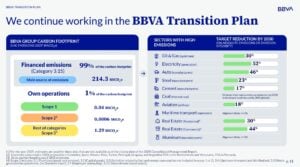
- These indirect emissions, known as Scope 3 emissions, account for about 99% of the bank’s total carbon footprint.
To address this issue, BBVA has developed sector-specific transition plans and monitoring systems. The bank has also set intermediate emissions reduction targets for 2030 to align its financing portfolio with global decarbonization pathways.
This effort is especially important because banks play a major role in financing industries such as energy, transport, manufacturing, and infrastructure. Their lending decisions can strongly influence the pace of the global energy transition.
Sustainable Business Activity Continues to Grow
Alongside reducing its own emissions, BBVA is increasing financing for sustainable projects and businesses.
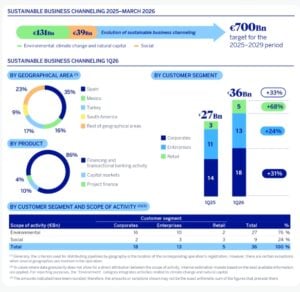
In the first quarter of 2026, the bank channeled €36 billion into sustainable business activities. This marked a 33% increase compared to the same period a year earlier.
Of this amount, €27 billion supported environmental initiatives linked to climate action and natural capital. The remaining €9 billion is focused on social projects and challenges.
Spain represented the largest share of sustainable business activity during the quarter at 35%. Türkiye followed with 17%, while Mexico contributed 16%. South America accounted for 9%, and other regions made up the remaining 23%.
Most of the financing came through traditional lending and transactional banking services, which represented 86% of the total. Capital markets activities accounted for 10%, while project finance contributed 4%.
The bank has now reached €170 billion toward its larger €700 billion sustainable business target for the 2025-2029 period.
The details are displayed in the image below:
BBVA Links Growth With Sustainability
BBVA’s latest strategy shows how major financial institutions are increasingly combining business growth with environmental goals.
The bank has already achieved sharp reductions in operational emissions and resource consumption. Now it is shifting attention toward harder challenges, such as financed emissions and sector-wide decarbonization.
Its growing sustainable finance business also highlights rising demand for funding tied to renewable energy, efficient resource use, and climate solutions.
As regulators, investors, and customers push companies toward lower emissions, banks like BBVA are expected to play a larger role in financing the global transition to a low-carbon economy.