


Google just made it easier for advertisers to go green. The tech giant has launched Carbon Footprint for Google Ads—a new tool that helps marketers measure and manage the carbon emissions from their ad campaigns.
After testing it with a few large advertisers earlier this year, Google has now opened it up to everyone. The tool gives users access to first-party data showing how much carbon their ads produce across Google Ads, Display & Video 360 (DV360), Search Ads 360 (SA360), and Campaign Manager 360 (CM360).
Understanding Ad Emissions with Google’s Carbon Footprint Tracker
The Carbon Footprint tool is designed to help advertisers see the bigger picture when it comes to sustainability. It breaks down emissions data across Scopes 1, 2, and 3, following the Greenhouse Gas Protocol and the Ad Net Zero Global Media Sustainability Framework. These standards make sure the numbers are accurate and in line with global climate reporting guidelines.
Here’s what advertisers can do with it:
- Get detailed, account-specific data: The tool uses Google’s first-party data to calculate emissions for each account based on targeting, media mix, and auction activity.
- Use trusted standards: Reports follow the Greenhouse Gas Protocol (GHGP) and Global Media Sustainability Framework (GMSF), which means the data meets international sustainability benchmarks.
- See exactly where emissions come from: Reports split the data into Scopes 1, 2, and 3, including both market- and location-based Scope 2 figures.
With this information, advertisers can identify where their emissions are highest—and take steps to reduce them.
Easy Access, Fresh Data
Advertisers using Google Ads, DV360, SA360, or CM360 can request their Carbon Footprint report directly from Google. Reports are updated every month and include data starting from January 2024.
For instance, if you request a report on October 20, 2025, it will include data from January 2024 through September 2025. Advertisers can submit up to five report requests a day, each covering up to 25 account IDs. Google processes up to 10,000 total requests daily across all advertisers.
Location-based emissions estimates for Google Ads go back to January 2024, while both market-based and location-based estimates for DV360, SA360, and CM360 start from July 2024.
- READ MORE: Google Hits $3 Trillion and Stock Surges to All-Time High: What About Its Net-Zero Goals?
Making Advertising More Sustainable
Google’s rollout of this tool is a big step for the ad industry. It helps marketers better understand their environmental footprint and gives them the insights they need to take action.
This isn’t just about meeting compliance requirements—it’s about making smarter choices. Advertisers can use this data to plan more efficient campaigns, reduce waste, and make their marketing strategies more eco-friendly.
In today’s world, sustainability isn’t just good ethics—it’s good business. Consumers increasingly want to support brands that care about the planet. By taking steps to reduce emissions, companies can boost their reputation and connect with those values.
Google’s Commitment to Green Tech
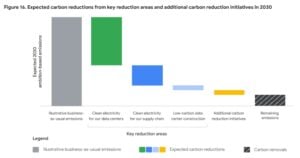
This launch fits perfectly with Google’s long-term sustainability goals. The company aims to run entirely on carbon-free energy and reach net-zero emissions by 2030. By giving advertisers access to tools like Carbon Footprint for Google Ads, Google is encouraging other businesses to follow the same path.
It also ties into Google’s broader eco-friendly efforts, from promoting sustainable shopping filters to helping companies track emissions through Google Cloud. Altogether, these tools show Google’s belief that sustainability should be built into digital products, not added as an afterthought.
Cutting Emissions Amid AI Growth
The company’s total greenhouse gas emissions have risen 51% since 2019, with AI being a key driver. However, its latest sustainability report revealed a notable achievement: a 12% drop in energy emissions from its data centers in 2024, even as AI demand surged.
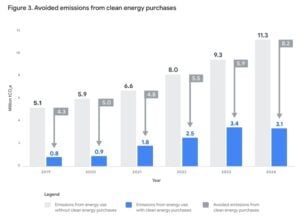
These data centers form the backbone of its AI operations. In 2024, they consumed 30.8 million megawatt-hours of electricity, more than twice the level recorded in 2020. The surge underscored the immense energy needs behind AI’s rapid expansion.
Despite the spike in power use, up 27% year-over-year, Google successfully reduced its direct emissions. The company credited this to long-term clean energy contracts, efficiency upgrades, and advanced cooling systems, which helped curb climate impact while keeping pace with AI-driven workloads.
In short, Google showed that scaling AI and cutting emissions can go hand in hand with the right technology and commitment.
A Step Toward Cleaner Advertising
If widely adopted, this tool could transform how the industry thinks about advertising. For years, the ad world has been criticized for its environmental impact, from data centers powering digital ads to the energy used in ad production. Now, there’s a concrete way to track and improve those impacts.
But the real change will come from how advertisers use this data. Measuring emissions is just the first step—acting on that information is what really counts. Companies that use these insights to reduce their footprint could set the standard for greener marketing practices.
Thus, Google’s Carbon Footprint for Google Ads shows that advertising is sustainable. It allows brands to balance performance with responsibility, proving that effective marketing doesn’t have to come at the planet’s expense.
As more advertisers embrace this kind of transparency, sustainability could become a standard metric alongside reach and engagement. And that’s a big win for both business and the environment.
Google’s move shows that every click, impression, and campaign can be measured not only by what it achieves—but also by its impact on the world around us.