

India is stepping into the global AI race with bold ambition. The Adani Group has unveiled a massive USD 100 billion plan to build renewable-powered, AI-ready hyperscale data centers by 2035. The strategy goes beyond digital infrastructure. Instead, it combines clean energy, advanced computing, and sovereign control into one integrated national platform.
If delivered as planned, this initiative could reshape India’s role in the global AI economy.
A $250 Billion Renewable-Backed AI Ecosystem Taking Shape
First and foremost, the scale of investment stands out. Adani’s direct $100 billion commitment is expected to catalyze another $150 billion across server manufacturing, advanced electrical systems, sovereign cloud platforms, and related industries. As a result, India could see the creation of a $250 billion AI infrastructure ecosystem over the next decade.
Currently, India’s data center capacity stood at 1,263 MW last year. However, projections suggest this could exceed 4,500 MW by 2030, backed by up to $25 billion in investments. At present, nearly 80% of capacity is concentrated in three metro cities. Therefore, policymakers are now pushing for more balanced regional expansion.
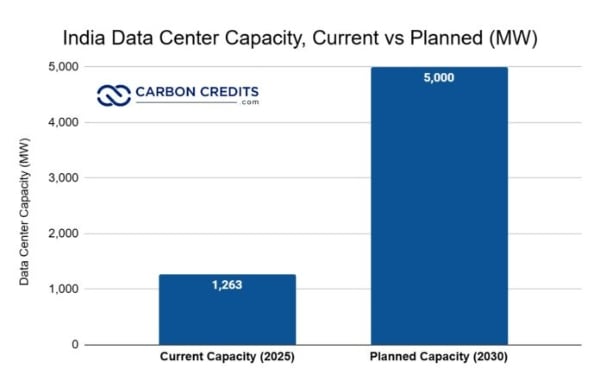
This broader vision aligns closely with AdaniConnex’s roadmap. The company plans to expand its existing 2 GW national footprint toward a 5 GW target. Consequently, India could emerge as one of the world’s largest integrated renewable-powered AI data center platforms.
Importantly, strategic partnerships are already in motion. The Group is working with Google to build a gigawatt-scale AI data center campus in Visakhapatnam. At the same time, it is collaborating with Microsoft on major campuses in Hyderabad and Pune.
In addition, discussions with Flipkart aim to develop a second AI-focused facility tailored for high-performance digital commerce and large-scale AI workloads. Together, these alliances strengthen India’s ambition to become a serious AI infrastructure hub.
Integrating Renewable Energy and Hyperscale Compute
Unlike traditional data center projects, this 5 GW rollout integrates renewable power generation, transmission networks, storage systems, and hyperscale AI computing within a single coordinated architecture. In other words, energy and compute capacity will expand together, not separately.
- This approach matters because AI workloads are becoming increasingly energy-intensive. Modern AI racks often draw 30 kW or more per unit.
- Therefore, high-density compute clusters require advanced liquid cooling systems and efficient power designs to maintain uptime and reduce waste.
At the same time, data sovereignty remains a priority. Dedicated compute capacity will support Indian large language models and national data initiatives. As a result, sensitive data can remain within the country while still benefiting from global-scale infrastructure.
Reliable transmission networks and resilient grids will underpin the system. By aligning generation, storage, and processing, the platform aims to ensure stability even at hyperscale.
Leveraging India’s Renewable Advantage
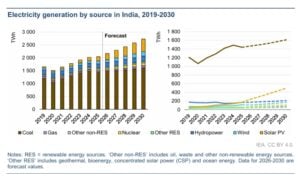
AI growth is directly tied to energy access. Globally, the surge in AI adoption has triggered concerns about rising electricity demand and carbon emissions. According to the IEA, 83 percent of India’s power sector investment in 2024 went to clean energy.
Adani plans to anchor its AI expansion on renewable energy. A key pillar is the 30 GW Khavda renewable project in Gujarat, where more than 10 GW is already operational. Moreover, the Group has pledged another $55 billion to expand its renewable portfolio, including one of the world’s largest battery energy storage systems.
Battery storage will help manage peak loads and smooth intermittent renewable supply. Consequently, hyperscale AI campuses can operate reliably without heavy reliance on fossil fuels.
In addition, cable landing stations at Adani-operated ports will enhance global connectivity. These links will support low-latency data flows between India and major regions across the Americas, Europe, Africa, and Asia. Thus, India’s AI infrastructure will remain globally integrated while being powered by domestic renewable energy.
Building Domestic Supply Chains and Digital Sovereignty
Another critical element of the strategy focuses on reducing supply-chain risks. Global disruptions have exposed vulnerabilities in sourcing transformers, power electronics, and grid systems. Therefore, Adani plans to co-invest in domestic manufacturing partnerships to produce high-capacity transformers, advanced power electronics, inverters, and industrial thermal management solutions within India.
This step not only lowers external dependence but also strengthens India’s industrial base. Over time, the country could evolve from being a data hub into a producer and exporter of next-generation AI infrastructure.
Furthermore, the Group intends to integrate agentic AI across its logistics, ports, and industrial corridors. By doing so, it connects digital intelligence with physical infrastructure. This alignment supports national infrastructure programs while modernizing heavy industries through secure automation.
Expanding Access to High-Performance Compute
Beyond infrastructure scale, accessibility is equally important. India’s AI startups and research institutions often face compute shortages. Therefore, Adani plans to reserve a portion of GPU capacity for domestic innovators.
This move could significantly reduce entry barriers for startups and deep-tech entrepreneurs. As a result, innovation may accelerate across sectors such as healthcare, logistics, climate modeling, and advanced manufacturing.
The strategy also aligns with India’s five-layer AI framework—applications, models, chips, energy, and data centers. By participating across these layers, the Group strengthens the entire AI stack.
In parallel, partnerships with academic institutions will establish AI infrastructure engineering programs and applied research labs. A national fellowship initiative will further address the country’s growing AI skills gap.
India’s AI Data Center Market Gains Massive Momentum
Meanwhile, market fundamentals remain strong. According to Mordor Intelligence, India’s AI-optimized data center market is valued at $1.19 billion in 2025 and could reach $3.10 billion by 2030, growing at over 21% annually.
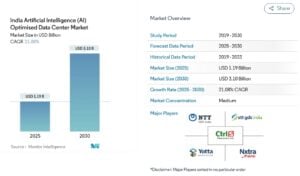
Several factors are driving this acceleration. Data localization requirements are tightening. Enterprises increasingly treat sovereign data processing as a strategic necessity rather than a cost burden. Moreover, energy-efficient AI hardware and hyperscale cloud expansions are fueling capital expenditure.
The Mumbai–Bangalore corridor has emerged as a key AI backbone due to its fiber density, cloud presence, and renewable energy agreements. Major hyperscalers have expanded aggressively, creating spillover demand for colocation providers and secondary cities.
Taken together, Adani’s $100 billion renewable-powered AI platform represents one of the most ambitious integrated energy-and-compute commitments ever announced at a national scale.
Importantly, this is about aligning renewable energy, grid resilience, hyperscale compute, domestic manufacturing, and digital sovereignty into a single long-term strategy. It would reduce India’s compute scarcity, accelerate clean energy deployment, and secure a leadership role in the global Intelligence Revolution.