

Amazon has signed a new long-term clean energy purchase agreement with RWE, one of Europe’s largest renewable energy developers. The deal is a Power Purchase Agreement (PPA) for 110 megawatts (MW) of power. This electricity comes from RWE’s Nordseecluster B offshore wind project in the German North Sea.
RWE and Amazon stated that the contracted power would produce enough clean electricity for over 139,000 German households every year.
For Amazon, the deal supports its climate commitment to reach net-zero carbon across its operations by 2040 under The Climate Pledge. For RWE, the contract helps finance a large new offshore wind build-out and adds a stable, long-term buyer for the project’s output.
Rocco Bräuniger, Amazon Country Manager for Germany, Austria, and Switzerland, stated:
“Germany is transitioning toward a modern, carbon-free energy system, and this agreement with RWE helps advance that vision. As Amazon works toward net-zero carbon by 2040, we continue enabling projects that strengthen Germany’s renewable energy capacity for generations to come.”
Nordseecluster: A Two-Phase Offshore Wind Giant in the North Sea
Nordseecluster is a major offshore wind development that RWE is building in two phases. The project sits in the German North Sea. Nordseecluster B is the phase tied to Amazon’s new 110 MW contract.
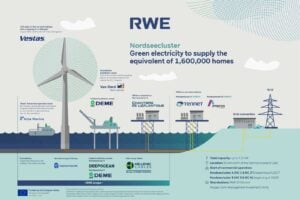
According to reporting based on company details, Nordseecluster A has a total capacity of 660 MW and is currently under construction. It is scheduled to begin operations in early 2027. Nordseecluster B adds another 900 MW and is expected to begin commercial operation in 2029.
- RWE said Nordseecluster is a joint project between RWE (51%) and Norges Bank Investment Management (49%).
The Amazon deal is a corporate PPA. That means the tech giant agrees to buy a defined amount of clean electricity tied to a specific project over a long period. These long-term contracts often help developers secure financing because they reduce revenue uncertainty. RWE’s press statement also framed PPAs as important tools for accelerating decarbonization while supporting supply security.
Ulf Kerstin, CCO at RWE Supply & Trading, noted:
“Power Purchase Agreements like this one with Amazon are crucial for accelerating Germany’s decarbonisation while strengthening long-term security of supply. By enabling large-scale offshore projects such as Nordseecluster, we can bring more reliable, carbon-free electricity onto the grid and support a resilient energy system.”
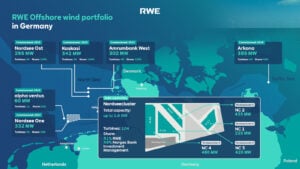
The image below shows RWE’s offshore wind portfolio in the German territory.
Rising Power Demand Meets Long-Term Clean Energy
Amazon’s electricity needs are rising, especially from logistics and fast-growing data infrastructure. Data centers also require reliable electricity 24 hours a day. That creates demand for large amounts of power, and it increases pressure to source cleaner electricity.
Amazon has made carbon-free energy a key part of its climate strategy. The company’s sustainability site states it plans to use more carbon-free energy. This is part of its goal to achieve net-zero carbon emissions by 2040.
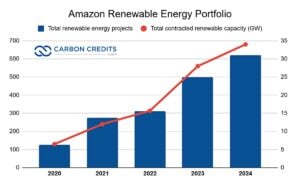
The company has also expanded its renewable energy procurement rapidly. In its 2024 Amazon Sustainability Report, Amazon said that as of January 2025, it had invested in 621 renewable energy projects globally. It said 124 of those projects were added in 2024. Together, these projects represent 34 gigawatts (GW) of carbon-free energy capacity.
Amazon reported that for the second year in a row, it matched 100% of the electricity used in its global operations with renewable energy. This was highlighted in its 2024 report and summaries. This does not mean every Amazon site runs on renewables every hour.
The company usually buys enough renewable energy to cover its yearly electricity use. This is done through PPAs and certificates, which vary by region and structure.
In Germany, Amazon has built a growing clean energy portfolio. RWE and Amazon said the Nordseecluster agreement is the tech company’s fourth large-scale offshore wind PPA in Germany.
Amazon also has six on-site solar projects in the country. Together, Amazon’s 10 renewable projects in Germany total more than 790 MW of capacity. When fully operational, they should generate enough renewable electricity to power over 1,000,000 German homes each year.
That “homes powered” figure is an equivalency used to help readers understand scale. It does not mean Amazon supplies those homes directly. It means the wind and solar output from these projects is similar to what many households would use.
Amazon’s Net Zero Goals: Powering Growth While Cutting Carbon
Amazon has pledged to achieve net-zero carbon emissions by 2040. This goal is part of The Climate Pledge, which it helped create in 2019 with Global Optimism. The goal is ten years ahead of the Paris Agreement’s target. More than 500 companies have now signed the pledge.
In its 2024 Sustainability Report, Amazon announced it matched 100% of the electricity used in its global operations with renewable energy. This is the second year in a row it achieved this goal, hitting the target five years early.
Amazon’s total carbon emissions increased from about 64.4 million tonnes of CO₂e in 2023 to around 68.3 million tonnes of CO₂e in 2024. This rise is partly due to business growth and the expansion of data centers. However, the company reduced its carbon intensity (emissions per dollar of sales), showing improved efficiency.
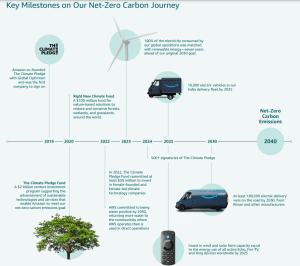
The company is also moving to reduce emissions in other ways. It is growing its electric delivery fleet. It increased from around 19,000 to over 31,000 electric vans in 2024. The goal is to reach at least 100,000 electric delivery vehicles by 2030.
Amazon also works to cut packaging waste, improve energy efficiency, and support suppliers in reducing their emissions. These efforts connect to Amazon’s rising energy demands. This is particularly true as it expands its data centers and logistics sites.
By scaling renewable energy, electrifying transportation, and improving energy efficiency, Amazon aims to balance growth with long-term climate progress.
Corporate PPAs Power the Next Wave of Offshore Wind
Germany continues to expand offshore wind because it can produce large volumes of electricity near major demand centers. Offshore wind also tends to generate more consistently than onshore wind, although it still varies with weather and season.
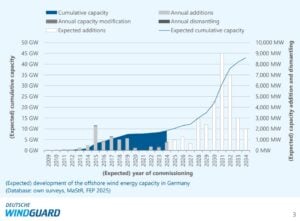
Corporate PPAs have become an important part of this market. They add demand from buyers beyond utilities and heavy industry. They also help fund projects by guaranteeing long-term revenue streams.
The Amazon–RWE deal also connects to a broader partnership between the two companies. The agreement builds on a Strategic Framework Agreement signed in June 2025. RWE backs Amazon’s goal for carbon-free energy. In return, Amazon helps RWE with digital changes using cloud services, AI, and data analytics from Amazon Web Services (AWS).
This pairing is becoming more common in the clean energy market. Utilities need digital tools to manage grids with higher shares of wind and solar. Tech firms need reliable clean energy for data infrastructure and long-term contracts can serve both sides.
What’s Next? Delivery Timelines, Grids, and the Next Energy Mix
The 110 MW deal adds another major offshore wind purchase to Amazon’s Germany portfolio. It also shows that long-term corporate PPAs remain important for financing offshore wind.
Several practical issues will shape the outcome. Nordseecluster B is due to start operating in 2029, but delays could shift when Amazon receives power. Grid integration is another challenge. Offshore wind output varies, and matching electricity use hour by hour is harder as data center demand grows.
Amazon’s broader energy strategy also matters. By January 2025, it had 621 clean energy projects and 34 GW of carbon-free capacity worldwide. The company is expanding beyond wind and solar, including nuclear investments, to support round-the-clock power needs.
Overall, the Amazon–RWE deal signals continued demand for long-term clean electricity as offshore wind expands in Germany’s North Sea and beyond.