


A U.S. federal judge has dismissed a proposed class-action lawsuit accusing Apple of misleading consumers with “carbon neutral” marketing for several Apple Watch models. The case targeted the Apple Watch Series 9, Apple Watch SE, and Apple Watch Ultra 2. Plaintiffs said the company exaggerated the environmental benefits of the watches. They claimed Apple relied on carbon offset projects that did not truly cancel the products’ emissions.
Seven buyers filed the lawsuit in February 2025 in federal court in California. They argued they would not have bought the watches, or would have paid less, if they knew the details of Apple’s carbon accounting.
In February 2026, U.S. District Judge Noël Wise dismissed the case. The court ruled the complaint lacked strong evidence showing Apple’s carbon-neutral claims were false or misleading. Wise said:
“At this juncture, the court has a narrow question to consider: have plaintiffs plausibly alleged that Apple’s claims of carbon neutrality are false? Because the court finds that the answer to that question is no, Apple’s motion to dismiss is granted.”
The ruling gives Apple an early legal win. But it also highlights growing scrutiny of corporate climate marketing.
How Apple Calculates a “Zero-Emission” Watch
Apple launched its first carbon-neutral devices in September 2023. The company said the Apple Watch models achieved neutrality through a mix of emissions reductions and carbon offsets.
For example, Apple estimates the lifecycle carbon footprint of a carbon-neutral watch model at about 8.1 kg of CO₂-equivalent emissions per device before offsets. After applying carbon credits, Apple says the net footprint becomes 0 kg CO₂e.
The tech giant says it lowers emissions by:
- using recycled materials,
- increasing renewable electricity in manufacturing,
- improving product efficiency, and
- reducing shipping emissions.
Any remaining emissions are offset through environmental projects.
The lawsuit challenged two offset projects tied to Apple’s claims. One project protects forests in Kenya’s Chyulu Hills, while another supports reforestation efforts in China. Critics argued such projects may not always deliver additional carbon reductions.
The court did not rule on the scientific debate over offsets. Instead, it said the plaintiffs failed to show Apple’s claims were clearly deceptive.
The Tech Giant’s 2030 Net-Zero Roadmap
Apple’s carbon-neutral watches are part of a larger climate plan known as “Apple 2030.” The company aims to make its entire business, supply chain, and product lifecycle carbon neutral by 2030.
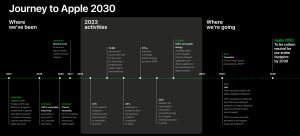
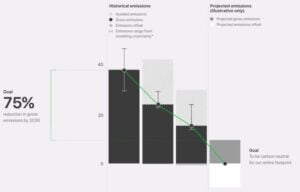
The iPhone maker has made progress toward that goal. The company says its global greenhouse gas emissions have fallen by more than 60% compared with 2015 levels.
In 2024, Apple reported a total carbon footprint of about 16.5 million metric tons of CO₂-equivalent emissions across its operations and supply chain. That figure represented a decline from the previous year.
Most of Apple’s emissions come from Scope 3 sources, including manufacturing and product use. To address that, it works closely with suppliers. The company reports that 17.8 gigawatts of renewable electricity are now operating in its global supply chain. Those projects helped avoid about 21.8 million metric tons of greenhouse gas emissions in 2024 alone.
Apple has also increased recycled materials in its products. About 24% of the materials used in Apple devices in 2024 came from recycled or renewable sources. These efforts are central to the company’s climate strategy.
Greenwashing on Trial: Climate Claims Face Legal Tests
Even though Apple won the U.S. case, climate lawsuits are rising worldwide. Greenwashing claims typically challenge marketing statements such as:
- “carbon neutral”
- “net zero”
- “climate friendly”
These terms can involve complex carbon accounting that consumers may not fully understand.
Apple has faced legal pressure outside the United States as well. A court in Frankfurt, Germany ruled in 2025 that Apple could not advertise the Apple Watch as “CO₂-neutral” in Germany. The court said the claim could mislead consumers under local competition law.
European regulators are also tightening rules on environmental claims. New EU consumer protection rules will restrict vague labels like “carbon neutral” in advertising beginning in 2026. These legal developments could reshape how companies communicate climate progress.
Big Tech Emissions: Clean Energy vs. Rising Power Demand
The Apple case reflects a larger trend in the technology sector. Tech companies are under growing pressure to cut emissions as demand for digital services rises.
Data centers, cloud computing, and artificial intelligence require massive amounts of electricity. As a result, technology firms are investing heavily in renewable energy and carbon removal projects.
Apple’s progress contrasts with some peers whose emissions have risen due to expanding AI infrastructure. Apple still emitted about 15.3 million metric tons of CO₂ in 2024, but that figure is far below its 2015 baseline of 38.4 million tons.
At the same time, clean energy adoption is growing globally. The rapid expansion of renewable power also supports other low-carbon industries, including electric vehicles.

Companies such as Tesla rely heavily on the decarbonization of electricity systems. The climate benefit of electric cars increases when power grids shift toward renewable energy.
Global electric vehicle adoption is rising quickly. According to the International Energy Agency, EVs represented about 20% of global car sales in 2024, compared with 18% in 2023 and just 4% in 2020. That growth is expected to continue as governments strengthen climate policies and consumers adopt cleaner transportation.
Technology companies and automakers both depend on credible climate strategies to maintain investor confidence.
The Role of Carbon Credits in Corporate Climate Plans
Carbon credits remain a key tool for many companies pursuing net-zero goals. Apple increased its use of carbon credits in 2024, retiring about 737,100 tons of CO₂-equivalent offsets—its highest level to date.
Carbon offsets support several projects such as:
- forest protection,
- reforestation,
- methane capture, and
- renewable energy development.
However, the quality of carbon credits has become a major issue in climate policy.
Some researchers argue that certain nature-based credits may overestimate their climate impact. Others say these projects are essential for protecting ecosystems and funding conservation. The debate is likely to intensify as more corporations adopt net-zero targets.
A Legal Win, but Climate Claims Under the Microscope
Apple’s victory in the U.S. greenwashing lawsuit marks an important moment in the evolving field of climate litigation. The court ruled that the plaintiffs did not present enough evidence to prove the tech giant’s carbon-neutral claims were misleading.
However, the case also shows how closely corporate climate messaging is now examined. Companies across technology, energy, and transportation sectors face growing pressure to show real emissions reductions and transparent reporting.
As the clean-energy transition accelerates, and industries from consumer electronics to electric vehicles expand, clear standards for climate claims will become increasingly important.
For Apple and other global companies, the challenge is not only reducing emissions but also proving those reductions in ways that stand up to scientific, legal, and public scrutiny.