

ArcelorMittal will invest €1.3 billion (about $1.5 billion) to build a new electric arc furnace (EAF) at its steel site in Dunkirk, France. The company said the project marks a major step in cutting emissions from its French steel production.
The steelmaker announced the decision as French President Emmanuel Macron visited the Dunkirk site. ArcelorMittal said it now has more confidence to move forward because of recent policy and market changes in Europe and France. CEO Geert van Poelvoorde said,
“The decision to proceed with building an EAF in ArcelorMittal Dunkirk, to produce low-carbon emissions steel at scale for our customers, has been made possible because we now have the conditions in place to make this project a success…We will now focus on steering the Dunkirk EAF project to completion and commercial success.”
The EAF is scheduled to start up in 2029. It will have a capacity of 2 million tonnes of steel per year.
A 2M-Tonne Shift Toward Scrap-Based Steel
Electric arc furnaces make steel mainly by melting scrap steel. They can also use low-carbon inputs like HBI/DRI (hot briquetted iron / direct reduced iron) mixed with hot metal. ArcelorMittal said its Dunkirk EAF will use a mix of scrap, HBI/DRI, and hot metal.
The company also gave a clear emissions estimate. It said the new EAF will emit about 0.6 tonne of CO₂ per tonne of steel and deliver three times less CO₂ than steel made in a blast furnace route.
This matters because steel is a hard sector to decarbonize. The industry produces significant CO₂e emissions, due to energy-intensive processes and heavy fossil fuel use.
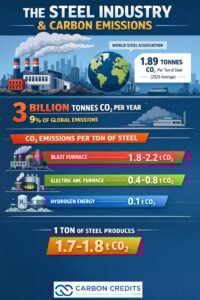
Per World Steel Association, the steel industry produces ~3 billion tonnes of CO₂ annually, accounting for ~9% of global emissions. The industry emits an average of 1.89 tonnes CO₂ per tonne in 2020. Producing one tonne of steel generates 1.7-1.8 tonnes of CO₂ on average, depending on technology use as seen below.
How Will France Support the Investment?
ArcelorMittal said part of the project will receive public support through Energy Efficiency Certificates (CEE). CEE is a regulatory mechanism in France that promotes energy savings and CO₂ reductions. The company said the support amount will represent 50% of the €1.3 billion investment.
The steelmaker also pointed to a key energy step in France. It said it recently signed a contract with EDF to secure a long-term supply of low-carbon, competitive electricity. The company described this as a major part of its energy strategy in France.
Electricity supply is critical for EAFs. The carbon benefit of an EAF depends heavily on how clean the grid is and how stable power prices are over time.
Why Did ArcelorMittal Invest in Bunkirk?
ArcelorMittal said three developments gave it confidence to confirm the Dunkirk investment.
- Import Controls
First, it cited new European Commission proposals to limit unfair imports through a Tariff Rate Quota (TRQ) mechanism. ArcelorMittal said this approach would limit import quantities and impose additional duties if imports exceed set limits.
- CBAM
Second, it pointed to proposed reforms to the EU’s Carbon Border Adjustment Mechanism (CBAM). ArcelorMittal said it expects these measures—if fully implemented—to restore “fair and competitive conditions” in the European steel market.
CBAM is the EU’s tool to apply a carbon price to certain carbon-intensive goods entering the EU. The European Commission says CBAM’s transitional phase runs from 2023 to 2025, and the definitive regime starts in 2026.
ArcelorMittal’s message was direct. It said it is important to implement the TRQ and adjust CBAM to close remaining loopholes as quickly as possible.
- EDF Deal
Third, it highlighted its EDF electricity deal as another factor supporting the project.
€500M Bet on Electrification Demand
ArcelorMittal also highlighted another major investment near Dunkirk. At its Mardyck plant, close to Dunkirk, the company said it is starting up a new electrical steel production unit this quarter.
It said the company invested €500 million in this facility. ArcelorMittal described it as its largest investment in Europe in the last 10 years, excluding decarbonization projects.
Electrical steel is used in electric motors and other electrification applications. ArcelorMittal said the new plant supports the electrification of industrial and automotive uses. This point matters for demand.
Steelmakers often need clearer long-term demand signals for low-carbon materials before committing large capital to new production routes.
- SEE MORE: Steel’s Heavy Carbon Burden: Is ArcelorMittal Pulling Back on Its Net Zero Climate Pledge?
From Blast Furnaces to EAFs: ArcelorMittal’s Broader Decarbonization Program
ArcelorMittal says it remains committed to reaching net-zero emissions by 2050. The company set this as a group-wide goal in 2020.
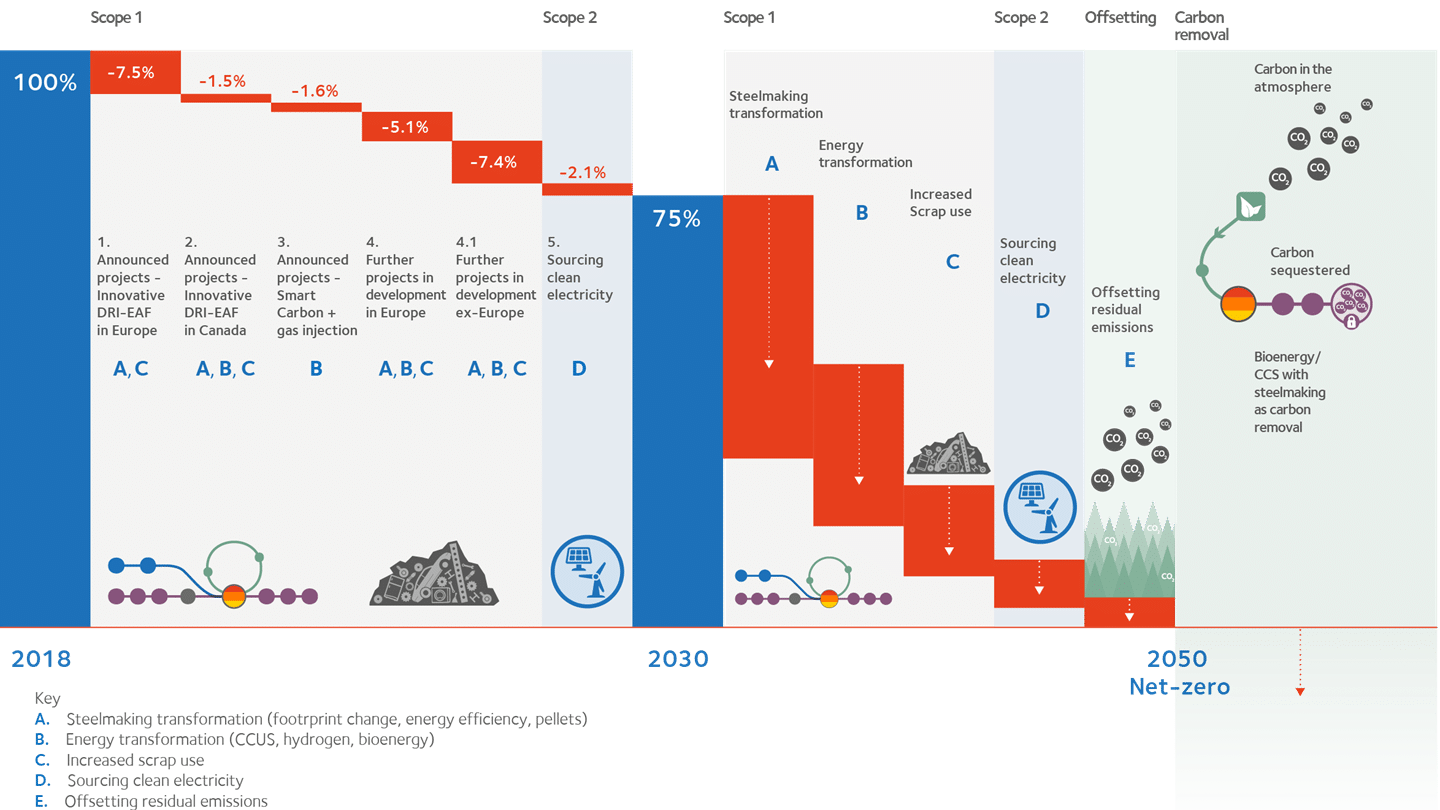
In its latest sustainability update, ArcelorMittal’s absolute emissions for its 2024 operating perimeter are almost 50% lower than its 2018 operating perimeter. The steel manufacturer further said it has invested $1 billion in decarbonization projects over that period.
The company is also shifting more steel production to the electric arc furnace (EAF) route. EAF production accounted for about a quarter of its global steelmaking in 2024, up from 19% in 2018.
In Europe, ArcelorMittal is moving ahead with several EAF-led projects. It said it started construction of a 1.1 million-tonne EAF at its long products plant in Gijón, Spain, which it expects will cut emissions by 1 million tonnes of CO₂e. It is also increasing output at Sestao, Spain, to 1.6 million tonnes by 2026, using two EAFs.
ArcelorMittal markets its low-carbon products under the XCarb® brand. The company said it can deliver low-carbon steel with a footprint as low as 300 kg CO₂ per tonne of steel, and it expected XCarb sales to rise to around 400,000 tonnes in the year it reported.
More notably, the company already operates an industrial-scale carbon capture and utilization (CCU) facility at Ghent, Belgium, with two additional pilots underway at the same site.
Carbon Pricing and Competitiveness Reshape Steel
Steel decarbonization requires major capital and new infrastructure. It also needs policy support that reduces carbon leakage risk and helps companies compete with lower-cost imports.
The EU’s CBAM design aims to put a fair carbon price on imports and reduce the incentive to shift production outside the EU. The Commission notes that CBAM is also aligned with the phase-out of free allowances under the EU ETS to support industrial decarbonization.
At the same time, the steel sector still needs faster progress on emissions cuts. The IEA notes that steel emissions and emissions intensity need to fall by about 25% by 2030—around 3% per year—to get on track for net zero by mid-century.
ArcelorMittal’s Dunkirk EAF fits this direction. It shifts part of production toward a lower-emissions process and signals confidence that market rules are moving toward stronger climate and competitiveness safeguards.
Execution Phase: Can Policy and Profit Align?
ArcelorMittal said it will now focus on delivering the Dunkirk EAF project through to completion and commercial success.
The company also said it will review the possibility of building further EAFs elsewhere in Europe, but it plans to take a cautious approach based on its “economic decarbonisation” strategy.
For France, the project adds to broader efforts to keep heavy industry competitive while cutting emissions. Meanwhile, it reflects a wider shift toward low-carbon industrial investment for Europe backed by border measures, market defenses, and energy contracts.
For customers, the key outcome is supply. A 2-million-tonne EAF could provide lower-carbon steel at scale, starting in 2029, if the project stays on schedule and the policy measures ArcelorMittal cited take effect as planned.