

Two fresh developments put carbon policy and carbon credits back in the spotlight. First, a new peer-reviewed study in Nature Communications estimates that national climate policy packages reduced real-world emissions substantially in 2022. Second, the UN carbon market approved the first-ever issuance of credits under the Paris Agreement.
Both stories focus on one core issue. Countries need to cut emissions fast, and they need tools they can trust. Policy rules can push change inside national borders. Carbon credits can help move money to projects that cut emissions on the ground. The hard part is proving results and avoiding double-counting.
What the New Study Measured: Inside the 3,917-Policy Climate Dataset
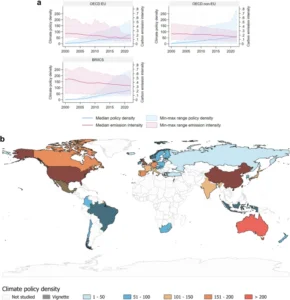
The Nature Communications study looks at national “policy portfolios.” That means many climate policies work together, not one rule at a time. The authors used the International Energy Agency (IEA) Policies and Measures Database and built a dataset of 3,917 climate policies from 2000 to 2022. They studied 43 countries, covering OECD members plus major emerging economies in the BRIICS group.
The study links larger and stronger policy portfolios with faster declines in fossil CO₂ emission intensity. Emission intensity means CO₂ per unit of economic output.
The paper also finds that policy results improve when countries pair policies with clear long-term targets and supportive institutions. The authors point to factors like national emissions reduction targets and dedicated energy or climate ministries.
The study’s most cited figure is its estimate of “avoided emissions.” The authors compare observed emissions to a counterfactual case where those policy portfolios did not exist.
- Across the full 43-country sample, they estimate 27.5 GtCO₂ avoided over 2000–2022, and 3.1 GtCO₂ avoided in 2022 alone.
How Big is 3.1 Gigatons?
A reduction of 3.1 GtCO₂ in 2022 is large. It equals 3.1 billion tonnes of CO₂ in one year, compared with the study’s no-policy scenario. In comparison, the International Energy Agency reports that global energy-related CO₂ emissions reached over 36.8 Gt in 2022.
If you put those two numbers side by side, 3.1 Gt is roughly a single-digit share of global energy-related emissions in that year.
That comparison is not perfect because the study focuses on a 43-country sample and uses a specific method. Still, it gives a sense of scale. Climate policies can measurably reduce emissions, but the world still emits tens of gigatons each year.
The study also highlights that results vary by country group. For the BRIICS subset, it estimates 14.6 GtCO₂ avoided over 2000–2022, and 1.8 GtCO₂ avoided in 2022. This suggests emerging economies play a major role in the total, because their emissions are large and still changing fast.
Article 6.4 Moves From Blueprint to First Issuance
On 26 February 2026, the UNFCCC announced that a UN body approved the first credits to be issued under the UN carbon market created by the Paris Agreement. The approval covers a clean-cooking project in Myanmar that distributes efficient cookstoves. UNFCCC says the stoves reduce harmful household air pollution and reduce pressure on local forests.
This matters because Article 6.4 is meant to be the Paris Agreement’s centralized crediting system. It aims to generate “Article 6.4 Emission Reductions,” which countries can use to cooperate on meeting climate targets. The UNFCCC release frames this first approval as a shift from designing the market to operating it in the real world.
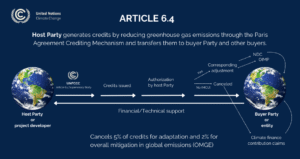
The release also includes details about how the credits will be used. It says the project is coordinated with authorized participants from the Republic of Korea.
Credits authorized for use in Korea can be transferred to Korean entities for use in the Korean Emissions Trading System. They can also support Korea’s climate target. UNFCCC says the remaining credits will support Myanmar’s own target.
The UN body also explains how it handled integrity concerns around older systems. It says the project previously received a provisional issuance under the Kyoto Protocol’s Clean Development Mechanism (CDM).
Under the Paris mechanism, the UN applied updated values and more conservative calculations. The Supervisory Body Chair, Mkhuthazi Steleki, said the credited reductions are about 40% lower than what older systems would have issued. He specifically noted:
“This initial issuance reflects the careful application of the rules set by countries under the Paris Agreement. By applying updated values and more conservative calculations, the credited reductions are about 40 percent lower than what older systems would have issued. The result is consistent with environmental integrity requirements and ensures that each credited tonne genuinely represents a tonne reduced and contributes to the goals of the Paris Agreement.”
UNFCCC notes that a short process step remains. Approval stays subject to a 14-day appeal period, during which project participants, the host country, and directly affected stakeholders can submit an appeal.
Policy Impact Meets Carbon Market Integrity
The Nature study and the UN issuance story connect in a simple way. The study focuses on what national policies can achieve at scale. The UN story focuses on how the world may credit and trade smaller project-level emission cuts under shared rules. Both depend on measurement and accounting.
- The Nature study tries to answer this question: Do policies, as a package, actually reduce emissions? It uses a cross-country econometric approach and estimates a 2022 “avoided emissions” value from those national portfolios.
- The UN carbon market tries to answer another question: Do project credits represent real reductions, and can countries use them without counting the same reduction twice? In the first issuance decision, UNFCCC emphasizes stronger safeguards and more conservative calculations compared with older crediting rules.
This matters for buyers and for governments. If credits overstate results, buyers may claim progress without a real climate impact. If countries double-count, global totals look better on paper than they are in the atmosphere. The UNFCCC framing of “about 40% lower than older systems” shows it wants to build credibility early.
Scale, Transparency, and the Real Test for Carbon Markets
The near-term question is scale. One issuance is symbolic, but global carbon markets and national plans need volume and variety.
UNFCCC says more than 165 host-Party-approved projects are in the pipeline to transition from the CDM into the new Paris Agreement Crediting Mechanism. It also says these activities span sectors such as waste management, energy, industry, and agriculture. That pipeline suggests more issuances could follow if projects meet updated standards.
At the same time, the Nature study suggests that national policy portfolios already avoid gigatons of emissions, but not enough to meet Paris goals on their own. That creates a practical lesson for carbon markets.
Carbon credits work best when they complement strong domestic policies, not replace them. Countries still need power-sector rules, efficiency standards, clean-industry support, and enforcement.