

Chery Automobile is steering full speed ahead. The Chinese carmaker posted record revenues and profits for Q4 2025, backed by a stronger global presence and growing investments in new energy vehicles (NEVs) and smart technology. While the future looks bright, investors should keep an eye on the challenges of NEV profitability and the costs of rapid expansion.
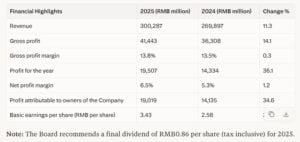
Last year, Chery’s net income jumped 34.6% to 19.02 billion yuan ($2.77 billion). This surge came on the back of record global deliveries of 2.63 million vehicles, an 8% rise from 2024.
Revenue also climbed 11.3% to 300.29 billion yuan. Despite tough competition in China’s passenger car market, Chery managed to slightly lift its overall gross margin to 13.8% from 13.5% the year before.
Financial highlights for the year ended 31 December 2025
NEVs Take the Spotlight
- Passenger vehicles made up the major revenue at 272.4 billion yuan, or 90.7% of total sales. NEVs stole the spotlight, with sales soaring 66.4% to 98 billion yuan, now making up almost a third of passenger vehicle revenue.
Traditional internal combustion engine (ICE) vehicles fell 7.2% to 174.3 billion yuan, reflecting the ongoing industry shift toward electrification. The surge in NEV sales shows how the market is changing fast, and Chery is clearly keeping pace.
Chery Going Global Pays Off
Chery’s international strategy is paying off.
- For the first time, overseas revenue outpaced domestic sales, jumping to 157.4 billion yuan from 100.9 billion yuan, while China’s sales dropped to 142.9 billion yuan.
This milestone highlights how Chery’s global expansion is more than a strategy—it’s a real driver of growth. It also shows the brand’s rising appeal outside China, particularly in markets that value affordable, high-tech, and energy-efficient vehicles.
A Rise in Gross Profit
Overall gross profit increased 14.1% to 41.4 billion yuan, but NEVs still lag behind ICE vehicles on margins, earning 8.8% compared to 15% for ICEs. As NEVs took up a larger share of the passenger vehicle mix, the core business margin slipped slightly to 12.8%.
The EV maker is investing heavily to meet rising global demand, pushing up capital expenditure, marketing, and R&D spending to build capacity and future models. Selling and distribution costs jumped 32.6% due to aggressive marketing campaigns, while research and development spending rose 23.8% as the company accelerated innovation for its next-generation vehicles.
Brand Performance Highlights
- Among Chery’s brands, Luxeed and iCar saw the fastest growth. Luxeed sold 90,493 vehicles, up 56% year-on-year, while iCar delivered 96,989 units, a 47% increase.
- Meanwhile, the premium Exeed brand fell 15% to 120,369 units, showing that not all segments are booming equally.
This show, Chery is clearly experimenting with a multi-brand approach, pushing emerging names forward while keeping an eye on premium offerings.
Chery’s Solid-State Batteries on the Horizon
Chery is doubling down on technology to stay ahead. According to the CnEV report, the company planned to unveil its solid-state battery technology at its upcoming “Battery Night,” promising ranges over 1,200 kilometers—a potential game-changer in the EV market.
The solid-state battery module showcased in October 2025 signals Chery’s serious step toward longer-range, high-performance electric vehicles, which could help it compete with international EV leaders.
Chery’s Emissions and Energy Use
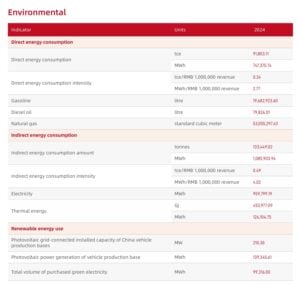
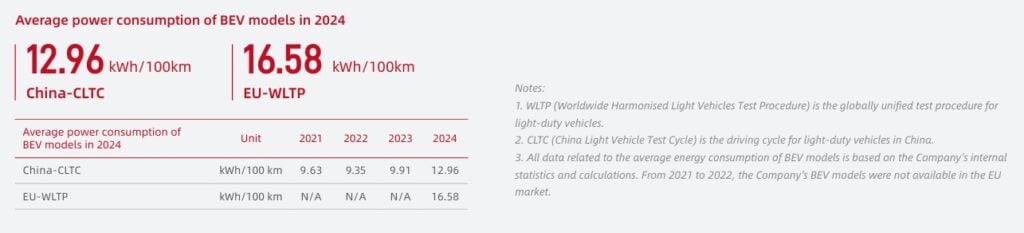
Chery is ambitious about cutting emissions and using energy more efficiently. In its 2024 ESG Report, the company tracks greenhouse gas emissions, energy consumption, and ways to make operations cleaner.
It reports both Scope 1 and Scope 2 emissions—direct emissions from the fuel it uses and indirect emissions from electricity.
- Scope 1 emissions rose from 140,000 to 203,000 tonnes of CO₂e in 2024, and total emissions for Scopes 1 and 2 reached over 733,000 tonnes.
- Emission intensity, which measures CO₂e per vehicle, rose slightly to 0.30 tCO₂e, reflecting changes in production and energy use.
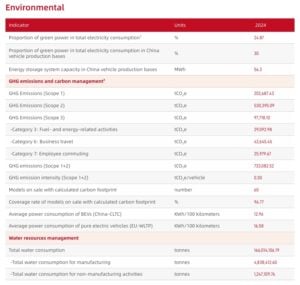
Chery’s energy strategy focuses on cleaner electricity and renewables, aligning with China’s targets for carbon peak by 2030 and carbon neutrality by 2060. About 30% of energy at China plants comes from green sources, and the company has installed 210 MW of solar panels across its facilities. It also improves energy efficiency in factories, cutting energy use and emissions.
On the vehicle side, it assesses the full lifecycle carbon footprint of nearly all models, from production to end-of-life, helping the company target areas with the highest impact.
To further reduce emissions, Chery is investing in hybrids, NEVs, and supply chain efficiency. Low-carbon materials, energy-efficient manufacturing, and renewable adoption are part of a multi-year transition to greener operations. This approach shows that Chery is serious about sustainability while scaling up production globally.
Smart Mobility and AI
Chery’s guiding philosophy, “Technology Shapes the Future,” reflects a clear commitment to electrification and intelligent mobility. The company is building cross-industry alliances and pushing innovations in AI and smart vehicles.
Its AI governance framework aligns with international standards, covering intelligent cockpits, driver assistance, and quality prediction tools. This ensures that Chery’s vehicles are not only electric but also smart, safe, and ready for future mobility trends.
Innovation in Hybrids and Ethanol Fuel
Chery focuses on hybrid powertrains, next-gen battery tech, and expanding electric vehicle options. The Fulwin, EXLANTIX, and JETOUR Shan Hai series offer hybrid and plug-in options for city driving, long trips, and off-road adventures.
Its fifth-generation Super Hybrid System powers multiple series, offering high fuel efficiency and long-range capabilities, tested under extreme conditions. The tri-motor architecture and 3-speed intelligent electric hybrid DHT enable the JETOUR Shan Hai T2 AWD to accelerate from 0 to 100 km/h in 5.5 seconds while covering over 1,200 kilometers.
Last year, the company rolled out plug-in hybrids compatible with high-ratio E32 ethanol fuel, further cutting carbon emissions and boosting energy flexibility. These moves highlight how the company blends innovation with environmental responsibility.
Looking Ahead
Chery’s 2025 performance shows a company in transition. Revenues and global sales are surging, NEVs are taking a larger share, and investment in technology and sustainability is accelerating.
However, challenges remain, including NEV profitability, execution risks, and cash flow management. But with strong finances, aggressive R&D, and a clear global strategy, Chery can become a major player in low-carbon, intelligent mobility.