


The U.S. Department of Energy (DOE) has announced a major funding initiative aimed at strengthening domestic battery supply chains and reducing reliance on foreign sources of critical minerals. The department introduced a Notice of Funding Opportunity (NOFO) worth up to $500 million to expand U.S. capabilities in mineral processing, battery materials manufacturing, and recycling.
Significantly, these investments target industries such as grid storage, transportation, manufacturing, and national defense. At the same time, the initiative reflects growing concerns about supply chain vulnerabilities for minerals that power modern energy technologies.
According to Chris Wright, the United States has relied for too long on foreign suppliers to provide and process key materials used in battery manufacturing. Strengthening domestic supply chains, he explained, will help the country meet rising energy demand while maintaining economic and technological leadership.
Strengthening the Domestic Battery Supply Chain
The DOE’s new funding program focuses on boosting the United States’ ability to process, recycle, and manufacture battery materials domestically. Currently, many minerals used in advanced batteries are mined globally but processed overseas before reaching U.S. manufacturers.
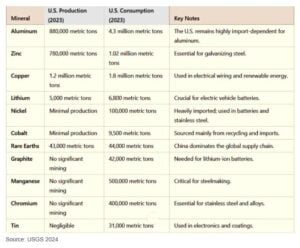
This dependency creates supply risks and exposes the economy to geopolitical disruptions. As a result, the new funding program aims to build a more resilient supply chain across several stages of battery production. Explained in detail below:
Critical Mineral Processing
First, the program seeks to expand domestic processing of critical minerals. Many essential battery materials—including lithium, nickel, graphite, copper, and aluminum—require complex refining processes before they can be used in batteries. By investing in new processing facilities, the United States hopes to reduce reliance on foreign refining capacity and ensure a stable supply of materials for domestic industries.
Battery Recycling Technologies
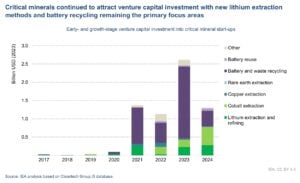
Second, the initiative emphasizes recycling technologies. Recovering valuable metals from used batteries and manufacturing scrap can significantly reduce the need for new mining while improving supply security. Recycling also lowers environmental impacts by reducing waste and conserving natural resources.
Battery Manufacturing Capacity
Finally, the program aims to expand manufacturing capacity for battery materials and components within the United States. Increasing domestic production of battery precursors, cathode materials, and other key components will help support the entire North American battery supply chain.
The funding is supported by the Infrastructure Investment and Jobs Act, which allocated billions of dollars to strengthen energy infrastructure and domestic manufacturing across the country.
Battery Storage Becomes a Major U.S. Energy Technology
The urgency behind these investments reflects the rapid growth of battery storage across the United States. In recent years, battery systems have emerged as a critical technology for managing modern power grids.
In fact, batteries became the largest form of energy storage in the country in 2024, surpassing traditional pumped hydro storage for the first time. This shift marks a significant milestone in the evolution of the U.S. electricity system.
At the same time, the number of battery projects expanded rapidly. Nearly 1,000 storage projects were either operating or under development across the country. Many of these projects are located in California and Texas, where large-scale renewable energy installations require flexible storage solutions to stabilize the electricity supply.
One notable example is the Moss Landing Energy Storage Facility, one of the largest battery installations in the United States. Located in California, the facility pairs a natural gas power plant with massive battery storage systems that can deliver electricity when demand peaks.
As renewable energy capacity continues to grow, battery storage will play an increasingly important role in maintaining grid reliability and balancing intermittent energy sources such as solar and wind.
EV Battery Manufacturing Market Continues to Grow
The electric vehicle industry is another major driver behind rising battery demand. As EV adoption accelerates globally, automakers and battery companies are investing heavily in new manufacturing facilities.
In the United States, the electric vehicle battery manufacturing market is projected to grow steadily over the coming years. Industry estimates suggest the market will reach approximately $17.94 billion in 2026, increasing from $16.36 billion in 2025.
Looking further ahead, the sector is expected to expand significantly. By 2031, the market could reach around $28.46 billion, reflecting a compound annual growth rate of nearly 9.7 percent.
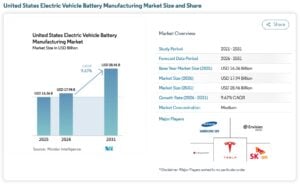
Multiple factors fuel this growth. Federal incentives for clean energy technologies, rising consumer demand for electric vehicles, and large-scale investments in domestic manufacturing are all contributing to the expansion of the U.S. battery industry.
However, sustaining this growth will require reliable access to the minerals that power advanced batteries.
America’s Critical Mineral Supply Remains a Concern
To address supply risks, the U.S. Geological Survey expanded its official list of critical minerals in 2025. The updated list now includes 60 minerals, up from 50 identified in 2022.
Several new minerals were added due to their growing importance for the economy and national security. These additions include boron, copper, lead, metallurgical coal, phosphate, potash, rhenium, silicon, silver, and uranium.
Despite these efforts, the United States remains heavily dependent on imports for many critical minerals. As of 2024, the country relied entirely on foreign suppliers for twelve critical minerals. Meanwhile, more than half of the domestic demand for twenty-nine minerals came from imports.
Rare earth elements represent one of the most significant vulnerabilities because global supply chains remain highly concentrated. China continues to dominate the production and processing of these materials, raising concerns about potential supply disruptions.
As a result, U.S. policymakers are increasingly focused on strengthening domestic mining, processing, and recycling capabilities.
Global Demand for Energy Minerals Is Rising Fast
The push to secure mineral supply chains also reflects rapidly growing global demand for energy materials. According to the IEA, demand for key minerals used in clean energy technologies is expected to increase dramatically in the coming decades.
Lithium demand, for example, could grow fivefold by 2040 under current policy scenarios. Copper will likely remain the largest mineral market by value, while other materials such as nickel, cobalt, graphite, and rare earth elements will also see strong growth.
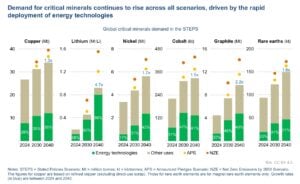
Overall, the combined market value for six key energy minerals—copper, lithium, nickel, cobalt, graphite, and rare earth elements—could reach approximately $500 billion by 2040. This surge reflects the rapid expansion of electric vehicles, renewable power systems, battery storage, and other clean energy technologies.
Consequently, governments around the world are competing to secure reliable access to these strategic resources.
Against this backdrop, the DOE’s $500 million funding initiative represents an important step toward strengthening America’s position in the global battery economy. By expanding domestic processing, recycling, and manufacturing capacity, the United States aims to reduce supply risks while supporting the technologies that will power the future energy system.