

The U.S. nuclear sector just received another strong signal of federal backing.
On February 21, the U.S. Department of Energy (DOE) finalized a $303 million Technology Investment Agreement with Kairos Power to advance its Hermes demonstration reactor in Oak Ridge, Tennessee. The deal supports the company’s selection under the Advanced Reactor Demonstration Program (ARDP), first announced in December 2020.
But this is not a traditional federal grant. Instead, DOE structured the agreement as a performance-based, fixed-price milestone contract. Kairos will only receive payments once it achieves clearly defined technical milestones.
This funding model was previously used by the Department of Defense and NASA’s Commercial Orbital Transportation Services (COTS) program. It aims to accelerate innovation while protecting public funds. Now, DOE is applying that same discipline to advanced nuclear technology.
Hermes: The First Gen IV Reactor Approved in Decades
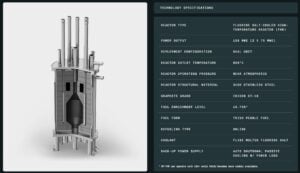
At the center of the agreement is Hermes — a low-power demonstration reactor based on Kairos Power’s fluoride salt-cooled high-temperature reactor (KP-FHR) design.
In December 2023, the U.S. Nuclear Regulatory Commission (NRC) granted Hermes a construction permit. That approval marked a historic milestone. Hermes became the first non-light-water reactor approved for construction in the United States in more than 50 years. It is also the first Generation IV reactor cleared for building.
The reactor is expected to be operational in 2027. While it will not generate commercial electricity, it serves a critical role. Hermes will demonstrate Kairos Power’s ability to safely deliver low-cost nuclear heat and operate a fully integrated advanced nuclear system.
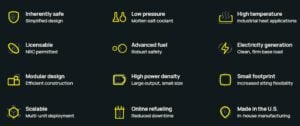
Its design combines two established technologies that originated in Oak Ridge: TRISO-coated particle fuel and Flibe molten fluoride salt coolant. Together, these systems enhance safety and simplify operations.
The molten salt coolant improves heat transfer and stability, while TRISO fuel provides strong containment of radioactive materials. The result is a reactor design that emphasizes inherent safety without relying on overly complex backup systems.
Significantly, Hermes represents Kairos Power’s first nuclear build, and it acts as a stepping stone toward commercial deployment.
Mike Laufer, Kairos Power co-founder and CEO, said:
“With the use of fixed-price milestone payments, this innovative contract provides real benefits to both Kairos Power and DOE to ensure the successful completion of the Hermes reactor. It allows us to remain focused on achieving the most important goals of the project while retaining agility and flexibility to move quickly as we learn key lessons through our iterative development approach.”
Risk Reduction and Private Capital Alignment
The DOE’s investment complements significant private funding already committed by Kairos Power. Since its ARDP selection, the company has built extensive testing facilities and manufacturing infrastructure to support its Engineering Test Unit series. It has also advanced its fuel development and molten salt coolant systems.
Unlike traditional large-scale nuclear projects that often suffer cost overruns, Kairos is pursuing an iterative development pathway. This approach allows the company to test, refine, and improve reactor components before full commercial rollout.
Fuel manufacturing plays a key role in that strategy. Kairos Power is working in partnership with Los Alamos National Laboratory to produce fuel for Hermes. Through its Low Enriched Fuel Fabrication Facility (LEFFF), the company aims to control quality, reduce delays, and manage costs more effectively.
Vertical integration is central to its business model. By managing more of the supply chain internally, Kairos hopes to deliver greater cost certainty for future commercial reactors — an area where traditional nuclear projects have struggled.
Key Features
Nuclear’s Return to the Energy Spotlight
The Hermes agreement comes at a time when nuclear energy is regaining political and investor attention.
Federal policy has shifted in favor of accelerating the development of next-generation reactors. In 2025, the U.S. administration introduced measures to shorten licensing timelines and rebuild domestic nuclear fuel supply chains. The Department of Energy has articulated an ambitious goal: expand U.S. nuclear capacity from roughly 100 gigawatts in 2024 to 400 gigawatts by 2050.
Programs such as the Energy Dominance Financing initiative aim to provide additional support for nuclear infrastructure. Once built, reactors can operate for up to 80 years, making them long-term strategic assets.
At the same time, electricity demand is rising. According to the International Energy Agency (IEA), U.S. electricity demand grew 2.8% in 2024 and another 2.1% in 2025. The country is projected to add more than 420 terawatt-hours of new demand over the next five years.
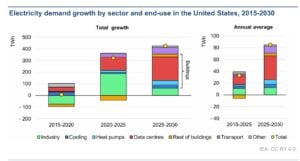
Data centers are driving much of that growth. The rapid expansion of artificial intelligence and cloud computing infrastructure could account for nearly half of total demand growth through 2030.
This dynamic is reshaping energy investment decisions. Technology companies require reliable, always-on power. However, they must also meet emissions reduction targets. Nuclear energy provides steady, low-carbon electricity, making it increasingly attractive for both policymakers and corporate buyers.
Small Reactors, Big Strategic Impact
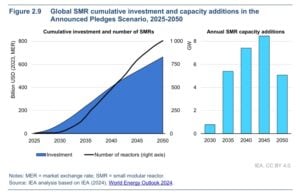
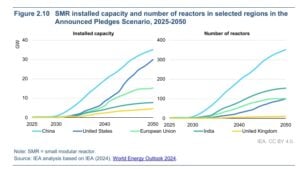
Small modular and advanced reactors are the keys to this renewed momentum. Compared to traditional gigawatt-scale plants, smaller reactors offer shorter construction timelines and lower upfront capital requirements. Developers can deploy them incrementally, reducing financial risk and improving flexibility.
Hermes, although it is a demonstration project, it represents a critical validation step. If successful, it could pave the way for commercial-scale KP-FHR reactors that supply industrial heat and electricity at competitive costs.
Dr. Kathryn Huff, Assistant Secretary, Office of Nuclear Energy, made an important statement, noting:
“The Hermes reactor is an important step toward realizing advanced nuclear energy’s role in ushering forward the nation’s clean energy transition. Partnerships like this one play a significant role in making advanced nuclear technology commercially competitive.”
For investors, this shift signals opportunity. Supportive government policy, rising electricity demand, AI-driven load growth, and decarbonization commitments are converging. Nuclear power, once viewed as a legacy industry, is re-emerging as a strategic solution.
A Measured Step Toward a Nuclear Renaissance
The DOE-Kairos agreement does not guarantee success. Advanced reactor development remains technically complex and capital-intensive. However, the deal’s structure reflects lessons learned from past nuclear projects.
By tying federal funding to performance milestones, DOE is promoting accountability. By combining public and private capital, the government is reducing financial risk while accelerating innovation.
Hermes now stands as one of the most closely watched advanced reactor projects in the United States. If Kairos delivers on schedule, the project could mark a turning point. Not just for one company but for the broader U.S. nuclear renaissance that policymakers increasingly envision.
In a world of rising electricity demand and tightening climate targets, advanced nuclear energy is inevitably essential. And with Hermes moving forward, it is becoming tangible infrastructure.