

Artificial intelligence is transforming the world, and its impact on energy is growing faster than anticipated. Over the past few years, tech companies have invested huge amounts of money into new data centres to train and run advanced AI models. These facilities are now significant energy consumers, and their rapid expansion is prompting governments and utilities to reassess grid planning, supply choices, and long-term energy strategies.
IEA’s 2025 World Energy Outlook has pointed out that AI’s influence on energy is not just about higher demand. AI is also becoming a powerful tool for boosting efficiency, cutting waste, and speeding up clean energy innovation. The next decade will show how well countries balance these two sides of the AI-energy equation.
Let’s dive deeper into this.
AI’s Rising Footprint: Data Centres Double Their Electricity Use by 2030
The world is building data centres at record speed. In 2025 alone, global investment in data centres is expected to hit USD 580 billion—surpassing the USD 540 billion going into oil supply that same year. This simple comparison shows how digital the global economy has become.
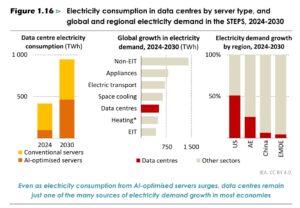
AI-optimised servers use far more power than traditional equipment. According to recent analysis, electricity use from these servers could increase fivefold by 2030, driven by soaring demand for AI applications.
- As a result, total data centre electricity consumption is set to double by the end of the decade.
Even with such rapid growth, data centres will still make up less than 10% of global electricity demand growth between 2024 and 2030. Other areas—such as industry, electric vehicles, and cooling—will drive more absolute growth. Still, the speed of data centre expansion creates pressure on regional grids, especially in the United States, where AI and cloud computing are scaling the fastest.
The Power Side Story: Where Will All This Electricity Come From?
As data centres multiply, the energy system must adapt. Most facilities rely on grid electricity, so their carbon footprint depends on the mix of power available where they operate.
Renewables lead the growth.
Between now and 2035, renewable energy will supply around 45% of the new electricity demand from data centres in many outlook scenarios. Wind and solar continue to dominate additions because they are cheap, scalable, and widely supported by policy.
Natural gas also plays a big role
In regions like the United States and the Middle East, natural gas remains a key backup to meet rising AI-driven loads. Gas-fired generation for data centres could grow by 220–285 TWh by 2035. But a surge in orders for new gas turbines is stretching supply chains, making equipment more expensive and slower to deliver.
Nuclear power is back in the conversation.
Tech companies are showing new interest in nuclear energy to power high-demand AI clusters. Several firms and utilities have announced deals to extend the life of existing reactors. The world also saw the first power-purchase agreement between a data centre and an SMR (small modular reactor)—a sign that nuclear could become a steady baseload option for AI operations.
A Geographic Tilt: The U.S., China, and Europe Dominate AI-Driven Power Demand
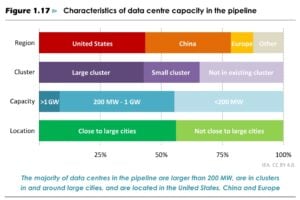
Data centres are not spread evenly across the world. The United States, China, and Europe make up 82% of global capacity, and they will host over 85% of new builds in the coming years.
But their impact on electricity demand differs sharply:
- United States: Data centres account for nearly half of the country’s electricity demand growth through 2030. This is the highest share globally.
- China and the European Union: Data centres contribute 6–10% of demand growth. Their energy systems are larger and more diverse, so AI plays a smaller role in shaping overall consumption trends.
A closer look at the project pipeline reveals even more pressure points:
- More than half of the upcoming data centres sit within or near cities with over 1 million people, where grids are already stressed.
- 55% of new data centres exceed 200 MW—each one consuming as much energy as 200,000 households once operational.
- Nearly two-thirds of new construction is happening in existing high-density clusters, increasing the risk of local grid congestion.
Beyond Demand: AI Could Cut Global Energy Use by Boosting Efficiency
AI’s story in energy is not only about higher consumption. It also offers major efficiency gains across sectors.
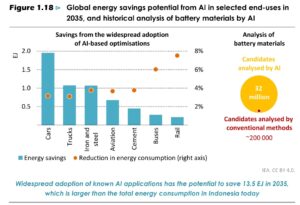
When deployed widely, AI systems can optimise manufacturing, improve logistics, manage transportation flows, detect energy waste, and improve industrial process controls. Analysts suggest that broad adoption of AI-enabled solutions could deliver 3–10% efficiency gains across transport and industry by 2035.
This would translate into 13.5 exajoules of energy savings—slightly more than the entire energy consumption of Indonesia today. Such savings would support national efficiency targets and help reduce emissions at a time when every region is under pressure to accelerate climate action.
However, several challenges stand in the way:
- Many industries lack high-quality datasets needed for advanced AI optimisation.
- Digital infrastructure is uneven, especially in developing countries.
- Concerns around privacy, regulation, and cybersecurity slow deployment.
- Some AI-driven improvements may create rebound effects, such as more automated car use, reducing public transport ridership.
AI is reshaping the energy system by driving rapid growth in electricity demand while also offering powerful tools to improve efficiency and accelerate clean-tech innovation. Data centres are expanding faster than many grids can handle, pushing regions to invest in renewables, natural gas, and nuclear power.
Yet AI’s real value lies in its ability to cut waste and make energy systems smarter—if supported by strong data, robust digital infrastructure, and sound regulation. AI is not a magic solution, but with thoughtful planning and investment, it can become a major force in building a cleaner, more resilient global energy future.