

Europe’s carbon market is facing new political pressure. Europe’s largest business lobby group has called for reforms. At the same time, Italy has asked for a temporary suspension of the system. These calls focus on the European Union Emissions Trading System (EU ETS).
The EU ETS is the world’s largest carbon market. It covers around 40% of the EU’s total greenhouse gas emissions. It sets a cap on emissions from power plants, heavy industry, and aviation within Europe.
Under this scheme, companies must hold allowances for each ton of carbon dioxide (CO₂) they emit. They can buy and sell these allowances on the market. Recent carbon price swings and concerns about industrial competitiveness have triggered a new debate.
Inside the System: How Europe’s Carbon Market Operates
The EU ETS started in 2005. It now operates in its fourth phase, which runs from 2021 to 2030. The cap on emissions declines each year. This ensures that total emissions fall over time.
Under the reforms agreed in 2023, the annual cap will decline faster. The linear reduction factor increased to 4.3% per year from 2024 to 2027 and to 4.4% per year from 2028 to 2030.
- The EU also decided to cut the total cap by 90 million allowances in 2024 and 27 million allowances in 2026.
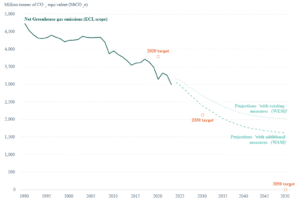
In 2023, emissions from sectors covered by the EU ETS fell by about 15.5% compared to 2022, according to the European Commission. Power sector emissions dropped sharply due to higher renewable energy use and lower gas demand. Since 2005, emissions from ETS sectors have fallen by around 47%.
The EU aims to cut net greenhouse gas emissions by at least 55% by 2030 compared to 1990 levels. This target is part of the European Climate Law. The EU ETS is a key tool to meet that goal.
From €10 to €100: The Price Swings Shaping the Debate
Carbon prices in the EU ETS have risen strongly in recent years. In 2018, prices were below €10 per ton. By early 2023, prices reached record highs of around €100 per ton.
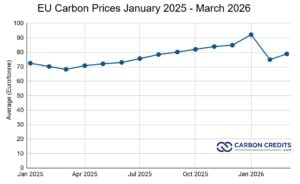
However, prices fell in 2024. By early 2025, EU carbon prices were trading closer to €60–€70 per ton. Slower industrial activity, lower energy demand, and market expectations about future supply influenced this drop.
Most recently, EU prices have fluctuated, trading around €70–€75 per tonne of CO₂ in early March 2026, after rising from their lows in late 2025. On March 3, 2026, EU carbon allowances were around €74.20 per tonne. This is a slight rise from recent lows, but still below the peaks above €90 from earlier in the year.
The Market Stability Reserve (MSR) adjusts the supply of allowances. It removes surplus allowances from the market when supply is high. In 2023, the MSR continued to absorb allowances to support market balance.
Despite these controls, industry groups say price volatility creates uncertainty. Energy-intensive sectors such as steel, cement, chemicals, and aluminum face higher costs when carbon prices rise.
BusinessEurope Calls for Reform
BusinessEurope represents national business federations across the EU. In early 2026, it called for reforms to the EU carbon market.
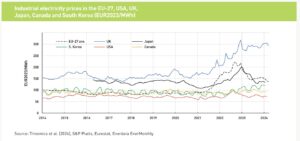
The group warned that high energy and carbon costs are hurting European industry. It said the EU risks “deindustrialization” if companies move production outside Europe. This could lead to carbon leakage, where emissions shift to countries with weaker climate rules.
BusinessEurope asked EU policymakers to review the Market Stability Reserve. It also called for measures to reduce excessive price swings. The group stressed the need to align climate policy with industrial competitiveness and reduce energy prices in the short term.
The lobby group noted in its paper:
“The enabling conditions and incentives to create a viable business case for decarbonisation are still largely missing. The EU has yet to put in place effective short-term measures to lower energy costs and close the related cost competitiveness gap faced by European companies compared to their global competitors… Moreover, EU climate and energy policies continue to lack a genuinely technology-neutral approach. For example, state aid thresholds still differentiate between technologies, making it harder for industries to invest in the technologies needed to achieve Europe’s climate neutrality targets.”
At the same time, the EU has introduced the Carbon Border Adjustment Mechanism (CBAM). CBAM will apply a carbon price on imports of cement, steel, aluminum, fertilizers, electricity, and hydrogen.
The goal is to level the playing field between EU and non-EU producers. The system is in its transitional phase from 2023 to 2025. Full financial obligations begin in 2026.
Italy’s Bold Proposal: Hit Pause on Carbon Pricing?
Italy has taken a stronger position. Italian officials have called for a temporary suspension of the EU ETS. They argue that high carbon prices increase electricity costs and hurt households and businesses.
Italy’s Industry Minister Adolfo Urso remarked:
“The ETS, as currently conceived, represents an additional tax on European companies, affecting costs and limiting their competitiveness.”
Italy relies on gas for a large share of its power generation. When gas prices rise, electricity prices also increase. Adding a carbon price can raise costs further. Italian leaders say this creates pressure on industry and families.
However, suspending the EU ETS would require agreement at EU level. The carbon market is governed by EU law. A single member state cannot stop it alone.
The European Commission has defended the system. It argues that the EU ETS reduces emissions in a cost-effective way. It also generates revenue for member states. In 2023, EU ETS auction revenues reached tens of billions of euros across the bloc. These funds support climate action, energy transition, and social measures.
Billions at Stake: Where Carbon Market Revenues Go
EU member states receive most revenue from auctioning carbon allowances. From 2013 to late 2025, total auction revenues have exceeded €245 billion, per official EU sources.
In 2024 alone, revenues totaled around €39 billion (down from €44 billion in 2023), with €24.4-25 billion going directly to member states despite lower average prices of €64.76/tCO2.
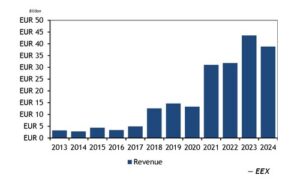
At least 50% of auction revenues must be used for climate and energy-related purposes. Many countries report using much more than this minimum share.
The EU ETS also funds innovation. The Innovation Fund supports low-carbon technologies in industry and energy. It is financed by the sale of 450 million allowances from 2020 to 2030. The Modernisation Fund supports lower-income EU countries in upgrading their energy systems.
These funds aim to help the industry reduce emissions rather than relocate.
What Could Reform Look Like?
The European Commission has signaled a review of the ETS later in 2026. This review comes as part of the broader European Green Deal, the EU’s plan to reach net-zero emissions by 2050.
Reform proposals could include:
- Adjusting the pace at which free allowances are phased out.
- Modifying how carbon prices are calculated or allocated.
- Changing how new sectors like transport and buildings are integrated into the system.
Some industry representatives also want changes to the CBAM. CBAM is a carbon tariff on certain imported goods, such as steel, cement, and fertilisers, starting in 2026. It aims to prevent carbon leakage by making non-EU products pay a carbon cost similar to EU goods.
However, the European Commission recently rejected calls to suspend carbon levies on fertilisers, saying the CBAM must remain stable to protect EU producers.
Reform could seek a balance between climate goals and business competitiveness. How to achieve this balance remains a key question for EU policymakers.
The Road Ahead: Reform, Resistance, or Reinforcement?
The debate reflects a broader tension. The EU wants to cut emissions quickly. At the same time, it wants to protect industrial jobs and economic growth.
The European Commission will continue monitoring the carbon market. It publishes regular reports on supply, demand, and price trends. Any major reform would require agreement from the European Parliament and EU member states.
For now, the EU ETS remains central to Europe’s climate policy. It has helped drive a nearly 50% cut in emissions from covered sectors since 2005. But political pressure is rising. The outcome will shape Europe’s path toward its 2030 target and its longer-term aim of climate neutrality by 2050.