


A major new investment is bringing geothermal energy back into focus. Fervo Energy has secured $421 million to build and expand its Cape Station geothermal project in Utah. The deal marks one of the largest recent financings in the U.S. geothermal sector.
This move comes at a time when energy systems are changing fast. Demand for reliable, carbon-free power is rising. Solar and wind are growing quickly, but they depend on the weather. Geothermal offers a different advantage. It provides steady electricity, day and night.
Fervo’s project shows how this technology is starting to scale. It also highlights a broader shift in clean energy markets. David Ulrey, Chief Financial Officer at Fervo Energy, said:
“Non-recourse financing has historically been considered out of reach for first-of-a-kind projects. Cape Station disrupts that narrative. With proven oil and gas technology paired with AI-enabled drilling and exploration, robust commercial offtake, operational consistency, and an unrelenting focus on health and safety, we have shown that EGS [enhanced geothermal systems] is a highly bankable asset class.”
A Major Investment in Next-Generation Geothermal
Fervo’s $421 million financing includes a mix of debt and credit support. The package is designed to fund the construction and early operations of the Cape Station project.
RBC Capital Markets is the coordinating lead arranger, working with Barclays, BBVA, and HSBC, with additional support from J.P. Morgan, Bank of America, and Sumitomo Mitsui Trust Bank’s New York branch.
Sean Pollock, Managing Director at RBC Capital Markets, remarked:
“As demand for firm, clean, affordable power accelerates, EGS is set to become a core energy asset class for infrastructure lenders. Fervo is pioneering this step change with Cape Station, a vital contribution to American energy security that RBC is proud to support.”
The project is located in Utah and is expected to become one of the largest EGS in the United States. Its initial phases could reach hundreds of megawatts of capacity, with long-term plans to scale up to 2 gigawatts (GW).
Conventional and EGS in the U.S.
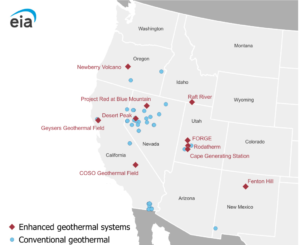
This is a significant size. A 1 GW power plant can supply electricity to hundreds of thousands of homes, depending on usage levels. At full build-out, Cape Station could rank among the largest clean energy facilities in the country.
Fervo’s approach uses advanced drilling methods adapted from the oil and gas sector. These techniques allow developers to access deep heat resources that were once too difficult to reach. This expands the potential for geothermal energy beyond traditional locations.
From Niche to Necessary: Geothermal’s Small Share but Large Potential
The United States currently has about 2.7 gigawatts (GW) of conventional geothermal capacity, per the US Energy Information Administration. This is only 0.2% of total U.S. summer generating capacity, which refers to the maximum power available during peak demand in summer.
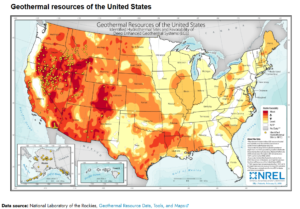
The potential for EGS is much larger. The U.S. Geological Survey estimates that 135 GW of power could be developed from EGS in the Great Basin alone.
Other estimates suggest that up to 150 GW of cost-effective geothermal capacity could be built in the coming decades, depending on market conditions and technological progress.
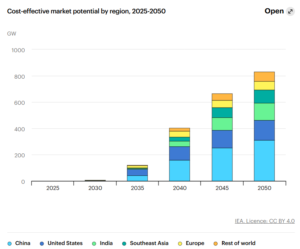
- In 2023, the National Laboratory of the Rockies estimated that about 90 GW of EGS capacity could be economically developed across the United States by 2050.
The small share reflects past limitations. Traditional geothermal projects require natural underground reservoirs of hot water or steam. These are only found in certain regions.
Technology Is Unlocking New Geothermal Resources
However, new technologies are changing that. Enhanced geothermal systems can create artificial reservoirs by injecting water into hot rock formations. This makes geothermal viable in many more areas.
The key to geothermal growth lies in innovation. Traditional geothermal systems are limited by geography. Enhanced systems aim to remove that constraint.
Fervo uses horizontal drilling and hydraulic stimulation. These methods are similar to those used in shale oil and gas production. They allow wells to reach deeper and hotter rock formations.
The company has already tested this approach. Its pilot project, known as Project Red, produced about 3.5 megawatts (MW) of continuous electricity. It also showed strong flow rates, which are critical for long-term performance.
Scaling up from pilot to commercial size is the next step. Cape Station represents that transition. If successful, it could prove that enhanced geothermal systems can operate on a large scale. This would open the door for wider adoption across the United States and other countries.
Why 24/7 Clean Energy Is in High Demand
Electricity demand is rising across the United States and globally. This is driven by electrification, population growth, and new industries.
At the same time, the energy system is shifting toward renewables. Solar and wind are now among the fastest-growing sources of electricity. However, these sources are variable. Solar only produces power during the day. Wind output can change with weather conditions.
This creates a need for stable energy sources that can run at all times. Geothermal meets this need. It provides baseload power, meaning it can operate continuously without interruption.
Other low-carbon baseload options include nuclear and hydropower. Geothermal adds another layer to this group, especially in regions where other options are limited.
As renewable energy expands, the value of steady power is increasing. This trend is driving interest in geothermal projects.
Investment Trends Support Geothermal Growth
Fervo’s funding reflects a broader shift in energy investment. Clean energy technologies are attracting increasing amounts of capital.
The company has raised about $1.5 billion in total funding since its founding in 2017. This includes equity investments and project-level financing.
Government policy is also playing a role. The U.S. Inflation Reduction Act provides tax credits and incentives for clean energy projects, including geothermal. These incentives help reduce project costs and improve returns for investors.
At the same time, utilities and large energy users are seeking long-term clean power contracts. This creates stable revenue streams for projects like Cape Station.
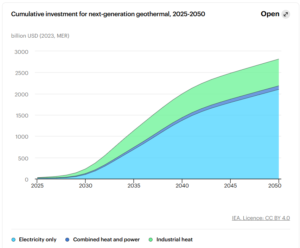
Global energy investment trends show continued growth in renewables, including geothermal. The International Energy Agency reports that clean energy investment is expected to exceed $2 trillion annually in the coming years, with solar leading but other technologies gaining support.
Geothermal is still a small part of this total today. However, its role could expand as the need for reliable clean energy increases, reaching nearly $3 trillion by 2050.
A New Role for Geothermal in the Energy Transition
Fervo’s $421 million project highlights a shift in how energy systems are evolving. The focus is no longer only on adding renewable capacity. It is also about building a stable and balanced grid.
Geothermal can help fill gaps left by solar and wind. It provides continuous, carbon-free electricity that supports grid reliability. This makes it useful for a range of applications, including:
- Powering cities and industrial operations.
- Supporting renewable-heavy grids.
- Reducing dependence on fossil fuel backup.
If enhanced geothermal systems continue to scale, they could become a key part of the clean energy mix. Fervo’s project is still in its early stages, but it represents a broader trend. Energy markets are starting to value not just clean power, but also consistent power.
As this shift continues, geothermal may move from a niche resource to a core component of the energy transition.