

France has approved a major new energy law that cuts back renewable energy targets and strengthens support for nuclear power. The law was passed by decree on 13 February 2026 after nearly three years of political debate.
The law is part of France’s Multiannual Energy Programming (PPE), a 10-year framework that guides energy policy through 2035. It sets long-term goals for how power is produced, with revised targets for wind, solar, and nuclear energy.
French Finance Minister Roland Lescure said the changes reflect slower electricity demand growth than expected and the government’s desire for a stable energy mix. He also said nuclear power remains the “backbone” of France’s electricity system, while adding:
“We need to stop our internal family squabbling. We need both nuclear and renewables.”
The new law marks a significant shift in French energy policy. It alters renewable goals that were set to help cut emissions and diversify power sources.
Wind and Solar Ambitions Dialed Down
However, the new regulation lowers France’s wind and solar capacity goals for 2035. Previously, draft plans set higher targets for renewable capacity, but under the new law, the goals dropped.
- Wind and solar combined (draft): 133–163 GW by 2035.
- Wind and solar (new law): 105–135 GW installed capacity by 2035.
The law also adjusts specific sub-targets:
-
Offshore wind: reduced to 15 GW by 2035 (from 18 GW).
The reduction aims to show slower growth in electricity demand. It also addresses challenges in permitting and grid integration in France and the wider EU.
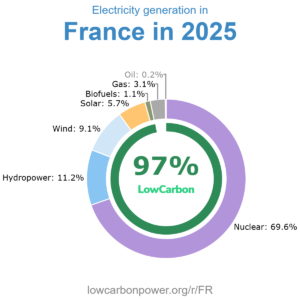
France’s wind and solar power deployment has been slower than in some neighbouring countries. Recent energy plans show that renewables made up about 14.6% of France’s electricity mix. Wind and solar still lag behind nuclear and hydro power.
Critics say that while renewable energy is growing, the new targets might slow down carbon cuts. They worry it could also make investors less confident in wind and solar projects.
Nuclear Reasserted as the Backbone
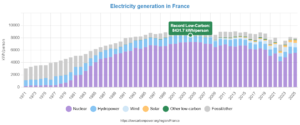
France’s low-carbon electricity history centers on nuclear power. In the 1980s, nuclear output grew quickly as new reactors came online. Growth slowed in the 1990s and early 2000s and after 2009, production declined.
Output later recovered, with gains of more than 25 TWh in 2021 and over 40 TWh in 2023 and 2024. Nuclear remains central to France’s low-carbon power system, again.
The new energy law lets state-run utility Électricité de France (EDF) keep 14 nuclear reactors open. This requirement was part of earlier commitments and had been controversial.
Instead, the framework reinforces nuclear’s role in the energy mix. It also sets a goal for net production of 650–693 terawatt-hours (TWh) of decarbonized electricity by 2035, compared with about 540 TWh today.
EDF currently operates a fleet of 57 nuclear reactors, which supply roughly 65% of France’s electricity — one of the highest nuclear shares in the world. The law also foresees the construction of at least six new nuclear reactors, with the first expected to be inaugurated around 2038.
EDF welcomed the revision and said the law would help the company focus on its output goals and long-term planning.
Support for nuclear power reflects a broader policy shift. France has long relied on nuclear energy for low-carbon generation, and policymakers view it as vital for energy security and independence.
Rebalancing the Power Mix for 2035
The new law reshapes France’s energy mix. It places greater emphasis on nuclear while easing pressure on the rollout of renewables.
The revised framework aims to balance supply security, carbon goals, and economic considerations. Slower electricity demand growth is one reason officials cited for the policy shift.
France is also planning to increase the share of electricity in overall energy consumption to 60% by 2030, up from around 30% today. This goal reflects efforts to electrify transport, buildings, and industry as part of broader decarbonization strategies.
However, renewable energy growth has not kept pace with previous plans. France has reduced its wind and solar capacity targets. Some projects are also facing delays due to regulations and grid issues.
Hydroelectric power is a key renewable source in France, but wind and solar are becoming more important. The country aims to cut fossil fuel use and meet EU renewable goals.
A Divisive Shift in the Energy Transition
The energy law triggered a heated debate among legislators. Some lawmakers criticised the reduction in renewables targets as a step backward for the energy transition.
Marine Le Pen, leader of the far-right National Rally party, urged lawmakers to submit a no-confidence motion in response to the law. She argued that lowered targets could harm French industry and agriculture.
Environmental groups also voiced concern. Greenpeace France stated:
“If this PPE is more than two years late on paper, it’s at least a decade behind in its vision of an energy transition.”
Industry groups, including wind and solar developers, had mixed reactions. Some welcomed the clarity provided by the law after years of uncertainty, while others cautioned that investment could slow without stronger renewable goals.
The debate reflects broader tensions in France between emissions reduction goals and economic and security considerations. The law tries to balance these priorities in the face of fiscal pressures and geopolitical uncertainties.
EDF at the Center of France’s Power Strategy
EDF plays a central role in France’s electricity system. The utility’s large nuclear fleet is critical for providing low-carbon base power. The company is also expanding its renewable business. It runs hydroelectric plants and is involved in wind and solar projects domestically and abroad.
However, abundant wind and solar power across Europe has pressured wholesale power prices, reducing revenue for nuclear plants that operate best at higher price levels. The new law seeks to ease some of this pressure by rebalancing targets and supporting nuclear output.
EDF is also working on modernising its fleet. In recent years, it secured financing to extend the life of its older reactors and to pursue small modular reactor (SMR) technologies for future deployment.
The utility’s path forward will involve managing a complex energy mix that includes nuclear, renewables, hydroelectric, and other clean sources. Meeting climate goals while ensuring reliable, affordable power remains a key challenge.
The Road to 2035: Implementation and Impact
France’s new energy law sets the course for the next decade. It guides energy planning through 2035 under the PPE framework.
The law aligns nuclear and renewable policy with expected demand and economic conditions. It seeks to stabilise the power market and support key utilities like EDF.
Energy markets, investors, and grid operators will be watching how capacity targets unfold and how demand patterns evolve. France’s approach may influence broader EU energy policy debates, especially around balancing nuclear with renewable goals in the transition to net zero.