

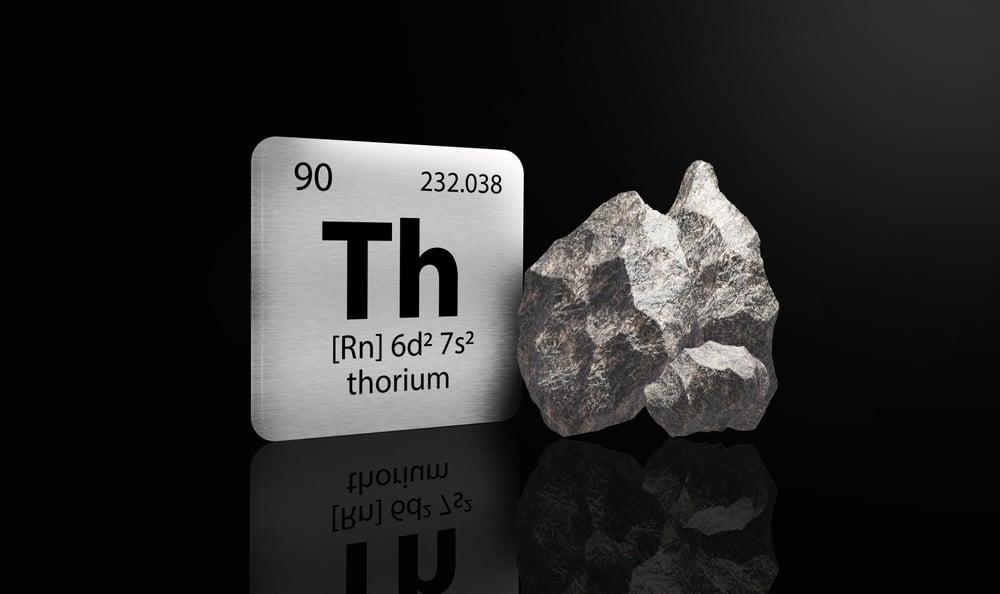
Thorium is making a strong comeback in the global energy conversation. For decades, it remained on the sidelines while uranium dominated nuclear power. Now, the shift toward net-zero emissions is changing that story. Countries need reliable, low-carbon energy that works around the clock. As a result, advanced nuclear technologies are gaining attention again—and thorium is leading that discussion.
At the same time, rapid innovation in reactor technologies is making thorium more practical. Designs such as molten salt reactors and small modular reactors are unlocking its potential. This combination of policy support, technological progress, and climate urgency is pushing thorium from theory toward reality.
Thorium vs Uranium: A New Nuclear Equation
Thorium is a naturally occurring radioactive metal found in the Earth’s crust, but it works differently from uranium. It is not directly fissile, which means it cannot sustain a nuclear reaction on its own. Instead, thorium-232 absorbs neutrons inside a reactor and transforms into uranium-233. This new material then drives the nuclear reaction.
This process may sound complex, but it delivers clear benefits. Thorium reactors or thorium-based fuel systems are more stable under high temperatures. They also reduce the risk of catastrophic failure, such as meltdowns. In addition, they generate far less long-lived radioactive waste compared to conventional uranium reactors
Thus, the comparison between thorium and uranium is the key to this transformation. We summarize the differences in the table below:
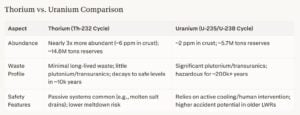
Another factor is safety. Many thorium reactors use passive safety systems that rely on natural processes, which lowers the risk of accidents. Uranium reactors, especially older ones, depend more on active cooling and human control.
Geopolitics also plays a role. Uranium supply is concentrated in a few regions, creating risks. Thorium is more widely available, which improves energy security and reduces dependence on specific countries.
However, uranium still has a clear advantage today. Its infrastructure is already in place, and it has long powered nuclear energy. Often called “yellow gold,” it is well understood and widely used with a mature supply chain. Thorium still needs new reactor designs, fuel systems, and regulatory support, so it is more likely to complement uranium in the near term.
Advanced Reactor Technologies Unlocking Thorium
For many years, thorium remained underutilized because conventional reactors were not designed for it. Today, that is changing. New reactor technologies are making thorium more viable.
- Molten Salt Reactors (MSRs): Use liquid fuel for better heat transfer and low pressure, improving safety, efficiency, and thorium utilization.
- Advanced Heavy Water Reactors (AHWRs): Support mixed fuel use, enabling gradual thorium adoption; central to India’s nuclear strategy.
- Small Modular Reactors (SMRs): Compact and flexible systems that are easier to deploy; increasingly designed to support thorium fuel cycles.
- Liquid Fluoride Thorium Reactors (LFTRs): A type of MSR offering high efficiency and built-in safety, making them a leading thorium energy solution.
Global Thorium Reserves Highlight Long-Term Potential
Thorium’s abundance is one of its strongest advantages. According to geological assessments, these reserves could theoretically generate electricity for several centuries if fully utilized in advanced reactor systems. That makes thorium not just an alternative fuel, but a long-term energy solution.
Even when compared to rare earth elements, which total around 120 million tons globally, thorium remains highly competitive in terms of its energy potential, despite differences in extraction economics.
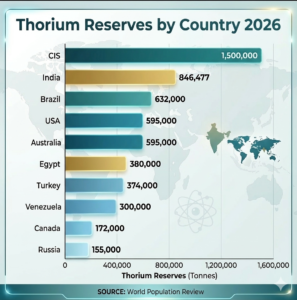
USGS data shows that the geographic spread of thorium further strengthens its appeal.
- Major reserves are located in India, Brazil, Australia, and the United States. India leads with approximately 850,000 tons, followed by Brazil with 630,000 tons. Australia and the United States each hold around 600,000 tons.
- In addition, countries within the Commonwealth of Independent States collectively hold about 1.5 million metric tons of thorium. This includes nations such as Kazakhstan, Uzbekistan, and Azerbaijan. This wide distribution supports global energy security by reducing reliance on a limited number of suppliers.
Regional Highlights
Asia-Pacific leads with over 55% of global share in 2025, supported by strong government backing, active research programs, and growing use of rare earth materials.
Countries like India and China are driving this growth. Rising energy demand and long-term policies are accelerating investment in thorium technologies. They are not just researching but actively preparing for deployment.
Meanwhile, North America is the fastest-growing region. Increased funding and private sector involvement are boosting innovation, especially in next-generation reactors that can use thorium fuel.
Together, this regional momentum is driving global competition and pushing the race for leadership in thorium energy.
Thorium Market Size and Demand Drivers
Market research reports indicate that the global thorium reactor market is projected to grow from $4.56 billion in 2025 to $8.97 billion by 2032, with CGAR 10.1%. This growth reflects increasing demand for clean, reliable, and low-carbon energy.
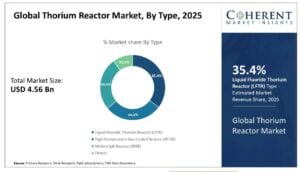
At the same time, other broader market estimates suggest the thorium sector could reach $13 billion by 2033, growing at a more moderate 4% rate. These figures include not just fuel, but also materials, reactor development, and associated technologies.

Several factors drive this growth. Governments are increasing investments in clean energy technologies. Research institutions are advancing reactor designs. At the same time, the need for energy security and reduced carbon emissions is becoming more urgent.
These converging trends are positioning thorium as a strategic energy resource. While large-scale commercialization is still ahead, the direction of growth is clear.
Competitive Landscape: A Market Defined by Innovation
The thorium market is still in its early stages, and this is reflected in its competitive landscape. Unlike mature energy sectors, it is not dominated by large-scale commercial players. Instead, it is shaped by collaboration, research, and pilot projects.
Copenhagen Atomics’ Strategic Partnership with Rare Earths Norway
As the industry evolves, partnerships are becoming increasingly important. One notable example is Copenhagen Atomics, which has signed a Letter of Intent with Rare Earths Norway. This agreement aims to secure access to thorium from the Fensfeltet deposit in Norway.
This partnership highlights a key shift in how thorium is viewed. It is now being recognized as a valuable energy resource. By integrating thorium into supply chains, companies are laying the groundwork for future commercialization.
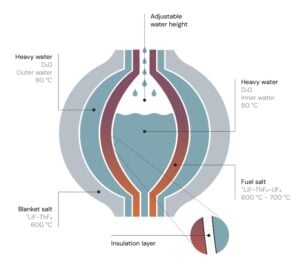
Copenhagen Atomics is also developing modular molten salt reactors designed for mass production. This approach requires not only technological innovation but also a reliable supply of materials. Partnerships like this are critical for building that ecosystem.
Thorium molten salt reactor, with the focus on low electricity price and fast installation
India’s Thorium Strategy Sets a Global Benchmark
India stands out as one of the most advanced players in the thorium space. Its nuclear program is built around a three-stage strategy designed to fully utilize its domestic thorium reserves.
- The country’s Department of Atomic Energy and Atomic Energy Commission are leading this effort. Research institutions are developing advanced reactor designs, including the Advanced Heavy Water Reactor and molten salt systems.
- One of the key milestones is the Prototype Fast Breeder Reactor at Kalpakkam, which is expected to play a crucial role in producing uranium-233 from thorium. This will enable a closed fuel cycle, improving efficiency and sustainability.
- Private sector involvement is also growing. Clean Core Thorium Energy is supplying advanced fuel for testing in existing reactors. At the same time, companies like NTPC and Larsen & Toubro are supporting large-scale deployment and infrastructure development.
India’s long-term vision is ambitious. With its vast thorium reserves, the country aims to secure an energy supply for up to 200 years. This strategy not only strengthens energy security but also positions India as a global leader in thorium technology.
Thor Energy: Leading in Fuel Development
Companies like Thor Energy are leading the way in fuel development. Their work on thorium-plutonium mixed oxide fuel and ongoing irradiation testing provides valuable real-world data. Similarly,
Other players are taking different approaches:
- Ultra Safe Nuclear Corporation is integrating thorium fuel cycles into its Micro Modular Reactor design. This approach focuses on creating a fully integrated energy system.
- NRG in the Netherlands is conducting critical experiments that provide data on reactor performance and fuel behavior.
- National laboratories also play a key role. Organizations such as Atomic Energy of Canada Limited provide the expertise and facilities needed to support research and development. Their contributions are essential for advancing the technology.
Overall, the market is best described as a technology race. Companies are not competing on volume yet. Instead, they are competing to prove that their solutions work at scale.
A Strong Fit for the Net-Zero Transition
The global push for carbon neutrality is a major driver behind thorium’s rise. More than 130 countries have set or are considering net-zero targets. Achieving these goals requires a mix of energy solutions.
As we may already know, renewables like solar and wind are essential, but they are not always reliable. Their output depends on weather conditions, which creates gaps in the electricity supply. These gaps must be filled by stable, low-carbon sources.
Thorium-based nuclear power offers exactly that. It provides consistent baseload electricity without producing greenhouse gas emissions during operation. At the same time, it addresses key concerns associated with traditional nuclear energy, such as safety and waste.
This alignment with climate goals is driving interest in thorium. Governments are exploring it as part of broader energy strategies. Investors are also paying attention, recognizing its long-term potential. Simply put, this phase can be seen as a technology race. The goal is to prove that thorium systems can operate safely, efficiently, and economically at scale. Success in this area will determine the pace of market growth.