


Inertia Enterprises, a fusion energy startup, has raised $450 million in a Series A funding round. The capital will help the company build the world’s most powerful laser and advance its fusion power technology.
The funding round was led by Bessemer Venture Partners. Other investors include GV (formerly Google Ventures), Modern Capital, Threshold Ventures, Long Journey Ventures, and others.
Inertia was founded in 2024. The company’s mission is to make fusion energy a practical and clean power source for the grid. It plans to use its new funds to build key parts of its fusion system and to scale components that are essential for commercial power plants.
Fusion energy has long been viewed as a potential source of abundant, clean power. Inertia’s recent funding round is one of the largest for any fusion startup. It reflects growing investor interest in bringing fusion out of the lab and into real-world use.
What Fusion Energy Is and How Inertia’s Approach Works
Fusion is the process that powers the sun. It happens when light elements such as hydrogen combine to form a heavier element. This process releases a large amount of energy. Fusion does not produce carbon emissions, and it generates much less long-lived radiation than fission nuclear power.
Inertia’s technology is based on a fusion method called inertial confinement fusion (ICF). ICF uses powerful lasers to compress tiny fuel pellets. When the pellets reach high temperature and pressure, fusion reactions occur.
The company plans to build a laser system called Thunderwall. This system is designed to deliver powerful beams at a rapid rate. The laser will fire repeated pulses into fuel targets, generating the conditions needed for fusion.
Inertia’s founders include leaders with experience in fusion science and large-scale research facilities. This includes scientists from the Lawrence Livermore National Laboratory’s National Ignition Facility (NIF). Their experiments showed fusion ignition, which produced more energy than they used on the target.
The company’s CEO and co-founder, Jeff Lawson, previously led Twilio, a technology company that grew into a major communications platform. He now leads Inertia’s effort to translate fusion science into clean energy technology. He said,
“Our plan is clear: build on proven science to develop the technology and supply chain required to deliver the world’s highest average power laser, the first fusion target assembly plant, and the first gigawatt, utility-scale fusion power plant to the grid. Inertia is building the team, partnerships, and capabilities to make this real within the next decade.”
Inside the $450M Bet on Commercial Fusion
The $450 million funding round is considered one of the largest for a fusion startup in its early phase. The money will support several major activities, including:
- Building Thunderwall, the powerful average-power laser system.
- Developing manufacturing lines for fusion fuel targets.
- Creating the first pilot plant and laying the groundwork for future commercial plants.
- Scaling supply chains for components like laser diodes and fuel pellets.
Investors say Inertia’s technology has the potential to reach commercial-scale fusion energy faster than other approaches. They cite the company’s focus on proven physics from earlier lab experiments.
Co-founder, Dr. Annie Kritcher, remarked,
“In just three years, we’ve gone from the first experiment to ever produce more fusion energy than was delivered to the target, to repeating that result many times and pushing the target gain higher. We’re now focused on translating physics we know works into a pathway toward commercial-scale fusion energy, and the real benefits it can deliver for people and the planet.”
From Lab Ignition to Grid Ambition: Inertia’s Fusion Roadmap
Inertia’s approach relies on key breakthroughs made at the NIF in Lawrence Livermore National Laboratory. In December 2022, researchers reported a major breakthrough. They conducted the first controlled fusion experiment that generated more energy than it received.
The NIF success provided proof of concept. It showed that inertial confinement fusion could technically produce net energy in a single experiment. Inertia’s team includes some of the scientists from that effort.
- Inertia’s long-term goal is to build a fusion power plant with 1.5 gigawatts (GW) of capacity. A plant of this size could supply electricity for about 1 million homes.
The next challenge is to make the fusion process repeatable and efficient enough to produce continuous power. Inertia plans to use advanced diode lasers. These lasers are expected to be about 10x more efficient than older technologies. The company believes this will significantly lower the cost of fusion energy production.
Fusion Joins the Clean Energy Investment Surge
Fusion energy investment has grown quickly in recent years. Both governments and private companies are putting large sums into the sector. It is now part of a broader clean energy funding trend that includes startups pursuing both fusion and fission technologies.
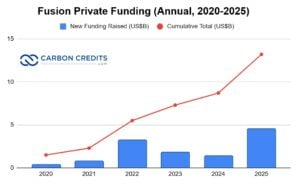
Private fusion funding has exploded over the past five years. Total investment reached $13.2 billion by the end of 2025. That amount is up 8x from 2020, when just 15 companies raised $400 million.
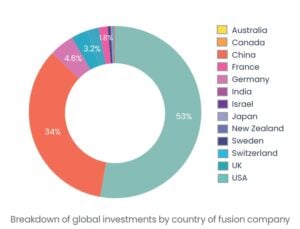
The US leads with 53% (~$7B) while China holds 34%. Active companies surged 400% from 15 to 77, reflecting broader investor diversification across ICF, tokamaks, and stellarators. Inertia’s $450M sits atop this record-breaking year.
Some other fusion startups that have attracted significant capital include:
- Commonwealth Fusion Systems, with roughly $2.86 billion raised to date.
- Helion Energy, with more than $1 billion in funding and commitments.
- Pacific Fusion, reported to have raised about $900 million.
- General Fusion, with about $357 million raised.
Private capital flows into fusion are increasing as the global demand for clean energy rises. Many countries are moving to reduce carbon emissions and to invest in technologies that can provide large amounts of clean power with minimal environmental impact.
In the United States, the Department of Energy (DOE) awarded $134 million for fusion research programs. These include the Fusion Innovative Research Engine (FIRE) and the INFUSE program. The DOE said it could invest up to $220 million over four years in the FIRE initiative. The goal is to link national labs, universities, and private firms to speed up fusion development.
The DOE has also partnered with companies such as Kyoto Fusioneering to test fusion fuel cycle systems at Oak Ridge National Laboratory. These efforts aim to prepare key technologies for future fusion plants.
Private capital is also rising, as shown in the chart.
Italian energy major Eni signed a more than $1 billion power purchase agreement (PPA) with Commonwealth Fusion Systems (CFS). The deal covers electricity from CFS’s planned 400-megawatt ARC fusion plant in Virginia. The plant is expected to connect to the grid in the early 2030s.
CFS has also signed a deal with Google for 200 megawatts of future fusion power. These agreements show that large energy buyers are planning for fusion in long-term clean energy strategies.
- READ MORE: Google Backs Fusion Energy: Signs 200MW Offtake Agreement with Commonwealth Fusion Systems
Governments and corporations now see fusion as a long-term clean energy option backed by serious funding and market commitments. That is because fusion energy does not emit carbon during power generation and uses fuel that is abundant in nature, such as isotopes of hydrogen. This makes it attractive as a long-term clean energy option alongside renewables such as wind and solar.
Could Fusion Become the Ultimate Baseload Power?
Inertia’s $450 million funding round is a landmark moment for the fusion industry. It shows that investors are willing to back ambitious clean energy technologies with long-term horizons.
Fusion has the potential to provide baseload clean power — power that is stable and available around the clock. This could complement intermittent renewables like solar and wind.
If commercial fusion is achieved, it could transform the global energy landscape. Countries could reduce dependence on fossil fuels. Power systems could become cleaner and more resilient.
However, fusion still needs major technological breakthroughs before it becomes a practical energy source. Inertia and other fusion companies are working to solve the remaining scientific, engineering, and supply chain challenges.
The next few years will be critical for measuring progress. Successful fusion commercialization could mark a turning point in the global effort to achieve deep decarbonization and sustainable energy systems.