

Chinese electric vehicle (EV) giant BYD is accelerating its global expansion, especially in Europe and Canada. In contrast, Tesla is losing ground across key markets. New sales data, policy shifts, and geopolitical deals suggest a major shift in the EV landscape.
This trend matters not just for automakers. It also impacts battery metals, supply chains, carbon markets, and the future of clean mobility.
BYD’s Germany Boom Marks Europe’s EV Shake-Up
BYD recorded a dramatic surge in German sales in January 2026. Bloomberg highlighted data from Germany’s Federal Motor Transport Authority (KBA) showing that BYD’s registrations jumped more than 10-fold from January 2025. The company sold only 235 vehicles in Germany last year, but recent data suggests sales likely exceeded 2,500 units.
Meanwhile, Tesla struggled. BYD more than doubled Tesla’s registrations in Germany during the same month.
Overall, car sales in Germany declined 6.6% to 193,981 vehicles in January. However, electric cars still accounted for 22% of new registrations, highlighting strong demand for EVs despite a weak auto market. This surge shows that BYD’s low-cost models and expanding lineup are gaining traction in Europe’s largest automotive market.
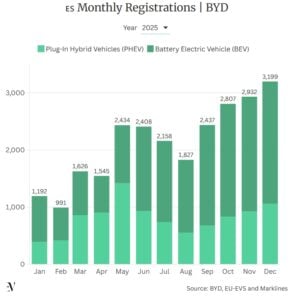
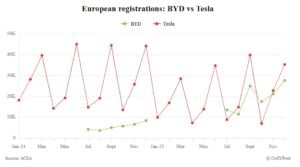
Significantly, the German numbers reflect a broader European trend. Throughout 2025, BYD recorded more than 200% year-on-year growth in many months. In December 2025 alone, its European registrations reached 27,678 units—up nearly 230%.
Breakthrough in Spain
Spain emerged as another key battleground. BYD dominated the Spanish EV and plug-in hybrid market in January 2026.
- The company registered 1,962 vehicles, a 64.6% year-on-year increase. It captured a 13.6% market share, leading both fully electric and plug-in hybrid segments.
- Fully electric sales rose nearly 30% to 1,039 units, putting BYD ahead of Kia and Mercedes-Benz. Tesla ranked fourth, with only 458 fully electric vehicles sold.
Spain’s performance highlights BYD’s strategy of combining affordable EVs with hybrids to capture diverse buyers.
Notably, BYD also sold 1,326 battery-electric vehicles in the UK, marking a nearly 21% increase from the previous year.
Tesla’s European Sales Collapse Deepens
Tesla, on the other hand, saw sales decline every month in Europe during 2025. The trend continued into 2026. Its struggles were especially visible in Northern and Western Europe.
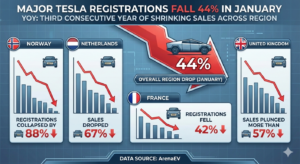
In five major European markets, Tesla’s registrations fell 44% year-over-year in January. This marked the third consecutive year of shrinking sales across the region.
- Norway: Registrations collapsed by 88%, with only 83 vehicles sold.
- Netherlands: Sales dropped 67%.
- France: Registrations fell 42% to 661 vehicles, the lowest in over three years.
- United Kingdom: Sales plunged more than 57% to just 647 vehicles.
Policy changes played a role. Norway reduced EV tax incentives starting January 1, which hurt Tesla demand. However, the scale of the decline surprised analysts.
Even in Sweden and Denmark, where Tesla saw sales rise by 26% and 3%, the total number of cars sold remains low. These minor gains do little to offset the sharp decline compared with two years ago.
Analysts believe that one key issue is Tesla’s aging lineup. The Model Y, once a top seller, is now over four years old, and buyers are looking for newer options. Although Tesla launched more affordable “Standard” versions of the Model Y and Model 3, these updates have not been enough to reverse the downward trend.
In the current scenario, Tesla is not only losing ground to Chinese brands. European automakers are also regaining market share. Volkswagen overtook Tesla in 2025 to become Europe’s top-selling EV brand. It sold around 274,000 units, compared to Tesla’s 235,000.
This shows Europe’s EV market is becoming more competitive, with local manufacturers and Chinese brands challenging Tesla’s early dominance.
Canada Opens the Door to Chinese EVs
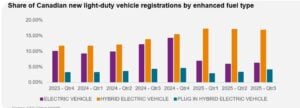
Europe is not the only region where BYD is gaining ground. Prime Minister Mark Carney signed a landmark trade agreement with China on January 16, 2026. This deal allows Chinese-made EVs to enter the market at low tariffs.
- So Canada will allow up to 49,000 Chinese EVs annually at a tariff rate of 6.1%. This marks a sharp reversal from the 100% tariff imposed in October 2024.
Also, the quota could rise to about 70,000 vehicles within five years. By 2030, at least half of imported Chinese EVs must be priced below CAD 35,000. In exchange, China agreed to reduce tariffs on Canadian canola seed, improving agricultural trade relations.
PM Carney said,
“At its best, the Canada-China relationship has created massive opportunities for both our peoples. By leveraging our strengths and focusing on trade, energy, agri-food, and areas where we can make huge gains, we are forging a new strategic partnership that builds on the best of our past, reflects the world as it is today, and benefits the people of both our nations.”
BYD Gains a Regulatory Edge in Canada
BYD holds a unique advantage in Canada. Its manufacturing facilities in Shenzhen and Xi’an are already approved for Canadian imports. This pre-clearance gives BYD a head start over rivals like NIO, XPeng, and Li Auto. However, other Chinese brands must wait for regulatory approvals or rely on slower case-by-case processes.
BYD also operates an electric bus assembly plant in Ontario, strengthening its local presence. Furthermore, affordable models like the Seagull and Dolphin, priced between $20,000 and $30,000, could qualify under Canada’s affordability requirements.
Political Backlash and U.S. Concerns
The Canada-China EV deal triggered political controversy. Ontario Premier Doug Ford initially urged Canadians to boycott Chinese EVs, warning the agreement could hurt domestic manufacturing.
Labor unions and automakers also expressed concern. They fear the deal could weaken North America’s automotive industry and strain U.S.-Canada trade relations.
As per reports, U.S. President Donald Trump threatened tariffs on Canadian goods if the deal moves forward, calling it a “disaster.” However, Canadian officials argue the agreement aligns with USMCA rules and will expand the EV market.
Analysts estimate Chinese EVs could capture around 23% of Canada’s EV sales in the first year, saving consumers about CAD 6,700 per vehicle.
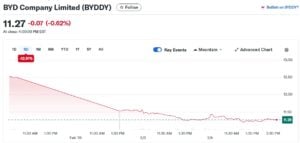
Stock Market Snapshot: BYDDY vs TSLA
BYD’s (BYDDY) stock trades around $11.28 per share, with a market cap of roughly $102 billion. The stock is near the lower end of its 52-week range, reflecting margin pressures and geopolitical risks.
Tesla’s (TSLA) stock trades near $406 per share, with a market cap of about $1.35 trillion. Analysts expect a volatile 2026, with forecasts ranging widely depending on EV demand and margins.

Despite Tesla’s valuation premium, BYD’s rapid sales growth is reshaping investor sentiment.
The Bigger Picture: A Global EV Power Shift
BYD’s rapid rise shows how the EV industry is changing. Chinese automakers are using scale, government support, and efficient production to challenge Western rivals. At the same time, Tesla remains strong in technology, software, and brand recognition. Yet, price competition and shifting policies are reshaping the market.
In Europe, declining subsidies, along with Canada’s new trade rules and ongoing geopolitical tensions, are affecting EV adoption and corporate strategies. As BYD gains ground in Germany, Europe, and Canada, it signals a turning point in the global EV race. Tesla’s falling sales highlight the increasing pressure from both Chinese and European competitors.
For investors, policymakers, and climate advocates, these trends matter. They will influence battery supply chains, emissions targets, and the demand for carbon credits. The EV transition is no longer led by a single company—today, it has become a global contest for scale, affordability, and sustainable leadership.