

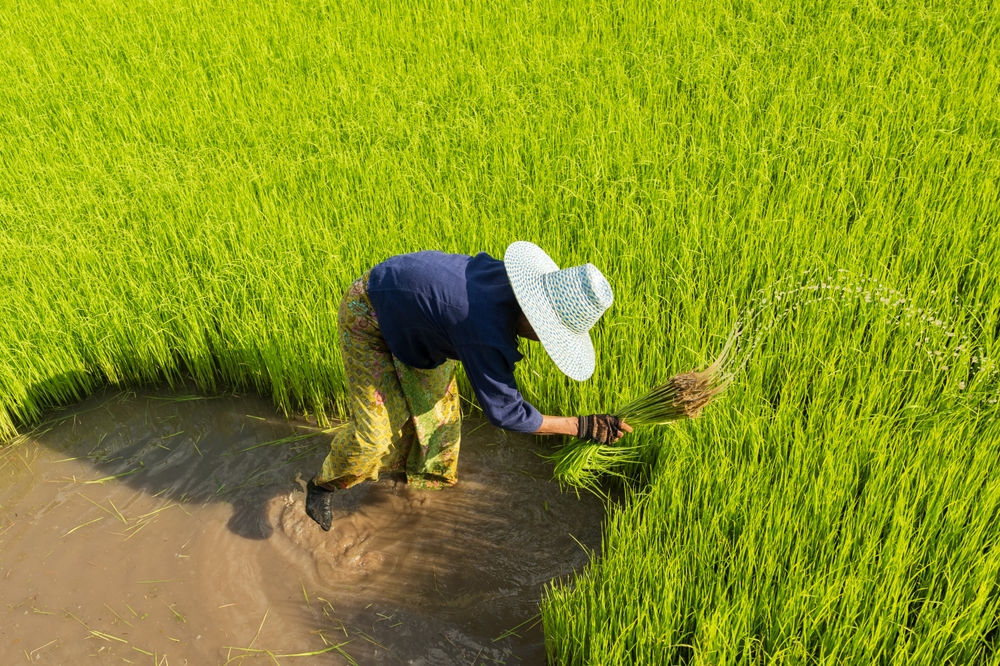
On February 16, Hirono Town signed a comprehensive partnership agreement with Fager Co., Ltd. to promote decarbonized agriculture and strengthen the local rice brand. The agreement focused on cutting greenhouse gas emissions while improving rice quality and farmer incomes.
Hirono’s mayor, Kazuma Komatsu, and Fager’s CEO, Takahiro Ishizaki, formalized the deal at a ceremony marking a new step toward linking climate action with rural economic revival.
A Climate Challenge Turns Into Opportunity
Rice farmers across Japan have struggled with extreme heat in recent years. High temperatures during the growing season have reduced grain quality and increased the risk of damage. In Fukushima’s coastal Hamadori region, growers have felt this pressure directly.
At the same time, Japan’s agricultural sector has begun to see decarbonization not just as an environmental duty but also as a business opportunity. Farmers can now generate carbon credits by reducing emissions from rice paddies and other farm activities. These credits create a new income stream while supporting national climate targets.
Hirono Town had already declared its ambition to become a Zero Carbon City by 2050. This partnership aligned with that goal. It aimed to make local agriculture more resilient, profitable, and climate-friendly.
How the Carbon Credit Model Works
Under the agreement, farmers in Hirono will adopt proven methods to reduce methane emissions from rice paddies. One key technique involves extending the mid-season drainage period. Farmers temporarily drain water from paddy fields during cultivation. This process lowers methane emissions, which normally form in flooded conditions.
Growers will also consider using biochar, a carbon-rich material that stores carbon in soil and improves soil health. Together, these measures can generate government-certified J-Credits.
Japan’s J-Credit system is a national carbon offset program. It certifies emission reductions or removals from activities such as renewable energy use, energy efficiency, forest management, and low-emission farming. Companies buy these credits to offset their emissions or meet climate goals. As a result, farmers and local governments gain a new source of revenue.
Fager has built strong experience in this field. The company supports J-Credit creation in 36 prefectures across Japan. In 2024 alone, it generated about 136,000 tons of CO₂ credits from agricultural projects. Now, it will bring that expertise to Hirono.
Reinventing “Hirono Rice”
Beyond carbon markets, the initiative aims to build a strong premium brand. Farmers will market locally grown Koshihikari rice as “Hirono Rice.” The brand will highlight three features: environmentally friendly cultivation, heat resilience, and high quality.
As extreme heat becomes more common, Japanese consumers are paying closer attention to how food is produced. Climate-smart branding could give Hirono’s rice a competitive edge.
One participating farmer, Toshirei Suzuki, already extended the mid-season drainage period in his paddies. He reported no negative impact on yield or grain quality. In fact, his rice ranked first in taste within Hirono Town, and all of his harvest met first-class standards. He said he joined the program smoothly and wants to continue if it benefits the environment.
His experience offered early proof that emission reductions and quality improvements can go hand in hand.
Digital Tools and Heat Countermeasures
The agreement goes beyond carbon credits as it also promotes agricultural digital transformation, often called agricultural DX.
Hirono and Fager will explore installing water-level and water-temperature sensors in paddy fields. These tools help farmers monitor conditions in real time. With better data, growers can respond quickly to heat stress and water management challenges.
Revenue from carbon credits will fund these upgrades. The partners aim to create a circular model. Farmers reduce emissions, generate credits, sell them, and reinvest the proceeds into better cultivation systems and climate adaptation measures.
This cycle connects environmental action directly to farm income and resilience.
A Model Linked to National Reconstruction
The partnership also fits into broader reconstruction efforts in Fukushima. Fager joined the national “Fukushima Reconstruction Living Lab” initiative led by Japan’s Reconstruction Agency. The program matches private firms with local governments to solve regional challenges.
In this case, agriculture stood at the center. By combining decarbonization, branding, and digital tools, Hirono aims to strengthen its rural economy while supporting recovery in the Hamadori area.
If successful, the model could expand beyond Hirono to other parts of Fukushima and eventually across Japan.
Japan Scales Up Carbon Markets to Hit 2050 Net Zero
Japan has pledged to achieve carbon neutrality by 2050. It also aims to cut greenhouse gas emissions by 46 percent from 2013 levels by 2030. To reach these goals, the government has steadily expanded carbon markets and sector-based policies.
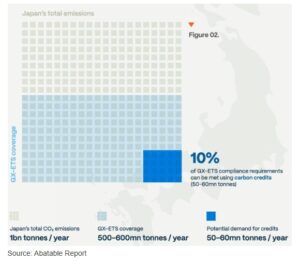
In April 2026, Japan will introduce a full-scale emissions trading scheme (ETS). Around 300 to 400 companies that emit more than 100,000 tons of greenhouse gases per year must participate. The system is expected to cover roughly 60 percent of national emissions.
To support this shift, the government launched the Green Transformation (GX) Promotion Strategy. The plan outlines more than 150 trillion yen in public and private climate investment over the next decade. It includes a 20 trillion yen early-stage package backed by GX Economic Transition Bonds. The goal is to stimulate new markets while keeping economic growth stable.
Japan has taken a cautious and pragmatic approach. Policymakers design climate rules that businesses can realistically follow. The Japan Business Federation, known as Keidanren, plays a key role in shaping legislation. Its involvement helps ensure that new climate policies remain practical and economically viable.
The Role of the J-Credit Scheme
The J-Credit Scheme plays a central role in Japan’s domestic carbon market. Three ministries jointly manage it: the Ministry of the Environment, the Ministry of Economy, Trade and Industry, and the Ministry of Agriculture, Forestry and Fisheries.
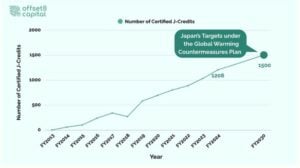
As of May 2025, the scheme had registered 1,262 projects. It had certified a total of 12.08 million tons of CO₂ credits. The government now targets 15 million tons of certified J-Credits by fiscal year 2030.
Projects can register individually or as programmatic bundles that group many small activities into one larger project. This structure makes it easier for small farmers to participate.
Hirono’s rice initiative fits well within this framework. It visualizes emission reductions measurably and links them directly to local economic benefits.
A Blueprint for Sustainable Rural Growth
The Hirono–Fager partnership showed how climate policy can work on the ground. It connected national carbon markets with everyday farming practices. It turned methane reduction into income. It funded heat countermeasures with carbon revenue. And it built a premium rice brand around sustainability.
If the project delivers as planned, Hirono Town could become a model for climate-smart agriculture in Japan. The town’s rice would stand not only for taste and quality, but also for environmental responsibility and resilience in a warming world.