


Meta and Microsoft have entered into long-term agreements to purchase carbon credits from a forestry project in Washington State’s Olympic Peninsula. These deals aim to support climate-smart forest management practices and contribute to the companies’ sustainability goals.
A Forest with a Mission
The project aims to shift 68,000 acres of forestland on the Olympic Peninsula to climate-smart management. This area near Olympic National Park is managed by EFM. It is supported by Climate Asset Management (CAM), a partnership of HSBC Asset Management and Pollination.
The initiative focuses on Improved Forest Management (IFM) practices. These include:
- Lengthening tree rotation periods,
- Reducing logging impact, and
- Promoting selective harvesting.
These methods aim to increase carbon storage, enhance biodiversity, and support local communities. James Bullen, Head of Asset Management at CAM, remarked:
“Blending timber income, conservation easements, and carbon credits can simultaneously de-risk and enhance returns…The Olympic Rainforest shows how corporates can mobilize capital at scale for high-integrity climate outcomes that complement, not replace, emissions reductions.”
For Microsoft and Meta, this initiative is a move forward for their carbon reduction and climate goals. Together, they’ll purchase almost 1.4 million carbon credits from the said reforestation project.
Meta’s Commitment to Net-Zero Emissions
Meta, the parent company of Facebook, Instagram, and WhatsApp, is working toward an ambitious climate target: to achieve net-zero emissions across its entire value chain by 2030. This means the company plans to cut greenhouse gas emissions from not only its operations, such as data centers and offices, but also from its suppliers and users’ activities, referred to as Scope 3 emissions, shown below.
Meta GHG Emissions 2023
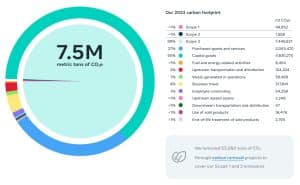
To meet this goal, Meta is focusing on energy efficiency, renewable energy, and carbon removal. As of 2020, Meta has already achieved net-zero emissions for its own operations and runs all its global facilities on 100% renewable energy. However, its larger challenge lies in addressing emissions from suppliers, product use, and transportation—areas that are harder to control directly.
The company’s recent 10-year agreement with EFM, which will provide 676,000 nature-based carbon removal credits by 2035, is part of its broader climate strategy. These credits will help offset unavoidable emissions while supporting reforestation and biodiversity restoration.
Meta also supports other high-quality carbon removal projects, such as direct air capture and soil carbon storage. By investing in nature-based solutions, Meta aims to balance its environmental impact while setting a strong example for digital platforms worldwide.
Microsoft’s Path to Becoming Carbon Negative
Microsoft has set one of the boldest climate goals in the tech sector: to become carbon negative by 2030. This means that the company plans not only to reduce its own emissions but also to remove more carbon from the atmosphere than it emits.

In addition, by 2050, Microsoft aims to remove all the carbon it has emitted either directly or through electricity use since it was founded in 1975.
To achieve this, Microsoft is taking a three-part approach: reducing its emissions, removing carbon through innovative solutions, and supporting high-integrity carbon offset projects.
As part of this strategy, Microsoft signed a multi-year agreement with EFM to purchase up to 700,000 carbon removal credits from the Olympic Rainforest project. These credits come from improved forest management practices that help store more carbon and support local ecosystems.
Beyond this agreement, Microsoft has committed $1 billion to its Climate Innovation Fund. This fund invests in early-stage technologies and nature-based solutions like reforestation, soil carbon enhancement, and ocean-based removal.
One of its key investments includes EFM Fund IV, which aims to raise $300 million for climate-smart forestry across the U.S. With this investment, Microsoft could access an additional 2.3 million carbon credits—further strengthening its long-term carbon removal portfolio and advancing global climate solutions.
Why Forests Matter for Climate Action
Forests play a critical role in fighting climate change. They act as carbon sinks, meaning they absorb more carbon dioxide (CO₂) from the atmosphere than they release. Trees store this carbon in their trunks, branches, leaves, and roots. When forests are managed well, they can remove large amounts of CO₂ every year, helping to slow global warming.
Globally, forests absorb about one-third of the CO₂ released from burning fossil fuels each year. That makes them one of the most effective natural tools we have for reducing greenhouse gases. Projects like the Olympic Rainforest help by stopping deforestation. They also remove CO₂ by boosting forest growth and restoring land.
Forests become very useful when managed with “climate-smart” practices. These practices balance carbon removal, conservation, and sustainable timber use.
As major companies like Meta and Microsoft and governments seek to meet climate targets, forestry-based carbon removal is gaining more attention. High-quality forest carbon credits can be a reliable part of long-term climate plans. This is true when they are monitored and verified correctly. That’s why big companies are putting money into nature-based solutions.
The latest market data shows that credits generated by IFM projects are getting more interest and value from corporations. Their trading volume increased three times as seen below.

Benefits of Climate-Smart Forestry
The project’s climate-smart forestry practices are expected to deliver multiple benefits:
- Carbon Removal. Over one million tonnes of carbon emissions are projected to be removed over the next decade.
- Biodiversity Enhancement. The project aims to restore habitats for endangered species and support wild salmon restoration.
- Community Engagement. Partnerships with the Quileute and Hoh locals focus on wildlife restoration and cultural harvesting.
- Economic Opportunities. The initiative supports sustainable timber growth and creates diverse, healthy habitats for wildlife and recreation.
Carbon Credits Get a Corporate Upgrade
These long-term carbon credit agreements reflect a shift in corporate procurement strategies. Companies are moving from spot carbon credit purchases to long-term offtake agreements, signaling a new era where carbon credits serve as strategic assets. This approach provides price certainty and supports the development of high-integrity carbon markets.
Climate Asset Management, managing over $1 billion in investor commitments, illustrates this evolution through its Natural Capital Fund and Nature-Based Carbon Fund. These funds offer exposure to real-asset carbon strategies that combine financial returns with measurable climate, biodiversity, and community impacts.
Meta and Microsoft’s long-term carbon credit deals with the Olympic Rainforest project represent significant steps toward their respective climate goals. By investing in climate-smart forestry practices, these companies are contributing to carbon removal efforts, biodiversity conservation, and community engagement. These agreements also highlight the growing importance of high-integrity carbon credits in corporate sustainability strategies.