


Meta has strengthened its clean energy strategy by expanding its partnership with Zelestra, a global renewable energy developer. The move supports Meta’s goal to power its operations with 100% clean electricity and add new generation capacity to the grid.
At the same time, it highlights how hyperscalers are reshaping the U.S. renewable energy market as data center power demand rises sharply.
Phil North, Zelestra’s US CEO, said:
“Our clean energy collaboration with Meta is gathering momentum across the US. We are delighted to welcome full operations at Jasper County and the start of construction at two further major projects, at the same time as closing another major agreement that will enable the construction of Skull Creek in Texas. Thanks to our forward-looking partnership, nearly 1.2 GWdc of new clean solar power will soon be operational in the US.”
Meta Backs New Solar Capacity in Texas
Meta and Zelestra recently signed a power purchase agreement (PPA) for the 176 MWdc Skull Creek Solar Plant in Texas. This project adds to Meta’s growing portfolio of contracted renewable energy and helps the company match its electricity use with clean power.
In total, they now have PPAs for about 1.2 GWdc of solar capacity across seven U.S. projects, all expected to be operational by 2028. Two of these projects began construction in late 2025, while the remaining projects are scheduled to start construction in 2026.
These agreements reflect Meta’s commitment to additionality—supporting projects that would not otherwise be built. By acting as a long-term offtaker, Meta reduces investment risk for developers and accelerates new renewable generation.
Four New Solar Projects Under Environmental Attribute Agreements
In a related announcement, Zelestra revealed that four new solar projects will be developed under Environmental Attribute Purchase Agreements (EAPAs). These projects will deliver electricity into the ERCOT grid in Texas, supporting Meta’s data center operations.
The projects are located in Hopkins, Lamar, Lampasas, and Henderson counties and will add 720 MWdc of solar capacity. Combined with earlier agreements, Meta and Zelestra have closed six EAPAs totaling 800 MWac, including two Indiana solar plants contracted in 2024. Overall, the signed agreements will enable Zelestra to build more than 1 GWdc of solar projects in the United States.
Zelestra is expanding rapidly in the U.S., with 6.6 GWdc of projects under development and a broader global pipeline of around 15 GW. The company is backed by EQT and ranked among the top corporate clean energy sellers by BloombergNEF.
Data Centers Drive Massive Power Demand Growth
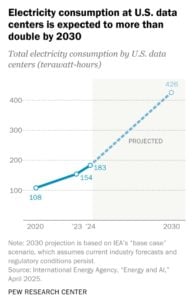
The partnership comes as global data center electricity demand rises at an unprecedented pace. Over the next five years, data center power demand could approach 219 GW of new capacity, equivalent to powering around 180 million U.S. homes.
DOE reported that in the United States, data centers could account for 12% of national electricity consumption by 2030. In clean-policy scenarios, renewables such as solar and wind could supply 60–90% of data center power by 2035.
This surge in demand explains why hyperscalers like Meta, Google, and Microsoft are aggressively securing renewable energy through long-term contracts. These deals help stabilize energy costs and support decarbonization goals.
Solar Growth Continues Despite Market Volatility
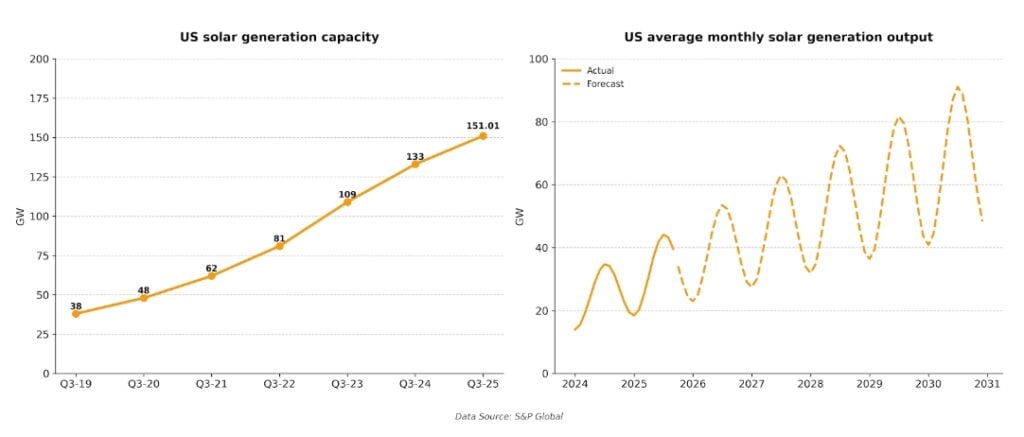
According to S&P Global Market Intelligence, the U.S. added 2.25 GW of solar capacity in Q3, up 1.5% from Q2 and 15.8% year over year. Solar projects benefit from relatively short development timelines of 18 to 24 months, making them the fastest route to expand utility-scale power generation.
However, solar additions declined sequentially. Q3 capacity additions were 50.7% lower than Q2, and Q2 additions were 21% lower than Q1. Only nine states added solar capacity in Q3, compared with 22 states in Q2 and 29 in Q1.
Texas remains the dominant solar market, with 32.7 GW of installed solar capacity, representing 21.7% of total U.S. solar capacity. The state also led additions in Q3, contributing 965 MW, or 43% of new solar capacity during the quarter.
Despite looming tax credit phase-outs after 2027, falling solar costs have made solar power competitive with other generation sources. However, capture prices in California declined slightly, reflecting increasing supply and market saturation.
Meta’s Emissions Strategy and Clean Energy Procurement
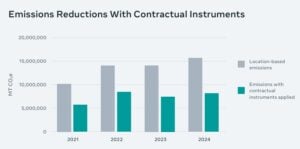
Meta has prioritized renewable energy procurement as a core pillar of its climate strategy. In 2024, Meta reported 8.2 million metric tonnes (MT) of CO₂e emissions after contractual instruments, compared with 15.6 million MT CO₂e on a location-based basis. This represents a 48% reduction due to clean energy purchasing decisions.
- Since 2020, Meta has matched 100% of its annual electricity use with clean and renewable energy.
- Over the last decade, the company has contracted more than 15 GW of clean energy worldwide, making it one of the largest corporate buyers globally.
As a result, Meta reduced operational emissions by 6 million MT CO₂e in 2024. The company also uses Energy Attribute Certificates (EACs) to cut Scope 3 emissions linked to fuel use, consumer hardware, and remote work. This approach reduced value chain emissions by 1.4 million MT CO₂e in 2024.
Overall, renewable energy procurement helped Meta cut 23.8 million MT CO₂e emissions since 2021.
Power Purchase Agreements as a Decarbonization Tool
Meta relies heavily on long-term PPAs to bring new renewable projects online. These agreements provide guaranteed revenue for developers and ensure new projects are built.
The company has supported several major renewable projects worldwide, including a 150 MW floating solar project in Singapore, 190 MW of solar capacity in Ireland, and a 190 MW solar facility paired with a 50 MW battery storage system in New Mexico.
Coming back to the expanded partnership between Meta and Zelestra, it reflects a broader shift in the energy market. Corporate demand is now a key driver of renewable energy development, especially in regions with growing data center clusters.
Texas, with its strong solar resources and competitive power market, has become a focal point for hyperscalers. At the same time, developers like Zelestra are scaling rapidly to meet corporate demand with multi-technology renewable portfolios.
As data center power demand continues to surge, long-term PPAs and attribute agreements will play a crucial role in financing new projects and stabilizing power grids. For Meta, the partnership strengthens its path toward net-zero operations while supporting large-scale renewable expansion across the United States.