


Microsoft is doubling down on nature-based carbon removal, and this time in West Africa. The tech giant has signed a long-term offtake agreement with Rainforest Builder, a fully integrated tropical forest restoration company, to support Project Buffalo in Sierra Leone. The deal will deliver up to 1.8 million carbon removal credits over 15 years, making it one of the largest single-project carbon removal agreements announced in Africa to date.
More than just a credit purchase, the partnership signals growing confidence in Africa’s high-integrity carbon markets. It also reinforces Microsoft’s aggressive push to become carbon negative by 2030.
A Landmark Carbon Removal Deal in Africa
Rainforest Builder operates across Sierra Leone, Ghana, and Guinea, employing more than 2,500 people. The company follows a science-led, community-focused model that blends ecosystem restoration with economic development.
Under the Microsoft agreement, Project Buffalo will restore 15,000 hectares of degraded community land in Sierra Leone. The initiative will plant more than 10 million trees, rebuilding native forest ecosystems in the Upper Guinean Forest — one of the most biodiverse yet threatened rainforest regions in the world.
So far, Rainforest Builder’s Sierra Leone team has planted more than 1.8 million trees since 2023. The scale-up now underway will dramatically expand restoration efforts.
Importantly, this is not a short-term offset arrangement. The 15-year offtake structure provides long-term revenue certainty. That stability helps finance restoration, workforce development, and monitoring systems. In turn, it raises the bar for project integrity and permanence.
Restoring the Upper Guinean Forest
The Upper Guinean Forest once stretched across West Africa as a dense tropical ecosystem rich in endemic species. Today, more than 90% of it has been cleared due to logging, agriculture, and land degradation.
In Sierra Leone, old-growth forest now covers less than 1% of the country’s total land area. Many mammal and plant species survive only in isolated fragments. Without intervention, biodiversity loss could accelerate.
Project Buffalo aims to reverse that trend. By restoring native species across 15,000 hectares, the project will rebuild wildlife habitat, strengthen carbon sinks, and restore ecological connectivity. The region contains the highest number of mammal species among the world’s biodiversity hotspots. Many species exist nowhere else.
Forest restoration here delivers dual impact: measurable carbon removal and biodiversity recovery.
Unlike avoided deforestation projects, reforestation physically removes carbon dioxide from the atmosphere and stores it in biomass and soil. When executed with scientific oversight and long-term monitoring, these removals can be accurately measured and verified.
Rainforest Builder operates under the stewardship of a Scientific Advisory Board. The company collaborates with research institutions across West Africa and conducts field trials to optimize species-site matching. These trials improve survival rates and accelerate ecosystem recovery.
Jobs, Infrastructure, and Community Benefits
In 2025 alone, Project Buffalo directly employed 1,200 people. Employment is expected to grow significantly as planting expands toward the 10 million tree target.
Beyond wages, the project includes a broad benefit-sharing structure. This includes:
- Community land leasing agreements
- Smallholder agricultural improvement programs
- Rural road infrastructure upgrades
- A community development fund
This model ensures local communities remain long-term stakeholders in forest recovery.
Carbon Credits Could Unlock Billions for Africa’s Economy
Africa contributes just 3.9% of global CO₂ emissions. Yet it faces some of the most severe climate impacts, including extreme weather, crop loss, and land degradation. Carbon markets, therefore, represent more than an environmental solution — they present an economic development pathway.
High-integrity African carbon credits could generate up to $6 billion annually by 2030. Longer-term projections suggest the market could scale to $120 billion per year by 2050, supporting as many as 30 million jobs.
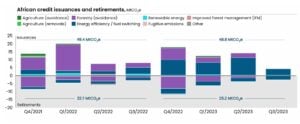
- In 2024, Africa issued approximately 75 million carbon credits, valued at around $15 billion. That represented roughly 14% of the global voluntary carbon market.
Initiatives such as the Africa Carbon Markets Initiative (ACMI) are accelerating this momentum. The ACMI has secured more than $1 billion in commitments, including major purchase agreements from global financial institutions.
Deals like Microsoft’s with Rainforest Builder strengthen both supply credibility and demand confidence.
Microsoft’s Expanding Carbon Removal Portfolio
The agreement also fits perfectly within Microsoft’s climate strategy.
The company has committed to becoming carbon negative by 2030 and to removing all historical emissions by 2050. To reach those goals, Microsoft shifted in 2020 away from avoided emissions credits and toward carbon dioxide removal (CDR).
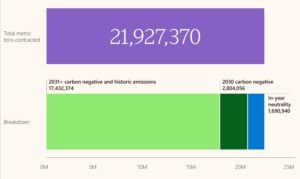
In fiscal year 2024, Microsoft signed long-term agreements covering 22 million metric tons of carbon removal — more than all previous years combined. Of that volume, 2.8 million metric tons are expected to contribute directly to its 2030 carbon negativity milestone. Additional tons extend into FY31 and beyond.
Microsoft’s approach has evolved. For example, in 2022, it signed its first long-term CDR agreement, purchasing 10,000 tons over 10 years from Climeworks’ direct air capture facility in Iceland.
Then in 2023, it scaled up to multi-million-ton agreements with developers capable of designing large projects from inception.
- And most importantly, the company refined commercial offtake structures and strengthened due diligence standards with its Criteria for High-Quality Carbon Dioxide Removal.
One of its significant milestones includes innovative climate finance structures. For example, it worked alongside Brazilian reforestation company Mombak and the World Bank to help unlock a $225 million outcome bond supporting Amazon restoration. That model blends natural capital investment with performance-based finance.
And the Rainforest Builder agreement follows a similar logic: long-term contracts create investment certainty, which enables scale.
Why This Matters for Africa’s Carbon Future
Africa’s carbon market remains primarily voluntary today. However, future integration with compliance systems, including mechanisms under Article 6 of the Paris Agreement, could dramatically increase demand.
To capture that opportunity, projects must demonstrate integrity, permanence, biodiversity co-benefits, and strong community engagement.
It restores degraded land rather than displacing communities. It plants native species rather than monocultures. It incorporates scientific oversight. And it delivers measurable socioeconomic benefits.
Ultimately, the Microsoft–Rainforest Builder partnership represents more than a bilateral agreement. It reflects a shift in how global corporations approach climate responsibility. Instead of short-term offsets, buyers are increasingly committing to long-duration, high-integrity carbon removal backed by science and community impact.